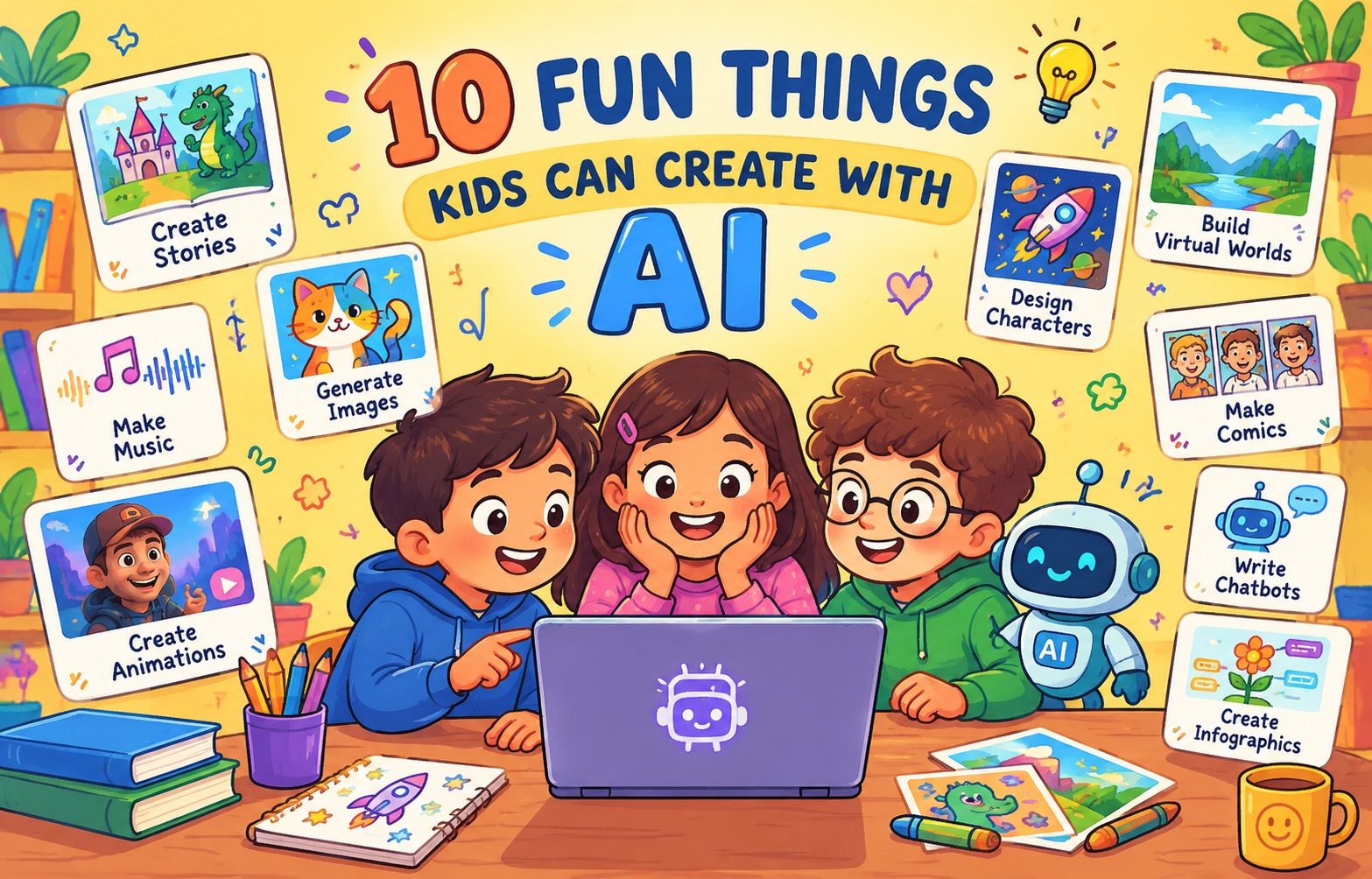
10 Fun Things Kids Can Create With AI
Introduction
AI Projects for Kids are turning screen time into an opportunity for creativity, exploration, and hands-on learning. Instead of only watching what artificial intelligence can do, children can use AI to build games, animate drawings, write stories, compose music, and create interactive experiences.
The best AI projects for kids encourage children to experiment with ideas, solve problems, and learn from their results. They do not need to be expert programmers. With the right tools and guidance, even a simple idea can become an exciting project.
Here are 10 creative AI projects for kids that can make learning technology fun and meaningful.
What Makes AI Projects for Kids Fun and Educational?
The best AI projects for kids combine creativity with a clear learning goal. Children should have an opportunity to try something themselves rather than simply watching AI produce an answer.
A good project can help children:
- Explore how AI works
- Practise problem-solving
- Experiment with different ideas
- Build something they can share
- Learn from mistakes and improve
Most importantly, children should remain part of the creative process. AI can be a helpful tool, but the child’s ideas, questions, and decisions should lead the project.
1. Build a Gesture-Controlled Game
What if a game could respond to your hand movements?
Using tools such as Google Teachable Machine and Scratch, children can collect examples of different hand gestures, train a simple AI model, and connect it to a game.
For example, one gesture could move a character left, another right, and another could make it jump.
This project introduces children to machine learning, classification, and coding while giving them something interactive to play with when they finish.
Recommended for: Grades 3–8
2. Bring a Drawing to Life
A drawing does not have to stay on paper.
With tools such as Meta Animated Drawings, children can draw a character, upload it, and turn it into a simple animation. They can experiment with characters that walk, dance, jump, or wave.
This is one of the simplest AI projects for kids because it starts with something children already understand: drawing.
It also shows how AI can work with images and movement while allowing children to keep their own artwork at the center of the activity.
Recommended for: PreK–Grade 5
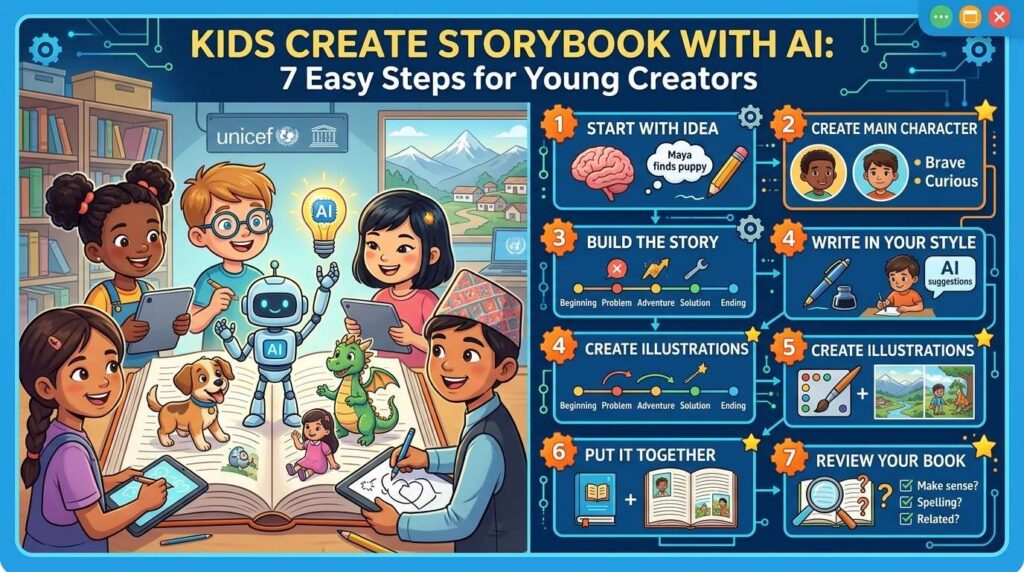
3. Create a Choose-Your-Own-Adventure Story
AI can help children turn their imagination into an interactive story.
Kids can create a main character, develop a story world, and introduce choices that lead to different endings. They can also create illustrations for important scenes.
For example:
You discover a mysterious door in the forest.
Do you open the door or follow the glowing footprints?
Children can try different prompts, compare the results, and rewrite sections until the story feels like their own.
This activity develops creative writing, storytelling, decision-making, and prompt-writing skills.
Recommended for: Grades 2–8
4. Compose an Original Song
Children do not need to be professional musicians to experiment with AI music.
Music-generation tools can help learners explore different genres, moods, tempos, and musical styles. They might create a song about friendship, animals, space, adventure, or a favorite hobby.
The finished song could become the soundtrack for a story, animation, game, or school project.
Along the way, children can begin exploring rhythm, melody, tempo, and musical structure.
Recommended for: Grades 4–12
5. Design Your Own AI Chatbot
What would your own AI assistant be like?
Older children can create a chatbot with a specific purpose or personality. It could be a science tutor, history helper, quiz master, space explorer, or fictional character.
Children can decide:
- What the chatbot should do
- How it should communicate
- What topics it should cover
- How it should respond to different questions
They can then test their instructions and improve them based on the results.
This type of AI project for kids introduces an important concept: the instructions given to an AI can influence how it responds.
Recommended for: Grades 6–12
6. Produce a Voice-Acted Audio Story
A written story can become a mini audio drama.
Children can write a short script, create different characters, add voices and sound effects, and turn their idea into a short podcast-style story.
They could create a mystery, a space adventure, or a story about friends solving a problem.
This combines writing, storytelling, audio production, and AI-powered voice technology while giving children a finished creative project they can share with family or classmates.
Recommended for: Grades 5–12
7. Teach AI to Recognize Sounds
Can a computer tell the difference between a clap, snap, whistle, or spoken word?
With tools such as Teachable Machine Audio, children can record different sounds, organize them into categories, and train a model to recognize new examples.
They could even create a project where a particular sound triggers an action in a game or animation.
This is one of the more interactive AI projects for kids, providing an accessible introduction to pattern recognition and machine learning.
Recommended for: Grades 3–8
8. Turn Doodles Into Posters and Presentations
AI can also become a creative design assistant.
Children can start with a rough sketch or idea and use AI-assisted design tools to create posters, presentations, comics, and infographics.
They might create:
- A science poster
- An animal fact sheet
- A digital comic
- A school presentation
- An infographic
The important part is that children make the creative decisions while AI helps them explore and develop their ideas.
Recommended for: All ages
9. Build an AI Fitness Game
AI is not limited to activities that happen behind a screen.
Using pose-estimation technology, children can explore how computers recognize body positions and use that information to create simple fitness challenges.
For example:
Complete 10 jumping jacks → earn 10 points!
Kids can experiment with squats, jumps, balance poses, or dance movements while learning about computer vision and movement tracking.
It is an excellent example of how AI projects for kids can combine technology with physical activity.
Recommended for: Grades 4–12
10. Become an AI Bias Detective
One of the most important lessons children can learn about AI is that AI can make mistakes.
Children can train a simple model using an unbalanced collection of examples, test it with new examples, and observe where it produces incorrect results.
They can then improve the training data and compare the results.
This project introduces important ideas such as:
- Data quality
- Fairness
- Testing
- Bias
- Critical thinking
- Responsible AI
Rather than simply accepting an AI result, children learn to ask:
“Why did the AI get this wrong?”
This makes AI projects for kids an opportunity to develop not only technical skills but also the habit of questioning and evaluating technology.
Recommended for: Grades 4–12
From Exploring AI to Creating With It
The finished project is only one part of the learning experience.
Children often learn the most when they try something, see what happens, make changes, and try again. A simple first project can gradually become more challenging as their confidence grows.
This progression allows children to move from understanding a concept to practising it and eventually creating something of their own.
For families and educators looking for a more guided learning experience, platforms such as ChimpVine can provide structured activities that help children develop these skills progressively through hands-on creation.
The goal is not simply to give children access to AI tools. It is to help them understand what those tools can do, experiment with them, and use them thoughtfully.
Keeping AI Projects for Kids Safe
Creative technology should always be paired with responsible digital habits.
When children work on AI projects for kids, they should:
- Protect personal information. Avoid sharing passwords, home addresses, school details, or other private information.
- Ask an adult before using unfamiliar AI tools.
- Check AI-generated information. AI can sometimes produce incorrect or misleading results.
- Keep their own ideas at the center. AI should support creativity rather than replace it.
- Question the results. Encourage children to think about why an AI system produced a particular answer or prediction.
Extra care is especially important when projects involve webcams, microphones, voice recordings, or body tracking.
Parents and educators can also use these activities as opportunities to discuss privacy, fairness, fact-checking, and responsible technology use.
Why AI Projects for Kids Matter
Learning about AI does not have to begin with complicated technical lessons.
A child who trains a model to recognize a hand gesture is already learning about data. A child who creates an AI-assisted story is practising communication and creativity. A child who investigates why an AI model makes mistakes is developing critical thinking.
These small experiences can gradually build a stronger understanding of how technology works.
That’s why AI projects for kids are most valuable when children are encouraged to explore, experiment, create, and reflect on what they have made.
Conclusion
AI gives children exciting new ways to turn curiosity into creativity.
From building games and animating drawings to writing stories, composing music, designing chatbots, and investigating AI bias, these activities show that children can do much more than simply use AI to find answers.
The most meaningful AI projects for kids put children in the driver’s seat. They decide what to create, experiment with different ideas, learn from mistakes, and improve their work.
With the right guidance and opportunities to practise, children can gradually move from AI users to confident AI creators.
So the next time a child asks, “What can I do with AI?”, the answer doesn’t have to be another question for AI.
It can simply be:
“Let’s create something.”
Related Sources
- https://www.chimpvine.com/ (ChimpVine)
- https://teachablemachine.withgoogle.com/ (Google Teachable Machine)
- https://sketch.metademolab.com/ (Meta Animated Drawings)
- https://consumer.ftc.gov/articles/protecting-your-childs-privacy-online (FTC)
Frequently Asked Questions
Do kids need coding skills to create with AI?+
No. Many activities, including storytelling, drawing, music, and visual design, require little or no coding. More technical projects can be introduced gradually as children become comfortable.
What is the best AI project for beginners?+
Drawing animation, interactive storytelling, and simple visual projects are excellent starting points. Children interested in how AI learns can later try a simple classification project.
Is AI safe for children?+
AI tools differ in their age requirements, privacy practices, and safety features. Parents and educators should review tools before children use them, particularly when cameras, microphones, or personal information are involved.
How can children learn AI in a structured way?+
A good learning experience allows children to first understand a concept, practise it through small activities, and then apply what they have learned to their own creations. This helps turn AI from something they simply use into a skill they actively develop.