20 Fun and Safe AI Prompts for Children
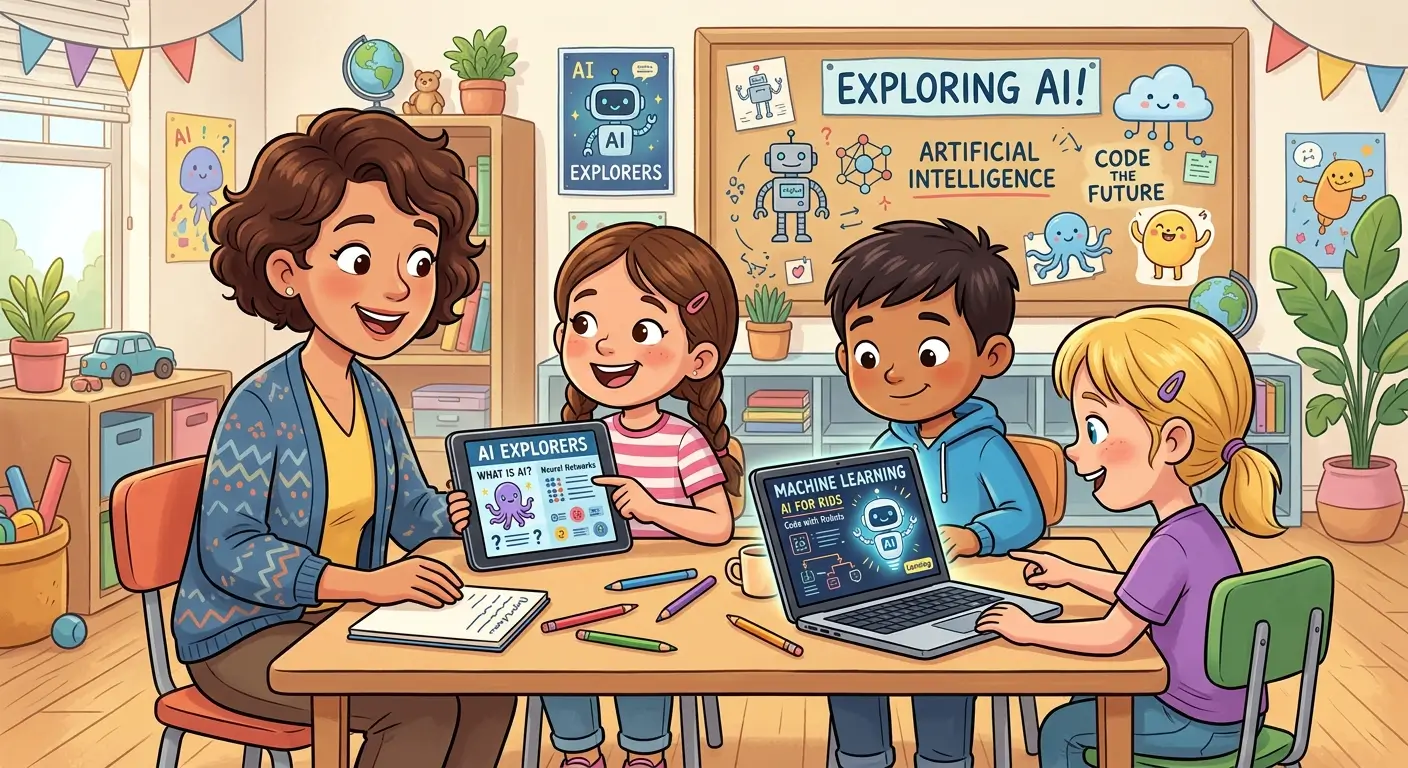
AI prompts for children can turn artificial intelligence into a creative learning partner rather than simply an answer machine. With the right prompts and appropriate adult supervision, children can use AI to explore stories, practice problem-solving, discover science, learn languages, and develop their imagination.
Artificial intelligence is already becoming part of children’s digital lives. UNICEF reported in 2026 that children are adopting AI at more than three times the rate of adults, with millions using it for learning and homework.
That makes AI literacy increasingly important. Children need to understand not only what AI can do, but also where it can make mistakes, why they should protect personal information, and when they should ask a trusted adult for help.
This guide provides 20 fun and safe AI prompts for children that parents, teachers, and caregivers can use as starting points. The prompts are designed to encourage creativity and learning without asking children to share sensitive personal information or rely on AI for important decisions.
Important: AI tools can produce incorrect, inappropriate, or misleading information. Younger children should use AI with a parent, teacher, or another trusted adult. Always check the age requirements and privacy policies of the specific AI service you use.
What Are AI Prompts for Children?
An AI prompt is simply an instruction or question given to an artificial intelligence system.
For example, instead of asking an AI chatbot, “Tell me a story,” a child could write:
“Write a funny story about a tiny dragon who wants to become a chef.”
The second prompt gives the AI more direction. It tells the system what kind of story to create, who the main character is, and what makes the story interesting.
AI prompts for children should generally be simple, creative, age-appropriate, and focused on learning or exploration.
A good prompt can encourage a child to think before asking AI for an answer. Instead of using AI to complete an assignment, children can ask it to provide hints, explain difficult concepts, generate questions, or help them brainstorm.
This distinction matters. Recent research from Common Sense Media found that many teens already use AI for schoolwork, but the way they use it can determine whether AI supports learning or replaces critical thinking.
Why Use AI Prompts for Children?
AI can provide children with a new way to experiment with ideas.
A child interested in dinosaurs can use AI to create a fictional dinosaur adventure. A child learning English can practice conversations. Another child might ask AI to explain why the Moon changes appearance.
The goal should not be to let AI do everything for them.
Instead, AI prompts for children should encourage children to ask questions, investigate answers, compare information, and create something of their own.
UNICEF’s guidance on AI and children emphasizes safety, privacy, fairness, transparency, children’s development, and preparing children for an AI-enabled future.
That makes supervised, purposeful experimentation more valuable than unrestricted chatbot use.
20 Fun and Safe AI Prompts for Children
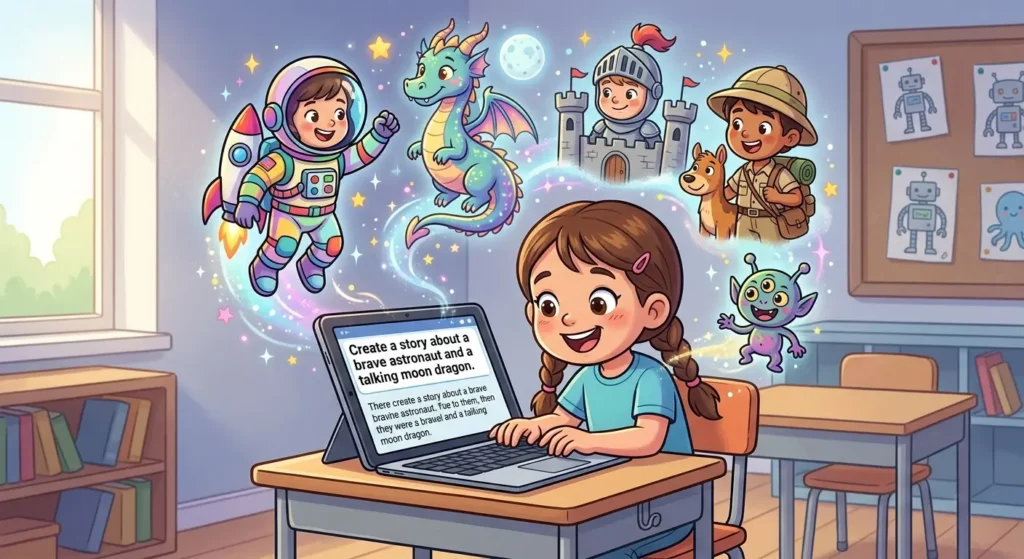
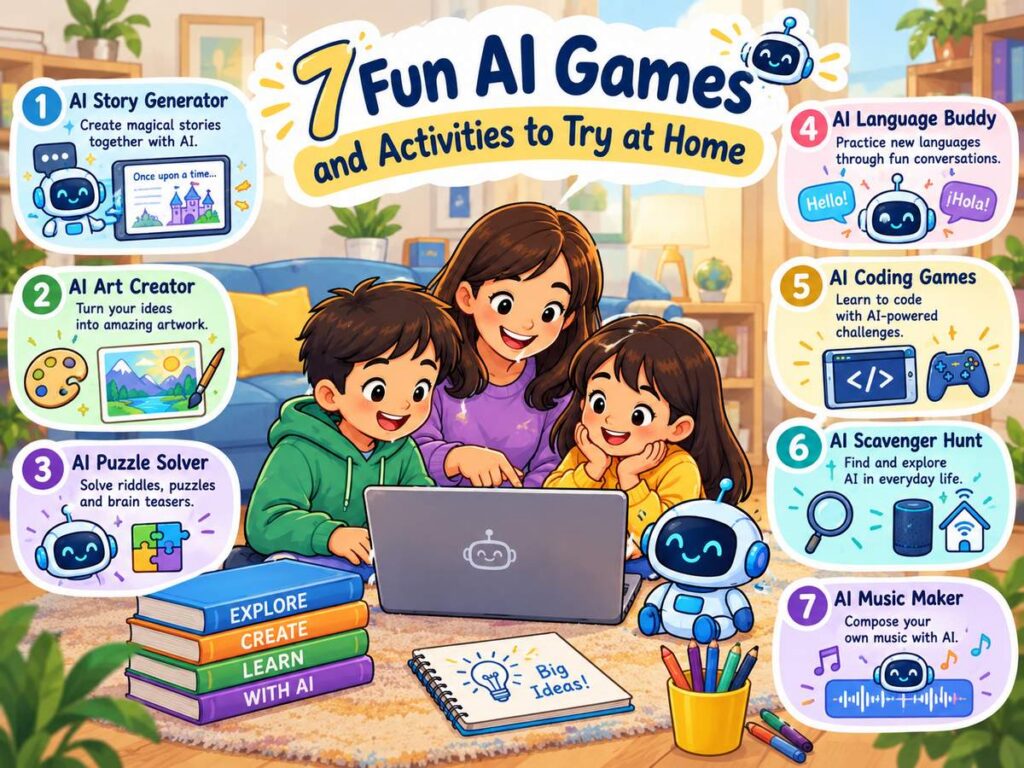
Here are 20 practical AI prompts for children that can be adapted for different ages and interests.
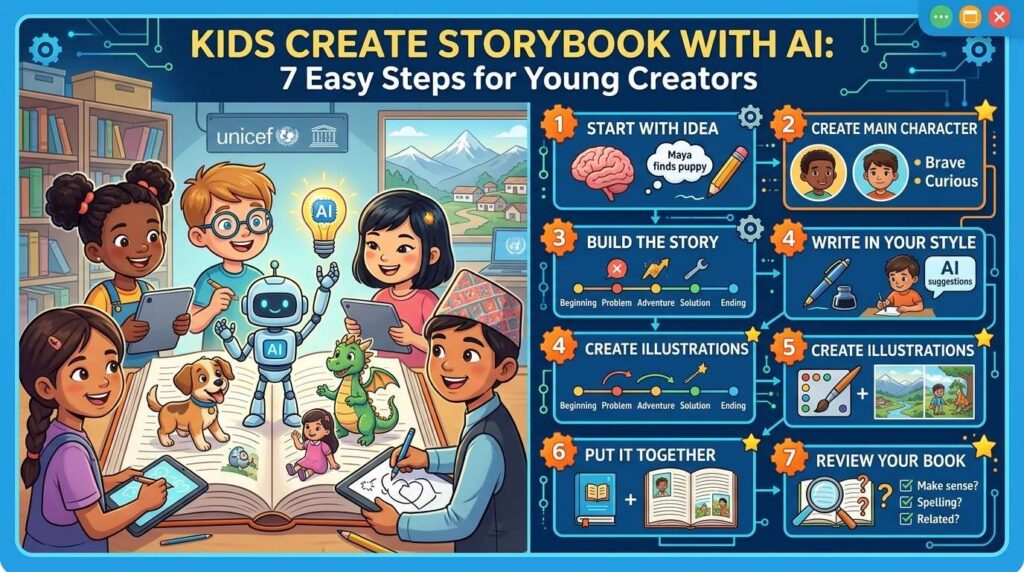
1. Create a Magical Adventure Story
Prompt:
“Create a funny adventure story about a young explorer who discovers a magical forest. Include three friendly animals, a mystery to solve, and a happy ending.”
This prompt encourages storytelling and imagination.
After AI creates the story, ask the child to change one part of it. They could create a new ending, add another character, or draw a picture of the magical forest.
This turns AI into a brainstorming partner rather than the final creator.
2. Invent a New Animal
Prompt:
“Invent a completely new animal. Give it a name, describe what it looks like, explain what it eats, and tell me where it lives.”
This is one of the easiest AI prompts for children because it combines science and creativity.
After receiving the answer, ask the child to draw the animal.
For an additional challenge, ask:
“What adaptations would help this animal survive in its environment?”
That introduces basic biological thinking while keeping the activity fun.
3. Become a Space Explorer
Prompt:
“Pretend you are my space exploration guide. Teach me five interesting facts about planets in simple language and then ask me five quiz questions.”
This prompt can transform an ordinary AI conversation into an interactive learning activity.
Parents can encourage children to answer the questions without looking back at the AI’s explanations.
If the child gets an answer wrong, AI can provide a hint rather than immediately revealing the correct answer.
4. Make a Riddle Challenge
Prompt:
“Give me five fun riddles for children. Don’t tell me the answers until I try to solve all five.”
Riddles encourage logical reasoning and vocabulary development.
A child can then create five riddles of their own and ask a parent, teacher, sibling, or AI to solve them.
This makes the activity interactive instead of passive.
5. Practice a New Language
Prompt:
“Help me practice basic Spanish. Teach me five simple words, use each word in a short sentence, and then quiz me one word at a time.”
Language learning is another useful area for AI prompts for children.
Children can substitute Spanish with another language they are learning.
Parents should still verify important vocabulary and pronunciation because AI can occasionally provide inaccurate information.
6. Solve a Mystery
Prompt:
“Create a short mystery suitable for children. Give me clues one at a time and let me guess who solved the mystery before revealing the answer.”
This prompt encourages children to analyze information rather than simply consume it.
For extra challenge, tell AI not to provide the next clue until the child explains their reasoning.
That small change can make the activity more focused on critical thinking.
7. Build a Fantasy World
Prompt:
“Help me create a fantasy world. Give me three kingdoms, five unusual creatures, one magical rule, and a problem the characters need to solve.”
Children can then decide which kingdom they would visit and explain why.
They can also draw a map of the world and add locations that AI did not mention.
This demonstrates an important principle of using AI creatively: the child should add their own ideas.
8. Become a Science Teacher
Prompt:
“Explain how rain forms as if you were teaching a curious 9-year-old. Use a simple example and finish with three questions I can answer myself.”
This is a good example of using AI prompts for children to simplify difficult concepts.
The same structure can be used for topics such as gravity, photosynthesis, volcanoes, electricity, or the water cycle.
For factual subjects, children should compare AI’s explanation with their textbook, teacher, or another trusted educational resource.
9. Create a Funny Comic
Prompt:
“Create a four-panel comic about a robot who wants to become a school teacher. Give each panel a short description and funny dialogue.”
The child can then draw the comic themselves.
This keeps the creative work in the child’s hands while AI provides an initial idea.
10. Invent a New Planet
Prompt:
“Invent a fictional planet. Give it a name, describe its atmosphere, weather, plants, animals, and one unusual feature. Make it scientifically inspired but imaginative.”
This activity combines astronomy, biology, writing, and creativity.
Ask the child to decide whether humans could survive there and explain their reasoning.
That follow-up question can turn a simple creative prompt into a science discussion.
11. Play 20 Questions
Prompt:
“Think of an animal but don’t tell me what it is. Let me ask yes-or-no questions until I guess it.”
This is a simple but effective way to practice questioning strategies.
Afterward, reverse the game.
The child thinks of something and asks AI questions until AI guesses it.
12. Create a Treasure Hunt
Prompt:
“Create a five-step indoor treasure hunt for children. Make each clue a simple riddle, and make the final discovery something funny.”
This can become a screen-free activity.
A parent or teacher can print the clues and hide them around a classroom or home.
AI generates the initial content, but the child interacts with the real-world environment.
13. Turn a Chore Into a Game
Prompt:
“Turn cleaning my room into a fun five-level game. Give me a challenge for each level and a silly reward idea that doesn’t involve buying anything.”
This demonstrates how AI can help children approach ordinary tasks creatively.
Parents can replace “cleaning my room” with organizing books, preparing a school bag, or completing another age-appropriate task.
14. Write a Silly Song
Prompt:
“Write a short, funny song about a penguin who wants to learn how to fly. Make it cheerful and easy for a child to sing.”
Children can then change the lyrics.
Ask them to write another verse themselves.
This helps turn AI-generated material into a collaborative creative exercise.
15. Practice a Job Interview
Prompt:
“Pretend you are interviewing me for the imaginary job of professional dinosaur explorer. Ask me five fun questions one at a time.”
Role-playing can help children practice communication and confidence.
The imaginary setting makes the exercise less intimidating than a traditional interview.
Teachers can adapt this idea for classroom activities about different careers.
16. Ask for Homework Hints
Prompt:
“I am trying to solve this math problem. Don’t give me the answer. Give me one hint that helps me figure out the next step.”
This is one of the most useful ways to approach AI prompts for children in education.
The instruction “don’t give me the answer” is important because it keeps the child involved in the problem-solving process.
AI should support learning rather than replace it.
17. Create a Would-You-Rather Game
Prompt:
“Create 10 funny and age-appropriate Would You Rather questions about animals, space, food, and adventure.”
After answering the questions, ask the child to explain why they made each choice.
This encourages conversation and reasoning.
It can also be used as a family activity where everyone answers the same questions.
18. Become a Book Discussion Partner
Prompt:
“Ask me five questions about a children’s book I just read. Don’t give me the answers. Ask questions that help me think about the characters, problem, setting, and lesson.”
This is a better educational use than asking AI to summarize an entire book for the child.
The child must remember and interpret what they read.
Parents can also ask the child to identify which parts of AI’s questions are based directly on the book.
19. Design a Dream Treehouse
Prompt:
“Help me design a dream treehouse. Give me five rooms or areas, three fun features, and one important safety feature. Then ask me what I would change.”
This prompt encourages design thinking.
Children can sketch the treehouse after discussing the concept with AI.
Older children can take the activity further by thinking about measurements, materials, weight, and structural stability.
20. Ask AI to Challenge Your Ideas
Prompt:
“I will give you an idea. Instead of agreeing with me, ask me three questions that help me think about the idea more carefully.”
This may be one of the most valuable AI prompts for children on the list.
It teaches children that AI does not have to be used simply to produce answers.
It can also be used to examine assumptions and encourage deeper thinking.
For example, a child might say, “I think everyone should have a robot.”
AI could respond with questions such as:
- What would the robot help people do?
- Who might not be able to afford one?
- What could go wrong?
- Would people still need to learn the skills themselves?
The objective is not to make AI the authority. The objective is to encourage the child to think.
How to Make AI Prompts for Children Safer
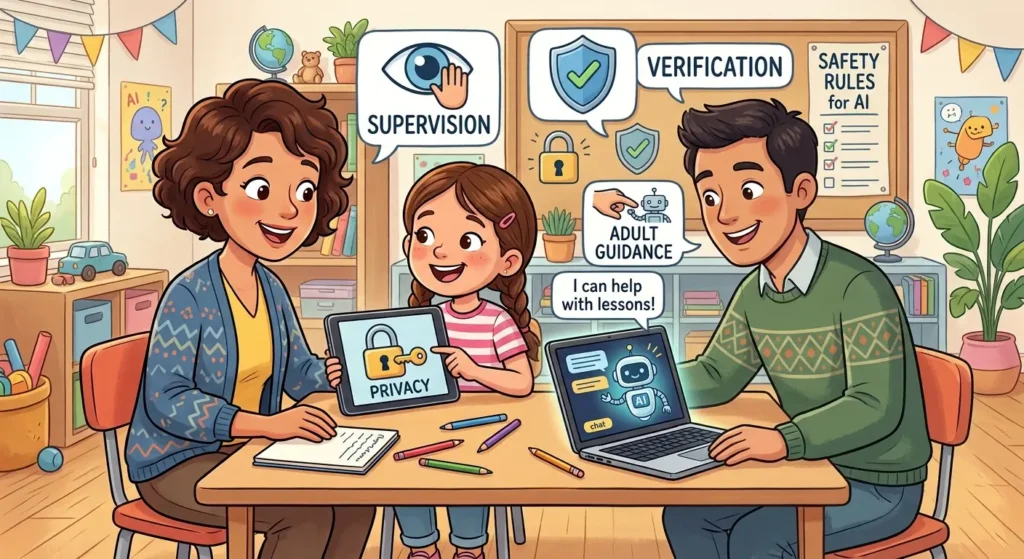
Fun activities are only one part of responsible AI use.
Parents and teachers should establish basic safety rules before children start experimenting with AI.
1. Never Share Private Information
Children should not enter sensitive information into an AI chatbot.
This can include their full name, home address, phone number, passwords, school login details, precise location, or other information that could identify or endanger them.
UNICEF’s child-centered AI guidance specifically emphasizes children’s privacy and data protection.
2. Don’t Treat AI as a Human Friend
AI can sound conversational, but it is not a human friend, teacher, doctor, counselor, or family member.
This distinction becomes especially important as AI companions become more common.
UNICEF has warned that children increasingly use AI chatbots for advice, support, and even relationship-like interactions, creating additional child-safety concerns.
For children, AI prompts for children should therefore focus primarily on learning, creativity, and supervised exploration rather than emotional dependence.
3. Check AI’s Answers
AI can be wrong.
It may invent facts, misunderstand questions, provide outdated information, or confidently present an incorrect answer.
Teach children to ask:
“How do I know this is true?”
For important information, compare the answer with a textbook, teacher, library resource, government website, or another trusted source.
Common Sense Media similarly recommends helping children question AI-generated information and verify claims through reliable sources.
4. Don’t Use AI to Cheat
There is a significant difference between using AI to understand a topic and using AI to complete an assignment.
A child can ask:
“Explain this math concept with an example.”
That supports learning.
A child asking:
“Do my entire math worksheet.”
is doing something very different.
The best AI prompts for children encourage participation rather than removing the need to think.
5. Use Age-Appropriate AI Tools
Not every AI product is designed for children.
Age requirements, privacy practices, parental controls, content filters, and data policies vary between services.
Common Sense Media’s current age-and-stage guidance recommends no AI chatbots for children five and under, limited use alongside an adult for ages 6–12, and supervised use for older teens. It also advises against using AI for emotional support or friendship.
These are useful guidelines, but parents should also check the specific AI product’s current terms and age requirements.
Tips for Parents and Teachers
The best way to introduce AI prompts for children is to participate in the process.
You don’t need to be an AI expert.
Instead, sit with the child occasionally and ask questions such as:
- “Why did you ask AI that?”
- “Do you think that answer is correct?”
- “How could we check it?”
- “Can you solve this without AI first?”
- “What would you change about the answer?”
- “Can you explain the answer in your own words?”
These questions teach AI literacy more effectively than simply telling children that AI is good or bad.
UNESCO’s guidance on generative AI in education also emphasizes human-centered, age-appropriate, ethical, and meaningful use of AI.
Turn AI Prompts Into Learning Activities
A simple prompt can become a much richer activity when it follows a three-step process.
Step 1: Ask AI
The child gives AI a carefully written prompt.
Step 2: Think About the Response
The child identifies what they like, dislike, question, or want to change.
Step 3: Create Something Without AI
The child draws, writes, explains, solves, builds, or presents something based on the activity.
This final step is important.
If AI writes a story and the child simply reads it, there may be limited learning.
If AI suggests a story idea and the child writes a different ending, draws the characters, and explains the lesson, the activity becomes much more engaging.
What Children Can Learn From AI Prompting
Learning how to write effective prompts can develop several useful skills.
Creativity
Children learn to describe ideas and experiment with possibilities.
Communication
They must explain what they want clearly.
Critical Thinking
They learn to question whether AI’s response makes sense.
Problem-Solving
They can use AI for hints, alternative approaches, and brainstorming.
Digital Literacy
They learn that technology can produce useful information without necessarily producing correct information.
AI Literacy
Most importantly, children begin to understand how to interact with AI responsibly.
These skills matter because AI is becoming increasingly embedded in education, communication, entertainment, and everyday technology.
UNICEF’s research emphasizes the need to prepare children with skills for an AI-enabled world while also protecting their safety and rights.
A Simple Rule for Using AI With Children
A useful rule for parents and teachers is:
AI should help children think, not think instead of them.
If a child uses AI to brainstorm a story, practice vocabulary, receive a hint, generate questions, or explore an idea, AI can become a useful learning tool.
If the child uses AI to avoid reading, writing, solving problems, researching, or thinking, the educational value decreases.
The best AI prompts for children therefore leave room for the child to make decisions.
Frequently Asked Questions About AI Prompts for Children
Are AI prompts safe for children?
They can be, when used with an age-appropriate AI service and suitable adult supervision.
Safety also depends on what the child asks, what information they share, and how the AI system handles data.
Parents should check the service’s age requirements and privacy policies before allowing children to use it.
What are the best AI prompts for children?
The best prompts encourage creativity, curiosity, reasoning, and learning.
Storytelling, riddles, science questions, language practice, mysteries, design challenges, and brainstorming are good starting points.
Should young children use AI chatbots alone?
Young children generally should not use AI chatbots independently.
Current Common Sense Media guidance recommends that children ages 6–12 use AI chatbots only in limited ways and alongside a parent or caregiver, while it recommends against AI chatbots for children five and under.
Always consider the child’s developmental level and the specific AI service.
Can children use AI for homework?
AI can support homework when it helps children understand concepts, brainstorm ideas, practice skills, or receive hints.
However, children should not use AI to complete assignments they are expected to do themselves.
Schools may also have their own AI policies, so students should follow their teacher’s requirements.
How can parents teach children about AI safety?
Start with a few simple rules: don’t share private information, don’t believe everything AI says, don’t use AI as a replacement for trusted adults, verify important information, and ask for help when something feels confusing or uncomfortable.
Final Thoughts
AI prompts for children can make technology more educational, creative, and engaging when they are used thoughtfully.
The goal is not to give children unlimited access to AI.
The goal is to teach them how to use AI responsibly.
Start with simple activities such as storytelling, riddles, science exploration, language practice, and creative challenges. Encourage children to question AI’s answers and add their own ideas.
Most importantly, keep the child at the center of the activity.
AI can generate a story, but the child can rewrite it.
AI can suggest a solution, but the child can work through the problem.
AI can provide information, but the child can verify it.
That approach helps children develop something more valuable than prompt-writing skills alone: the ability to think critically and creatively in a world where AI is increasingly present.
For additional guidance, parents and educators can explore UNICEF’s Guidance on AI and Children, AI for Children resources, UNESCO’s Guidance for Generative AI in Education and Research, and Common Sense Media’s AI guidance for children and families.