What Is Generative AI? A Kid-Friendly Explanation
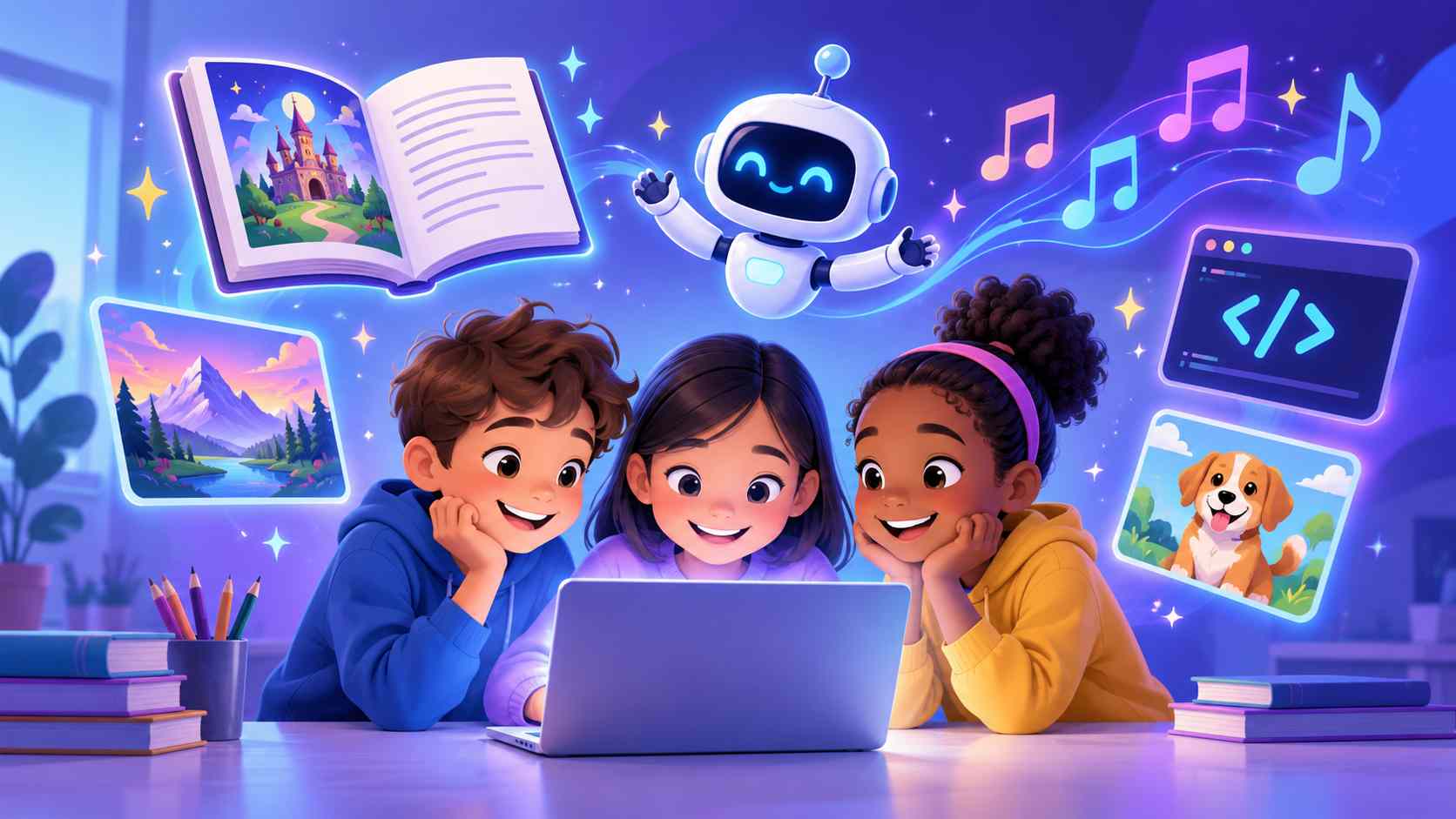
Imagine you could ask a computer to write a funny story about a talking dog, create a picture of a superhero cat, or help you come up with ideas for a school project. Instead of simply searching for something that already exists, the computer could create something new for you.
This is where Generative AI for Kids becomes interesting.
Generative AI is a type of artificial intelligence that can create new content based on the instructions, questions, or ideas that people give it. It can create stories, pictures, music, videos, computer code, explanations, and much more.
You may have already heard of tools such as ChatGPT, Gemini, or other AI applications. These tools can use generative AI to respond to questions and create different types of content.
But how does it work? And how can students use it safely and responsibly?
Let’s find out.
What Does Generative AI Mean?
To understand Generative AI for Kids, let’s first understand the word “generative.”
The word “generate” means to create or produce something.
So, Generative AI means artificial intelligence that can generate or create new content.
For example, traditional computer programs usually follow specific instructions written by people. If you use a calculator, you enter numbers and it follows mathematical rules to give you an answer.
Generative AI works differently. It can take an instruction from you and produce an original response based on patterns it has learned.
For example, you could type:
“Write a short story about a robot who wants to become a chef.”
The AI can create a story based on that request.
You could also ask:
“Give me five fun ideas for a science project about plants.”
The AI can generate several ideas for you to explore.
This is one reason Generative AI for Kids can be useful as a learning and creativity tool.
How Does Generative AI Work?
You might be wondering how a computer can create a story or answer a question.
Generative AI systems are trained using very large amounts of information. During training, the AI learns patterns from the information it processes.
For example, a language-based AI can learn patterns in words, sentences, and different styles of writing.
It can learn that certain words commonly appear together and that questions often have particular types of answers.
When you give the AI a prompt, it uses these learned patterns to generate a response.
A simple way to imagine the process is:
Your idea → Your prompt → AI processes the request → AI generates an answer
However, this does not mean the AI understands everything in exactly the same way a human does. It is using patterns and information to produce a response that fits your request.
That is an important part of understanding Generative AI for Kids.
What Can Generative AI Create?
One of the exciting things about Generative AI for Kids is the variety of things AI can help create.
Stories and Writing
Generative AI can create stories, poems, descriptions, questions, and other types of writing.
For example, you might ask:
“Write a funny story about three friends who discover a secret room in their school.”
The AI can create a story based on your idea.
Images
Some AI tools can generate images from written descriptions.
You could describe:
“A colorful village in the mountains with flying bicycles.”
An image-generation tool may create a picture based on your description.
Music
Some AI tools can generate music based on instructions about mood, style, or instruments.
For example, you might ask for a cheerful song about friendship.
Videos
Generative AI can also help create or edit video content. Some tools can turn text or ideas into video scenes, animations, or presentations.
Computer Code
AI can help people write and understand computer programs.
For students learning coding, it can explain what a particular piece of code does or help identify a possible error.
How Can Kids Use Generative AI for Learning?
There are many useful ways students can explore Generative AI for Kids in school.
1. Ask Questions
If you are struggling to understand a topic, you can ask AI to explain it in simpler language.
For example:
“Explain photosynthesis as if I am 12 years old.”
The AI may give you a simpler explanation that helps you understand the topic.
You can then compare that explanation with your textbook or teacher’s explanation.
2. Brainstorm Ideas
Sometimes you know you need to create something but don’t know where to begin.
AI can help you brainstorm.
For example:
“Give me five ideas for a school project about reducing plastic waste.”
You can look at the ideas and choose one that interests you.
3. Improve Your Writing
AI can help you identify spelling mistakes, improve sentence structure, or suggest ways to make your writing clearer.
You can still make the final decisions about your writing.
4. Practice
You can use AI to create practice questions.
For example:
“Give me five Grade 7 questions about fractions. Don’t give me the answers yet.”
You can solve the questions yourself and then ask AI to help you check your work.
5. Explore Creativity
You can use Generative AI for Kids to explore creative ideas for stories, drawings, presentations, characters, games, and projects.
The important thing is to use AI as a starting point rather than letting it do everything for you.
Can Generative AI Make Mistakes?
Yes!
This is one of the most important things students need to understand about Generative AI for Kids.
AI can sometimes give an answer that sounds completely correct but is actually wrong.
For example, you might ask about a historical event and receive an incorrect date. You might ask about a famous person and receive information that isn’t true.
Sometimes AI can even create information that sounds realistic but does not actually exist.
These kinds of mistakes are often called AI hallucinations.
So, what should you do?
Check important information.
For school projects, compare AI-generated information with reliable sources such as your textbook, teacher, library resources, or trustworthy websites.
Never assume that something is true simply because an AI tool said it confidently.
Is Generative AI the Same as a Human?
No.
AI can write stories, answer questions, create images, and have conversations, but it does not experience the world in the same way humans do.
People have emotions, experiences, memories, relationships, imagination, and personal opinions.
AI works differently. It generates responses based on patterns and information from its training and the instructions it receives.
That’s why human thinking remains extremely important.
Generative AI for Kids should support human creativity, not replace it.
AI Should Not Do Your Homework for You
Imagine your teacher asks you to write a story.
You could ask AI:
“Write my entire story so I can submit it.”
The AI might produce a complete story, but you haven’t really done the learning yourself.
A better approach would be:
“Give me five possible story ideas about a student who discovers a secret door at school.”
You can choose one idea, change it, add your own characters, develop the plot, and write the story yourself.
In this situation, AI is helping you brainstorm while you remain the creator.
This is one of the best ways to think about Generative AI for Kids: use it to help you learn, explore, and create rather than simply doing your work for you.
Five Rules for Using Generative AI Responsibly
If you’re using Generative AI for Kids activities at home or school, remember these five simple rules.
1. Think Before You Trust
AI can make mistakes. Always question information that seems unusual or important.
2. Check Important Facts
Use books, teachers, trusted websites, and other reliable sources to verify information.
3. Protect Your Privacy
Never share passwords, private messages, home addresses, phone numbers, or other sensitive personal information with an AI tool.
4. Don’t Use AI to Cheat
If your teacher asks you to complete an assignment yourself, don’t use AI to secretly do the whole assignment.
5. Keep Your Own Ideas
AI can give you suggestions, but your imagination and creativity are valuable. Add your own ideas, opinions, experiences, and solutions.
A Simple Generative AI Challenge for Kids
Here’s a fun way to understand Generative AI for Kids.
Choose an everyday object, such as a pencil.
Now ask an AI:
“Imagine a pencil that can talk. Give me three ideas about what it might say to a student.”
Read the ideas.
Then create your own idea that is completely different from the AI’s suggestions.
You can turn it into a short story, comic, drawing, or classroom presentation.
This activity shows an important idea: AI can give you ideas, but you can take those ideas somewhere new.
What Should Kids Remember About Generative AI?
Generative AI is a powerful technology that can create text, images, music, videos, code, and other types of content.
For students, Generative AI for Kids can be a useful tool for learning, brainstorming, practicing, and exploring creativity.
But it isn’t perfect.
AI can make mistakes. It doesn’t think exactly like a human. And it should not replace your own effort, imagination, or judgment.
The smartest way to use AI is not to ask:
“How can AI do everything for me?”
Instead, ask:
“How can AI help me learn and create better?”
Generative AI is a tool.
Your curiosity, creativity, and ability to think critically are what make the tool useful.
Use AI. Ask questions. Check the answers. Add your own ideas. And most importantly, keep thinking for yourself.
Frequently Asked Questions About Generative AI for Kids
What is Generative AI for Kids?
Generative AI for Kids refers to explaining and using generative artificial intelligence in ways that are simple, age-appropriate, safe, and useful for young learners. Generative AI can create things such as text, images, music, videos, and computer code based on instructions from a user.
Can kids use Generative AI for schoolwork?
Kids can use AI as a learning and brainstorming tool, but they should follow their school’s rules and their teacher’s instructions. AI can help explain difficult topics, generate practice questions, brainstorm ideas, or provide feedback on writing. Students should not use it to secretly complete assignments that they are expected to do themselves.
Can Generative AI make mistakes?
Yes. Generative AI can produce incorrect information even when the answer sounds confident. Students should check important facts using reliable sources such as textbooks, teachers, libraries, and trusted websites.
Is Generative AI safe for children?
AI tools should be used carefully by children. Privacy, age requirements, school policies, and the specific rules of each AI tool matter. UNESCO recommends an age-appropriate, human-centred approach to generative AI in education and highlights the importance of protecting children’s data and privacy.
Should kids share personal information with AI?
No. Children should avoid entering sensitive personal information such as passwords, home addresses, private messages, financial information, or other information they would not want shared. When using AI at school, students should follow their school’s privacy and technology policies.
Can Generative AI replace teachers?
No. Generative AI can provide explanations, ideas, and learning support, but teachers provide human guidance, experience, encouragement, context, and judgment. AI should support education rather than replace the important human relationships involved in learning.
How can Generative AI help kids be creative?
Generative AI can help students brainstorm story ideas, create visual concepts, explore different writing styles, develop characters, or come up with project ideas. The best use is often to take an AI suggestion and then develop it with your own imagination and ideas.
What is the most important thing kids should learn about AI?
One of the most important skills is critical thinking. Students should learn that AI can be useful but is not always correct. They should know how to question AI-generated information, check sources, protect their privacy, and make their own decisions. UNESCO’s AI competency framework similarly emphasizes understanding, applying, and creating with AI while developing ethical awareness and critical judgment.
Conclusion: Learn With AI, But Keep Thinking for Yourself
Generative AI is changing the way people learn, create, and work. For students, Generative AI for Kids can open up exciting ways to explore ideas, practice skills, solve problems, and express creativity.
But using AI well is about more than knowing which button to press.
Students also need to know when to question an answer, how to check information, what information should remain private, and when they should complete a task without AI.
AI can suggest a story idea, but you can make the story your own.
AI can explain a difficult topic, but you still need to understand it.
AI can create an image, but your imagination decides what you want to create.
AI can help you find possibilities, but you are still responsible for the choices you make.
That is the real lesson behind Generative AI for Kids.
Don’t think of AI as a magic machine that does everything for you. Think of it as a tool that can help you explore and learn.
Ask. Explore. Check. Create. Think.
The more you understand both the strengths and limitations of AI, the better prepared you will be to use it responsibly — not only in school, but in the world around you.