How Can Schools Start Teaching AI to Students?
Teaching AI to Students is becoming an important part of modern education as artificial intelligence becomes increasingly common in classrooms, workplaces, and everyday life. Students are already interacting with AI through search engines, recommendation systems, chatbots, writing assistants, image generators, and educational applications.
Schools therefore have an opportunity to help students understand not only how AI tools work, but also how to use them safely, critically, creatively, and responsibly.
Teaching AI does not necessarily mean turning every student into a programmer. Instead, schools can begin with basic AI literacy and gradually introduce students to concepts such as data, algorithms, machine learning, prompting, bias, privacy, and responsible AI use.
The UNESCO AI Competency Framework for Students supports this broader approach. It identifies 12 competencies across four areas: human-centred mindset, ethics of AI, AI techniques and applications, and AI system design. The framework also describes progression through three levels: Understand, Apply, and Create.
The goal is to prepare students to become informed users and creators of technology rather than passive consumers of AI-generated information.
Why Should Schools Start Teaching AI to Students?
Artificial intelligence is already influencing how people learn, work, communicate, and make decisions. Students will encounter AI regardless of whether schools formally teach it.
Without proper guidance, students may treat AI-generated answers as automatically correct, share personal information with AI systems, or use AI to complete assignments without actually learning the underlying concepts.
Teaching AI to students helps schools address these challenges while also giving students valuable skills for the future.
AI education can help students:
- Understand how artificial intelligence works at a basic level.
- Recognize where AI is used in everyday life.
- Evaluate whether AI-generated information is accurate.
- Identify potential bias in AI systems.
- Use AI tools responsibly and ethically.
- Develop effective prompting and digital research skills.
- Understand privacy and data protection.
- Use AI to support creativity and problem-solving.
- Become more prepared for AI-influenced careers.
UNESCO’s student competency framework emphasizes that students should develop the knowledge, skills, and values needed to become responsible and creative participants in an AI-driven world. This means AI education should extend beyond simply learning how to operate a chatbot.
The purpose is not simply to teach students how to use the latest AI tool. Technology will continue to change. Schools should instead focus on developing skills that remain useful even as individual AI tools evolve.
What Should Students Learn About AI?
A good AI education program should go beyond teaching students how to operate an AI tool. Students need a basic understanding of what AI is, how it uses data, where it appears in everyday life, and what risks and responsibilities come with using it.
Understanding Artificial Intelligence
Students should first understand what artificial intelligence means in simple terms.
AI refers to computer systems designed to perform tasks that normally require aspects of human intelligence, such as recognizing patterns, understanding language, making predictions, or generating content.
Teachers can introduce AI through familiar examples. Voice assistants, recommendation systems, navigation applications, facial recognition, spam filters, and generative AI tools can all provide useful starting points.
The objective at an early stage is not to teach complex mathematics or programming. Students should understand that AI is a technology created by humans and that different AI systems are designed for different purposes.
How AI Learns From Data?
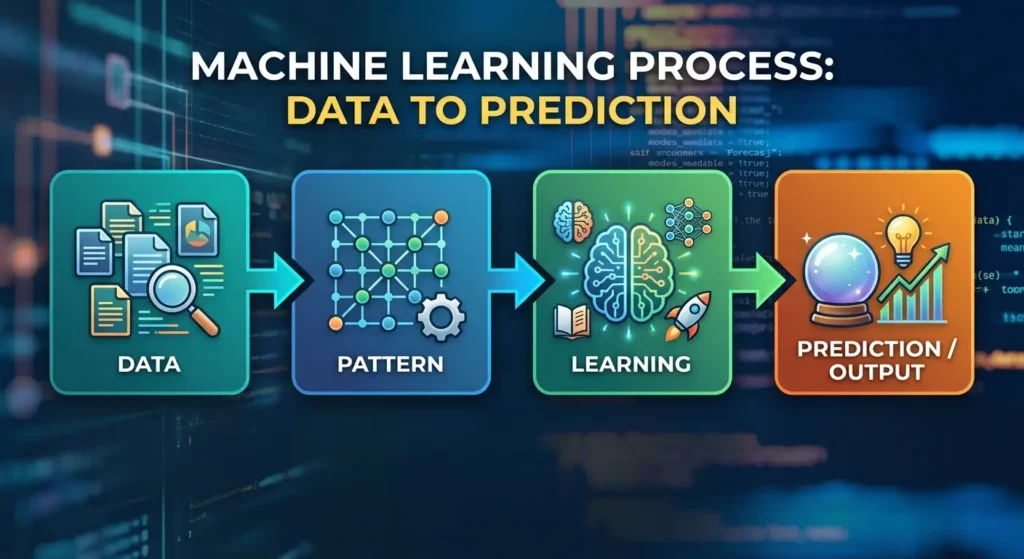
Data is one of the most important concepts students should understand when learning about AI.
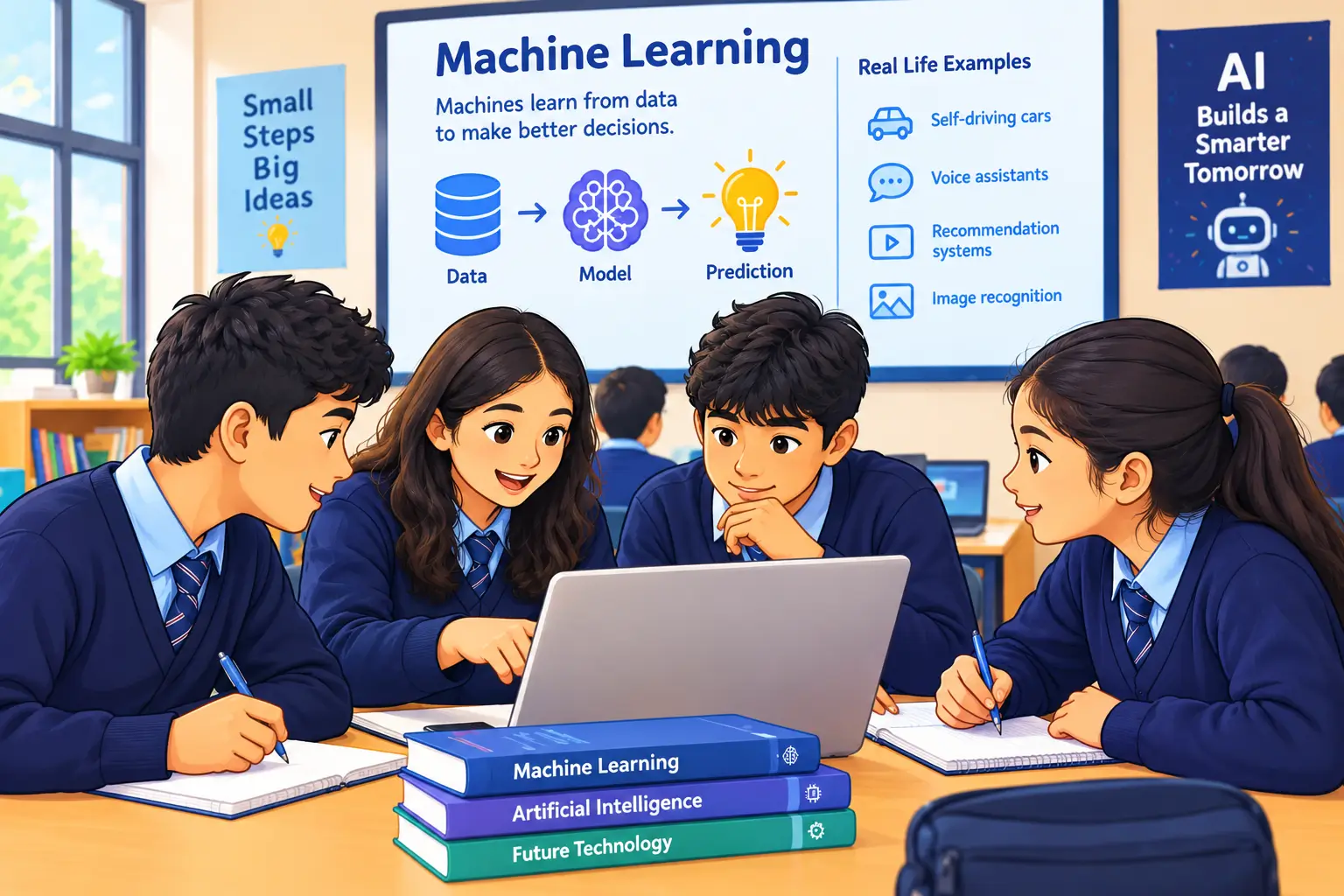
Many AI systems identify patterns from large amounts of data. Students can understand this concept through simple classroom demonstrations.
For example, a teacher could show students several pictures of cats and dogs and ask them to identify characteristics that distinguish the two. The class can then discuss how a machine-learning system might similarly identify patterns from examples.
This helps students understand that AI does not “think” exactly like a human. Its outputs depend on how the system has been designed and the data used to train it.
UNESCO’s AI competency framework similarly places AI techniques and applications alongside human-centred and ethical understanding, reinforcing the idea that students should learn both how AI works and how it should be used.
AI in Everyday Life
Students may be surprised by how often they already interact with AI.
Schools can ask students to identify AI-powered systems they encounter during a normal day. These might include:
- Search engines
- Video and music recommendations
- Online shopping recommendations
- Navigation applications
- Translation tools
- Spam filters
- Chatbots
- Smart assistants
- Generative AI applications
This activity makes AI less abstract. Students begin to see artificial intelligence as an existing part of digital life rather than something limited to science-fiction stories.
Responsible and Ethical AI Use
Responsible AI use should be introduced alongside technical knowledge.
Students should learn that AI systems can produce inaccurate, biased, incomplete, or misleading information. They should also understand why privacy matters when entering information into online AI tools.
Schools can introduce important concepts such as:
- Privacy and personal data
- Bias and fairness
- Copyright and attribution
- Academic integrity
- Misinformation
- Human oversight
- Transparency and accountability
These concerns are especially important when children interact with AI systems. UNICEF’s Guidance on AI and Children identifies child safety, data and privacy protection, non-discrimination and fairness, transparency, explainability, accountability, and children’s well-being as key requirements for child-centred AI.
Students should therefore understand that having access to an AI tool does not mean that every possible use of that tool is appropriate.
How Can Schools Start Teaching AI to Students?
Schools do not need to immediately create a complex AI curriculum. A practical approach is to start with basic concepts and gradually introduce more advanced activities.
Start With Age-Appropriate AI Concepts
AI lessons should match students’ age, existing knowledge, and developmental level.
Younger students can learn through stories, games, visual examples, and simple classification activities. Older students can explore machine learning, generative AI, algorithms, bias, privacy, and ethical questions in greater depth.
The progression can follow a simple structure:
Understand → Apply → Create
Students first learn what AI is, then learn to use and evaluate AI systems, and eventually create projects that demonstrate their understanding.
This progression aligns well with UNESCO’s framework, which organizes AI competencies across the levels of understanding, application, and creation.
Use Real-Life Examples
Students learn more effectively when abstract concepts are connected to situations they recognize.
Instead of beginning with technical definitions, teachers can ask questions such as:
- Why does YouTube recommend certain videos?
- How does a map application suggest a route?
- How does an email service identify spam?
- How can an AI chatbot generate an answer?
- Why can two AI systems produce different answers?
These questions can turn everyday technology into an opportunity for AI education.
Introduce AI Tools Through Guided Activities
When schools introduce generative AI tools, students should not simply be told to “ask AI anything.”
Teachers can provide structured activities with clear objectives.
For example, students could ask an AI system to explain a scientific concept at two different reading levels and then compare the responses. They can identify useful information, missing information, and potential inaccuracies.
TeachAI’s guidance for schools recommends that educators clarify if, when, and how AI tools should be used for classroom activities and that students and teachers critically assess AI-generated outputs before using them.
This teaches students to treat AI as a tool that requires human judgment.
Teach Students How to Write Effective Prompts
Prompting is becoming a useful digital skill when working with generative AI.
Students can learn that better instructions often produce more useful results. Teachers can demonstrate the difference between a vague prompt and a specific one.
For example:
Basic prompt:
“Explain climate change.”
More specific prompt:
“Explain three major causes of climate change for a Grade 8 student using simple examples.”
Students can then experiment with specifying the task, audience, format, constraints, and desired level of detail.
The important lesson is that prompting is not about finding a magic phrase. It is about communicating a clear objective.
Develop Critical Thinking About AI
Critical thinking should be one of the central goals of teaching AI to students.
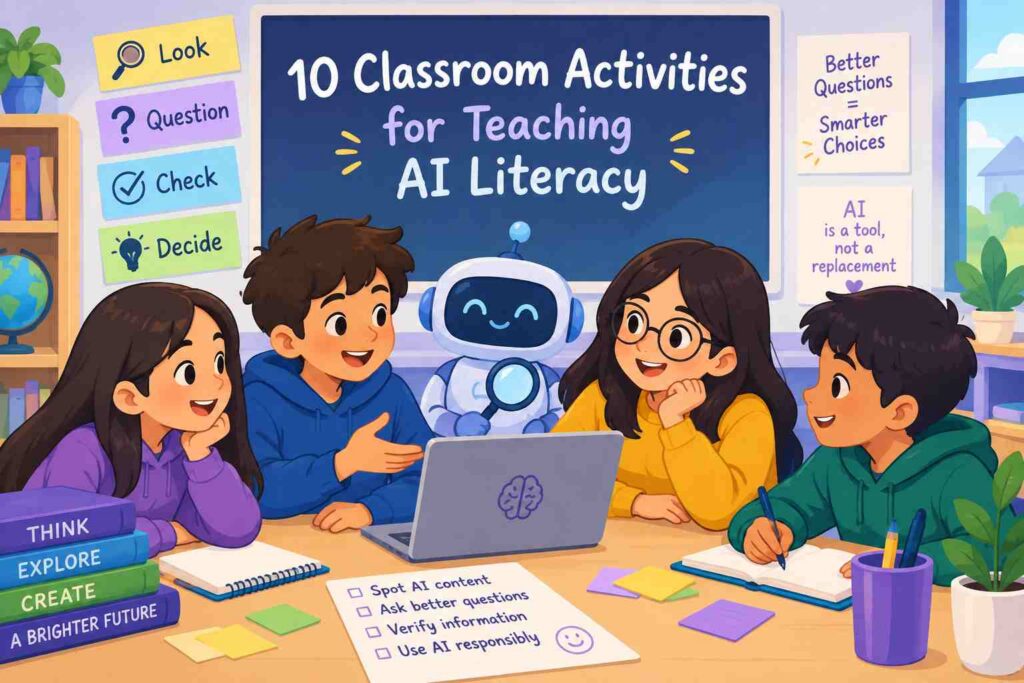
Students should learn to ask:
- Is this information accurate?
- What evidence supports the claim?
- Could the AI have misunderstood the question?
- Is important context missing?
- Could the answer contain bias?
- Can I verify this information using reliable sources?
TeachAI specifically highlights the risks of overreliance on AI and loss of critical thinking. Its school guidance recommends that students and educators remain critical consumers of AI-generated content rather than relying on AI outputs without review.
This helps students understand that AI-generated content should be evaluated rather than automatically trusted.
Teaching AI to Students by Grade Level
Schools can introduce AI progressively rather than using the same curriculum for every age group.
Primary School Students
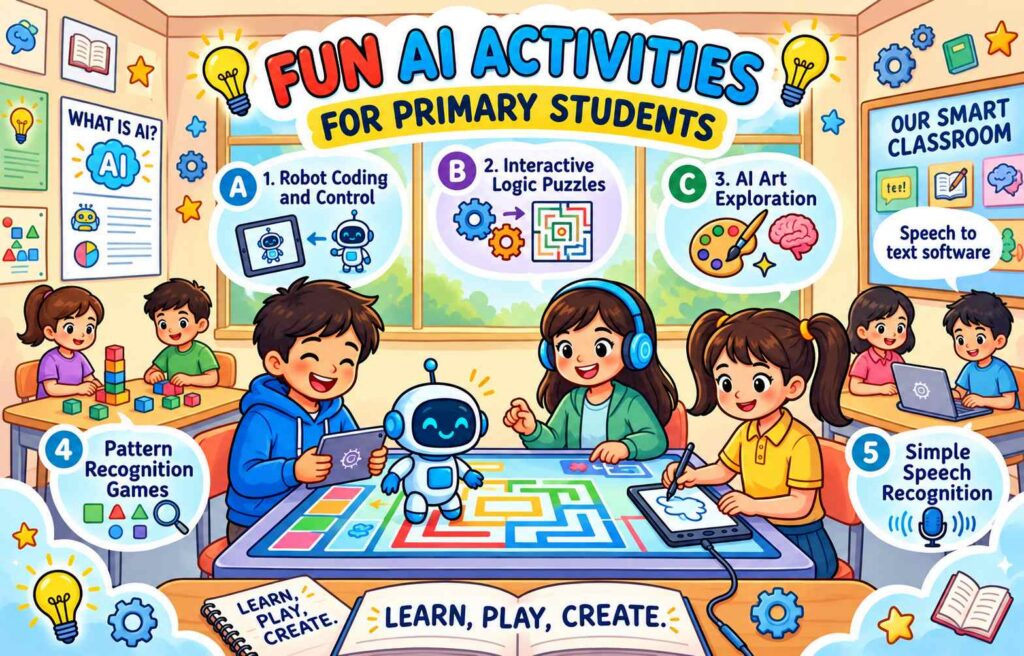
For primary students, AI education should be simple, visual, and activity-based.
Teachers can introduce concepts such as:
- What AI is
- Where students encounter AI
- How computers recognize patterns
- Basic ideas about data
- Safe technology use
- Why humans need to check computer-generated information
Simple games can be particularly effective. Students might sort pictures into categories and discuss how a computer could learn from examples.
The focus should be curiosity, digital awareness, and responsible behavior.
Middle School Students
Middle school students can explore AI concepts in greater depth.
Lessons can cover:
- Machine learning basics
- Data and patterns
- Generative AI
- Prompt writing
- AI bias
- Misinformation
- Privacy
- Copyright
- Fact-checking AI responses
Students can also begin using AI tools for controlled classroom activities, provided teachers establish clear rules about acceptable use.
At this stage, schools can introduce more structured discussions about the social and ethical impact of AI.
Secondary School Students
Secondary students can explore more complex technical, social, and ethical questions.
Topics may include:
- Machine-learning models
- Training data
- Algorithms
- Generative AI
- AI ethics
- Algorithmic bias
- Data privacy
- AI and employment
- AI regulation
- Human-AI collaboration
Students can also complete research projects, debates, presentations, and practical AI projects.
At this level, schools can connect AI education with subjects such as computer science, mathematics, business, science, social studies, and language.
Classroom Activities for Teaching AI
Hands-on activities can make AI concepts easier to understand and remember.
AI or Not AI?
Give students a list of technologies and ask them to decide whether each one uses AI.
Examples can include a calculator, spam filter, recommendation system, voice assistant, navigation application, and chatbot.
After voting, discuss why they made each choice.
This activity introduces students to the idea that AI is not simply a synonym for “advanced technology.”
Train the Machine
Use Google’s Teachable Machine to help students understand how machine-learning systems identify patterns from examples.
Students can create a simple image, sound, or pose-recognition project without needing advanced programming skills. For example, they can train the tool to recognize different classroom objects, hand gestures, facial expressions, or sounds.
A typical activity can follow these steps:
- Divide students into small groups.
- Ask each group to choose two or more categories.
- Collect examples for each category using the Teachable Machine tool.
- Train the model using those examples.
- Test the model with new examples that were not part of the training data.
- Discuss when the model makes mistakes and why.
Students can then classify objects based on characteristics such as size, shape, color, sound, or movement. The teacher can introduce an unfamiliar example and ask students to predict its category before testing it with the model.
This activity demonstrates how AI systems identify patterns from training examples and why the quality, variety, and accuracy of training data matter. It also helps students understand that AI models can make mistakes when they receive limited, unclear, or biased examples.
Create a simple classification game.
For example, students can classify objects based on characteristics such as size, shape, or color. One group can act as the “training data,” while another group acts as the “AI system.”
The teacher can then introduce an unfamiliar example and ask students to predict its category.
This demonstrates how systems can identify patterns from examples and why the quality of training data matters.
AI Prompt Challenge
Give students the same task and ask them to create different prompts for an AI tool.
Students can compare the outputs and identify which prompts produced the most useful responses.
The activity teaches students how specificity, context, audience, and instructions affect AI-generated results.
AI Fact-Checking Activity
Provide students with an AI-generated answer containing several factual claims.
Ask them to verify the claims using reliable sources.
Students can categorize each claim as:
- Correct
- Incorrect
- Partially correct
- Unable to verify
This is one of the most valuable activities because it develops both AI literacy and information literacy.
Create an AI-Assisted Project
Students can complete a project where AI is used as a supporting tool rather than as a replacement for their own work.
For example, students could create a presentation, research project, story, poster, or science explanation with appropriate AI assistance.
They should document:
- What they created themselves.
- How AI was used.
- Which AI-generated information they verified.
- What changes they made to the output.
- What they learned from the process.
TeachAI’s sample student guidance similarly emphasizes responsible use, disclosure of AI assistance, checking AI-generated work for mistakes, and avoiding the submission of fully AI-generated work as a student’s own.
This encourages transparency and keeps the student at the center of the learning process.
What Teachers Need to Teach AI Effectively
Teachers do not need to become AI engineers before introducing AI concepts in the classroom.
However, they should have enough AI literacy to understand the tools they are asking students to use and the risks associated with them.
Professional development should cover:
- Basic AI concepts
- Generative AI capabilities and limitations
- Prompting fundamentals
- Fact-checking AI outputs
- Privacy and data protection
- Academic integrity
- Bias and fairness
- Age-appropriate AI use
- Classroom AI policies
TeachAI’s school toolkit specifically identifies teachers as an important audience for AI guidance and recommends professional development that helps educators understand both the opportunities and risks of AI in instruction and assessment.
Teachers should also be encouraged to experiment with AI themselves. Practical experience makes it easier to identify both useful applications and potential problems.
Common Challenges of Teaching AI in Schools
Teaching AI can create challenges for schools, particularly when technology changes faster than educational policies.
One challenge is teacher preparedness. Teachers may not feel confident using AI tools or explaining technical concepts.
Another challenge is academic integrity. Students may use generative AI to complete assignments without understanding the material.
TeachAI recommends updating academic integrity policies to address AI use and emphasizes honesty, proper attribution, and clear expectations about when students may use AI tools.
Privacy and safety are also important. Schools need to carefully evaluate AI platforms before allowing students to use them and should avoid unnecessary collection or sharing of student information.
UNICEF’s guidance emphasizes protecting children’s data and privacy and using age-appropriate, transparent, and accountable AI systems.
There is also the challenge of digital inequality. Not every student has the same access to devices, internet connectivity, or AI tools.
Schools should therefore focus on equitable access and avoid designing AI learning activities that depend entirely on students having premium tools or personal devices.
How Schools Can Build an AI-Ready Learning Environment
Building an AI-ready school does not require introducing dozens of AI applications.
Schools should begin with clear educational goals and establish practical policies for responsible use.
An AI-ready learning environment can include:
- A basic AI literacy curriculum
- Age-appropriate classroom activities
- Teacher professional development
- Clear student AI-use guidelines
- Privacy and safety requirements
- Fact-checking and information-literacy instruction
- Equal access to learning resources
- Opportunities for hands-on projects
- Regular review of AI policies as technology changes
TeachAI’s AI Guidance for Schools Toolkit recommends treating AI guidance as part of a broader school ecosystem that includes AI literacy, privacy, academic integrity, responsible use, and ongoing policy review.
Schools should also involve relevant stakeholders when developing AI policies, including teachers, students, parents or guardians, school leaders, and where appropriate, legal or policy advisers.
Most importantly, schools should create a culture where students are encouraged to question AI outputs rather than blindly accepting them.
The long-term goal is not simply to produce students who know how to use AI tools. It is to develop students who can understand, evaluate, question, and responsibly apply AI.
Frequently Asked Questions
At what age should students start learning about AI?
Students can begin learning basic AI concepts during primary school through age-appropriate activities. Younger students can learn about patterns, classification, and everyday examples of AI, while older students can explore machine learning, generative AI, ethics, privacy, and more advanced applications.
The specific timing should depend on students’ developmental level, curriculum, available resources, and the type of AI being introduced.
What should schools teach students about AI?
Schools should teach students what AI is, how AI systems use data and patterns, where AI is used, how to interact with AI tools effectively, and how to evaluate AI-generated information.
Responsible use, privacy, bias, academic integrity, and ethics should also be part of AI education. UNESCO’s AI competency framework provides a useful foundation for structuring these learning objectives.
Do teachers need programming skills to teach AI?
No. Basic AI literacy does not require teachers to be programmers.
Teachers can begin with concepts such as data, patterns, AI applications, prompting, fact-checking, and responsible use. Programming can be introduced separately for students who want to explore the technical side of AI.
Can schools use AI tools in the classroom?
Yes, schools can use AI tools for appropriate educational purposes, but they should evaluate tools carefully and establish clear guidelines around privacy, age suitability, academic integrity, accuracy, and responsible use.
Teachers should also maintain appropriate human oversight. TeachAI’s guidance emphasizes that AI should support human judgment rather than replace the role of teachers in instruction, mentoring, assessment, and decision-making.
Conclusion
Teaching AI to students is becoming an important part of preparing young people for a technology-driven world. Schools do not need to introduce complicated AI systems or create a highly technical curriculum from the beginning.
A better approach is to start with AI literacy.
Students should learn what artificial intelligence is, how it uses data, where they encounter it, and why AI-generated information needs to be evaluated. As they become more comfortable with these concepts, schools can introduce prompting, guided AI activities, ethical discussions, fact-checking, and hands-on projects.
The most important outcome is not simply knowing how to use an AI chatbot. Students should develop the judgment to understand when AI is useful, when it can be wrong, and how it should be used responsibly.
This approach is consistent with the broader recommendations from UNESCO, UNICEF, and TeachAI: AI education should develop student competencies while protecting children’s safety, privacy, well-being, and agency.
By making AI education age-appropriate, practical, and focused on critical thinking, schools can help students become confident and responsible participants in an increasingly AI-driven world.