AI for K-3: A Fun Guide to Learning About Smart Machines
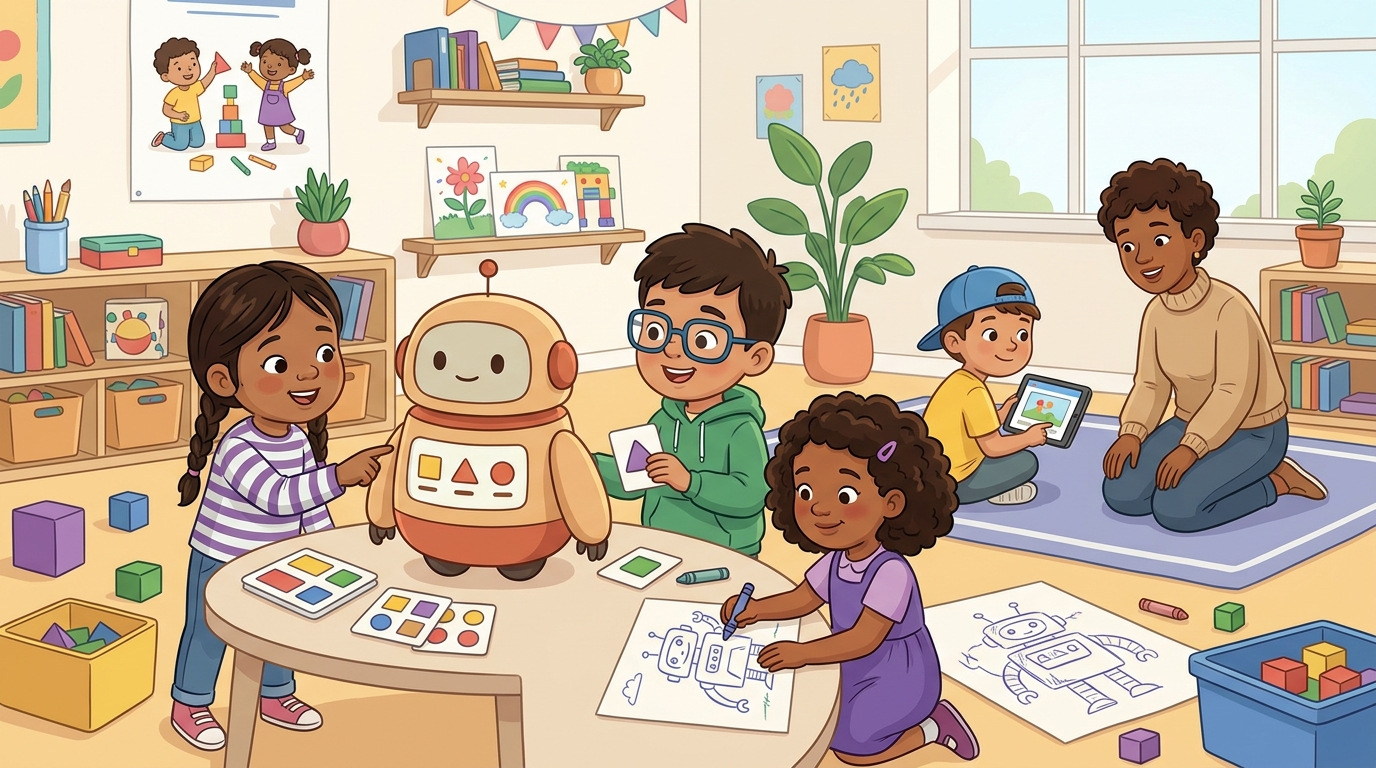
AI for K-3 can start with something children already know: the technology they use every day.
If your child has ever asked, “How does Alexa know what I said?”, “Why did YouTube show me that video?”, or “How does my phone recognize my face?”, they have already started noticing artificial intelligence.
Children today are growing up surrounded by technology that can recognize voices, recommend videos, identify pictures, translate languages, and respond to questions. They may not know the term “artificial intelligence” yet, but they are already interacting with systems that use it.
That raises an important question for parents and teachers:
How can young children learn about AI without making it complicated or overwhelming?
For children in Kindergarten through Grade 3, AI for K-3 does not need to begin with programming lessons, complicated technical explanations, or long lectures about algorithms.
At this age, AI learning can begin with something much simpler: play, stories, questions, drawing, patterns, and everyday experiences.
The goal is to help children become curious and thoughtful about the smart machines they see around them.
What Does AI Mean for a Young Child?
For AI for K-3, you can start with a simple idea:
Artificial intelligence can sound like a big and complicated subject.
For a young child, however, you can start with a simple idea:
AI is technology that can learn from information and use what it has learned to do certain tasks.
For example, a child might already have seen AI in:
- Voice assistants that answer questions
- Video or music recommendations
- Face recognition on phones
- Smart cameras
- Translation tools
- Educational apps
- Some games and toys
You do not need to explain exactly how these systems work.
Instead, start with questions children can understand:
“How do you think the computer knew that?”
“Did a person tell it exactly what to do?”
“Can a computer make a mistake?”
These simple questions can turn an ordinary moment with technology into a learning opportunity.
Why Does AI for K-3 Matter?
Children do not need to become AI experts at age six or seven.
What they do need is a foundation for understanding the technology that is becoming part of everyday life.
Early AI for K-3 learning can help children develop several important habits.
1. Curiosity
This is one of the simplest ways to make AI for K-3 engaging for young learners.
Children naturally ask questions.
Instead of giving them every answer immediately, AI learning can encourage them to investigate how technology works.
For example:
“The app recommended this video. Why do you think it chose it?”
That one question can lead to a conversation about patterns, choices, and information.
2. Critical Thinking
AI can sometimes give incorrect answers or make mistakes.
Children can begin learning that just because a computer says something does not automatically mean it is true.
A simple classroom or family question could be:
“How could we check if the computer is right?”
This introduces an important habit: check before you trust.
3. Pattern Recognition
Patterns are a natural starting point for AI for K-3 learning.
Young children already work with patterns in mathematics, language, music, and games.
You could give them a simple pattern and ask:
“What comes next?”
Then explain:
“Computers can also look for patterns in information.”
The activity stays playful while introducing a basic idea behind many AI systems.
04. Creativity
Creativity is an important part of AI for K-3, because children can imagine how technology might help people.
AI education should not only be about understanding machines.
Children should also have opportunities to create.
They can:
- Draw their own robot
- Invent a smart toy
- Design a machine that helps people
- Create a story about a robot
- Draw a machine that solves a classroom problem
ASK YOUR CHILD:
“If you could create a smart machine, what would you want it to help with?”
The answer can reveal how children think about problems, people, and technology.
Start With the AI Children Already Know
Everyday technology gives parents an easy starting point for AI for K-3 conversations.
One of the easiest ways to introduce AI is to look around.
You may not even need a special device or AI lesson.
Think about a normal day.
A child wakes up and asks a voice assistant a question.
Later, a video app recommends something to watch.
A phone recognizes a face.
A game responds to what the player does.
A camera detects a person.
A translation tool changes words from one language to another.
These everyday moments can become small learning experiences.
Instead of saying:
“Today we are going to learn about artificial intelligence.”
Try:
“Did you notice what the phone just did? How do you think it did that?”
That feels much more natural to a young child.
PARENT TIP
You do not have to turn every interaction with technology into a formal lesson. A short conversation can be enough.
The goal is to encourage children to notice technology and become curious about how it works.
Teach AI Through Stories
Stories can make AI for K-3 concepts easier for children to understand.
Stories are one of the easiest ways to introduce complicated ideas to young children.
Imagine a story about a little robot called Milo.
Milo wants to sort a box of toys.
There are cars, balls, books, and blocks everywhere.
At first, Milo gets confused.
After looking at many examples, Milo starts noticing patterns.
Cars usually have wheels.
Balls are round.
Books have pages.
Now ask the child:
“How did Milo learn to sort the toys?”
This gives children a simple way to think about learning from examples without introducing technical terminology.
You can continue the story by asking:
“What happens if Milo sees a toy he has never seen before?”
Now children have an opportunity to think about uncertainty, mistakes, and the limits of smart machines.
KEY IDEA
Stories allow children to explore how AI works without requiring them to understand complicated technical concepts.
Drawing Can Become an AI Activity
For young children, a pencil and paper can sometimes be more useful than a complicated digital tool.
TRY THIS: Draw Your Smart Machine
Ask your child to imagine a machine that could help people.
They might draw:
- A robot that helps clean a classroom
- A machine that helps find lost toys
- A smart garden that reminds people to water plants
- A robot that helps older people
- A machine that sorts recycling
Then ask three questions:
“What does your machine do?”
“Who does it help?”
“What could go wrong?”
The first two questions encourage creativity.
The third introduces critical thinking.
Children begin to understand that technology can be useful while still having limitations.
PARENT TIP
There does not need to be a “correct” drawing.
The important part is the conversation your child has while explaining their idea.
Teach Children That AI Can Make Mistakes
One of the most important lessons in AI for K-3 learning is that computers are not always correct.
TRY THIS: Find the Mistake
Show your child several pictures of animals and ask them to sort them into groups.
Then deliberately include a tricky example.
Ask:
“Would a computer always get this right?”
You can explain that AI systems learn from information and examples, and sometimes that information can be incomplete, unclear, or misleading.
This gives children an important message:
Technology can be helpful, but people still need to think.
That idea can become increasingly important as children grow older and begin using more advanced AI tools
What Parents Should Avoid When Teaching AI for K-3
AI education for young children does not need to become another academic burden.
Avoid making it too technical too early.
Children do not need to memorize definitions such as:
- Machine learning
- Neural networks
- Large language models
- Deep learning
Those concepts can come later.
For K–3, focus on the foundations:
Notice. Explore. Question. Create.
Also avoid presenting AI as either completely magical or completely dangerous.
Children can learn a more balanced message:
AI can be useful. AI can make mistakes. People are responsible for how technology is used.
PARENT TIP
Follow your child’s curiosity.
If your child wants to know how a voice assistant works, explore it together.
If they would rather draw a robot, let them draw.
If they ask a difficult question, it is perfectly fine to say:
“I am not sure. Let’s find out together.”
Learning about AI does not have to feel like another school assignment.
AI Learning Should Still Feel Like Childhood
Perhaps the most important point is this:
Children do not need to stop being children in order to learn about AI.
They can learn through stories.
They can draw.
They can build things.
They can play guessing games.
They can solve puzzles.
They can ask silly questions.
They can imagine robots.
They can make mistakes.
And they can wonder, “How does that work?”
Those are not distractions from AI education.
For young children, they are the starting point.
The purpose of AI for K-3 education is not to turn a six-year-old into a programmer.
Instead, AI for K-3 learning should help children grow up understanding that technology is something they can question, explore, use responsibly, and eventually help shape.
Explore Age-Appropriate AI Learning With ChimpVine
For families and educators who want a more structured way to introduce AI concepts to young children, ChimpVine’s K–3 AI learning approach focuses on exploration, imagination, creativity, patterns, stories, and critical thinking.
The aim is to give young learners an age-appropriate introduction to AI without making the subject unnecessarily technical.
Explore the K–3 AI curriculum
https://www.chimpvine.com/ai-curriculum-grades-k-3/
External Resources Parents Can Explore
Parents who want to learn more about AI, children, and age-appropriate AI education can explore these resources.
UNESCO: AI Competency Framework for Students
UNESCO’s AI Competency Framework for Students provides a broader framework for understanding the knowledge, skills, values, and competencies students can develop as they learn about artificial intelligence.
Explore the UNESCO AI Competency Framework for Students
https://www.unesco.org/en/articles/ai-competency-framework-students
UNICEF: Guidance on AI and Children
UNICEF’s Guidance on AI and Children looks at how artificial intelligence can affect children’s safety, privacy, fairness, inclusion, well-being, and development.
Read UNICEF’s Guidance on AI and Children
https://www.unicef.org/innocenti/reports/policy-guidance-ai-children
Common Sense Education: AI Literacy Toolkit for Families
Common Sense Education provides family-friendly resources that can help parents and children learn about AI through activities, videos, conversation starters, and practical guidance.
Explore the AI Literacy Toolkit for Families
https://www.commonsense.org/education/families-ai-literacy-toolkit
Day of AI: Family and Educator Resources
Day of AI offers educational resources that help children and educators explore artificial intelligence through lessons and activities designed for different age groups.
Explore Day of AI Resources
UNICEF: AI for Children
UNICEF’s AI for Children resources explore the opportunities and challenges artificial intelligence creates for children, including questions around children’s rights, safety, and development.
Explore UNICEF’s AI for Children Resources