How Parents Can Help Their Children Learn AI?
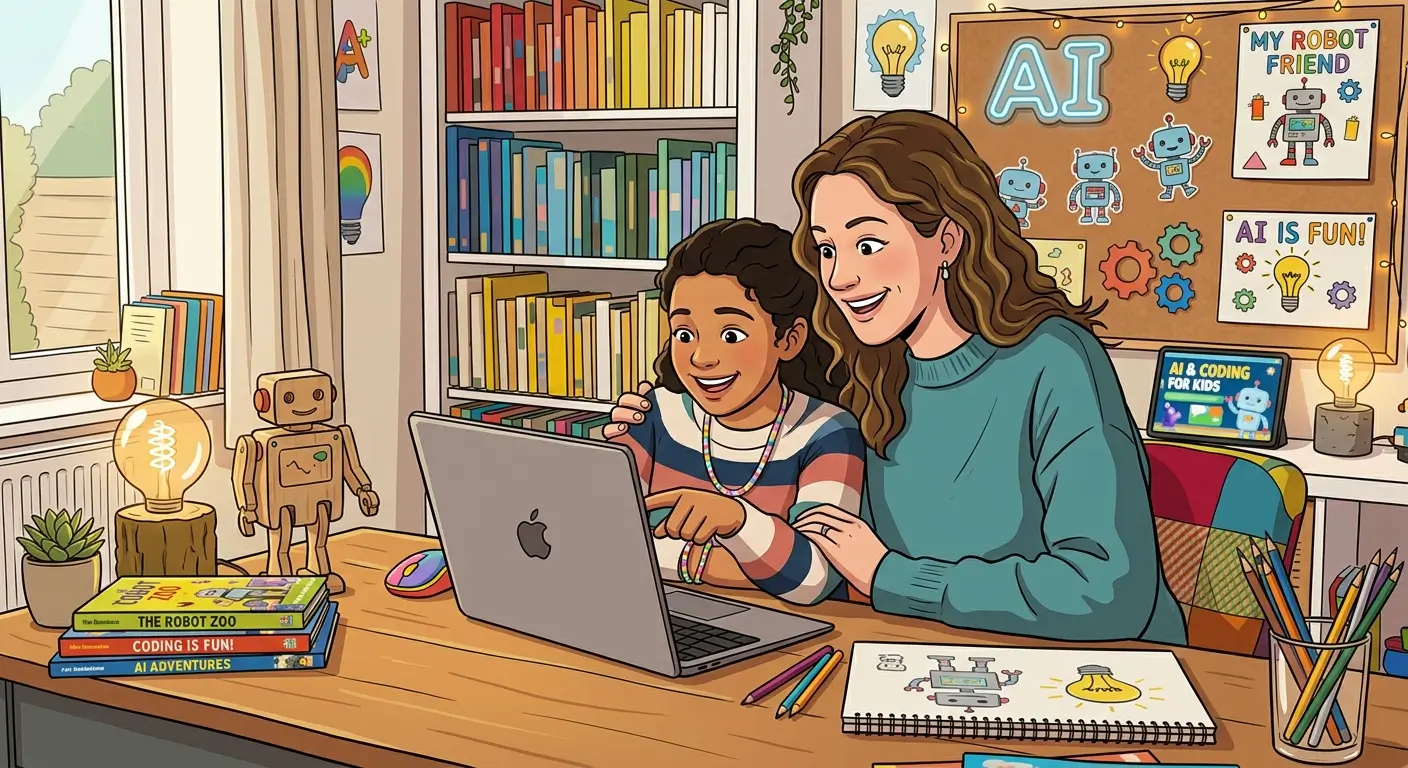
Parents help children learn AI by making artificial intelligence understandable, age-appropriate, and connected to everyday life. Children do not need to become programmers to start learning about AI. They need opportunities to ask questions, recognize how AI works, think critically about its answers, and understand how to use technology responsibly.
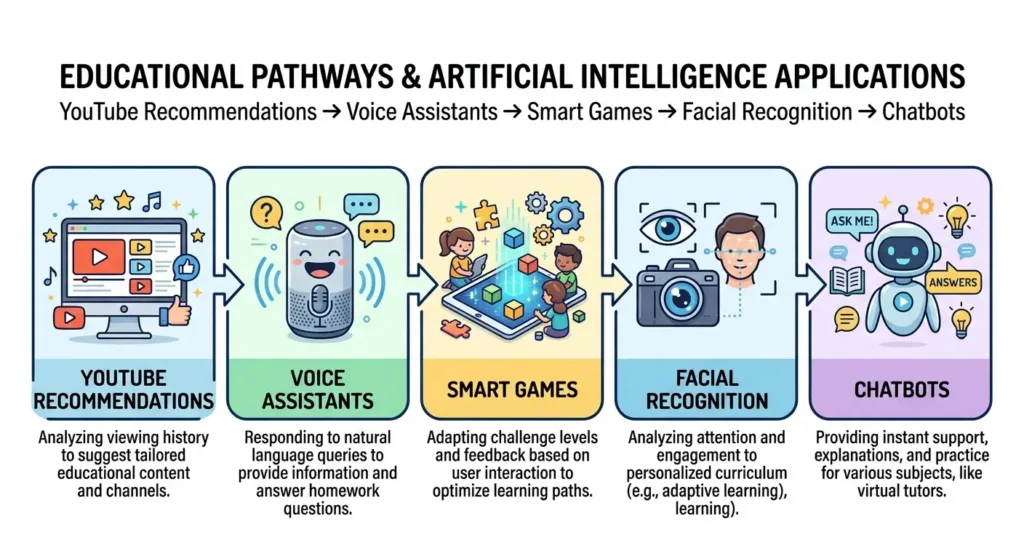
Artificial intelligence is already part of children’s everyday experiences. Recommendation algorithms decide which videos appear in feeds, voice assistants respond to questions, games adapt to players, and generative AI can create text, images, and other content.
That makes AI education more than a future preparation exercise. It is becoming part of digital literacy.
UNESCO’s AI Competency Framework for Students identifies competencies across human-centred thinking, AI ethics, AI techniques and applications, and AI system design. The framework also emphasizes progression from understanding to applying and eventually creating with AI.
For parents, the goal is not to put an AI chatbot in front of a child and tell them to experiment. The goal is to help children develop the knowledge and judgment they need to understand AI before relying on it.
This guide explains practical ways parents can support that process at home.
Why Should Parents Help Children Learn AI?
AI literacy is becoming an important part of education because children are growing up surrounded by systems that use artificial intelligence.
A child may interact with AI without realizing it.
When a video platform recommends another video, an algorithm is making a prediction. When a photo app recognizes a face, AI may be involved. When a game adjusts its difficulty, an intelligent system may be responding to the player’s behavior.
Children therefore need more than the ability to operate technology.
They need to understand what technology is doing.
Common Sense Education describes AI literacy as understanding what AI is, how it works, its benefits and risks, and how people can use it responsibly.
This distinction is important.
Learning AI does not mean teaching children to use ChatGPT or another chatbot as early as possible. It means developing foundational knowledge, critical thinking, digital citizenship, creativity, and responsible technology habits.
UNICEF’s updated guidance on AI and children also emphasizes safety, privacy, fairness, transparency, well-being, inclusion, and preparing children for developments in AI.
Parents can contribute to these skills long before children begin using advanced AI tools.
What Does AI Education Look Like for Children?
AI education should change as children grow.
A kindergarten student does not need a technical explanation of neural networks. A fourth grader can begin exploring patterns and how machines learn from examples. Older students can investigate bias, privacy, misinformation, generative AI, and ethical decision-making.
The foundation should come first.
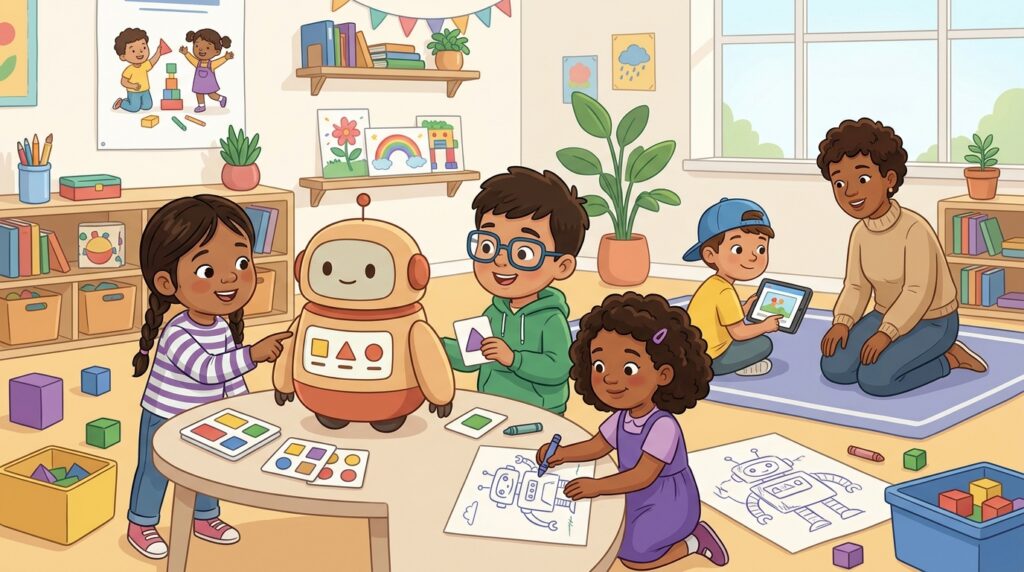
For younger children, AI education can involve:
- Recognizing smart machines
- Finding examples of AI in everyday life
- Understanding patterns
- Sorting and classification games
- Storytelling and creative activities
- Learning the difference between human and machine abilities
- Developing curiosity about technology
For older elementary students, parents can introduce:
- How AI learns from data
- Why AI can make mistakes
- Algorithms and recommendations
- AI-generated content
- Privacy and personal information
- Bias and fairness
- Deepfakes and misinformation
- Responsible AI use
- Human creativity versus machine-generated content
The objective is progressive AI literacy rather than early exposure to complicated tools.
7 Practical Ways Parents Help Children Learn AI
1. Start With AI They Already See
One of the easiest ways parents help children learn AI is by starting with technology children already encounter.
Ask questions such as:
“Why do you think this video was recommended to you?”
“How does your phone know which face is yours?”
“Why does the game become easier or harder?”
“How does a voice assistant understand what you said?”
These questions turn ordinary technology into learning opportunities.
Children do not need a textbook definition of artificial intelligence to begin thinking about AI.
They need to become curious about how technology makes decisions.
For example, if a child receives a recommendation for a particular video, discuss what information the system might have used.
Maybe the child watched similar videos before.
Maybe other people with similar viewing habits watched it.
Maybe the platform identified a pattern.
This simple conversation introduces an important AI concept: prediction based on data.
2. Teach Children That AI Is Not Always Right
One of the most important lessons children can learn is that AI can make mistakes.
AI systems do not possess human understanding in the same way people do. Their outputs depend on their training, data, design, and the context in which they are used.
An AI system can provide an incorrect answer while sounding extremely confident.
That makes critical thinking essential.
Try a simple family activity.
Ask an AI system a factual question and then investigate the answer together using reliable sources.
The lesson should not be:
“AI is bad.”
Instead, teach:
“AI can be useful, but we should check important information.”
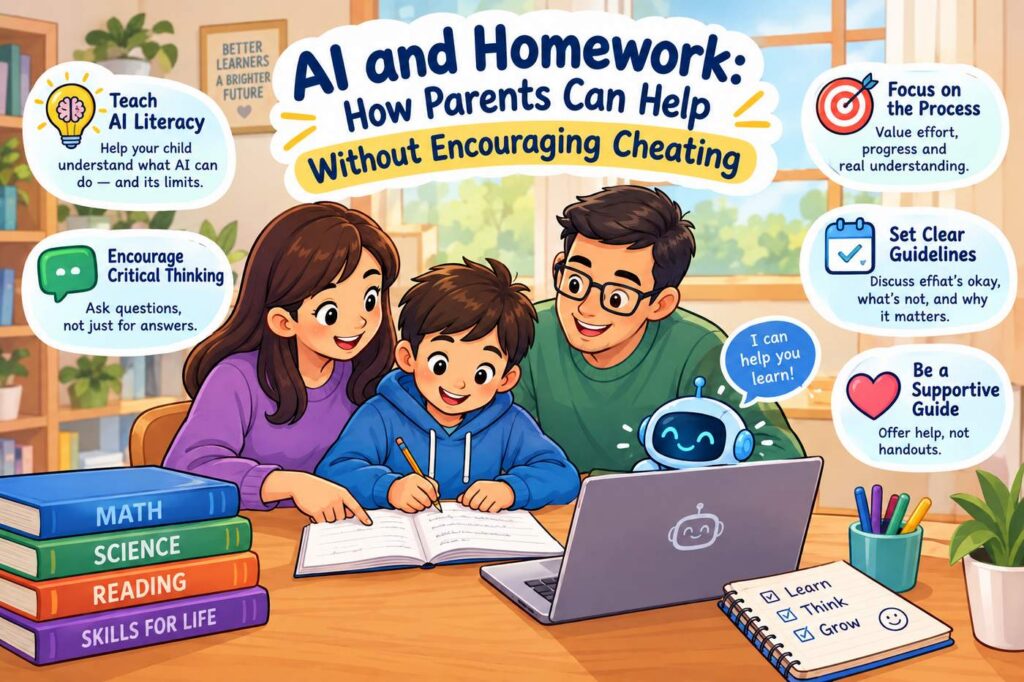
This habit becomes increasingly valuable as children begin using AI for school research.
Common Sense Education similarly emphasizes helping students understand AI’s capabilities and limitations and teaching them how to evaluate whether AI-generated information is trustworthy.
3. Turn AI Learning Into Games
Children learn effectively when concepts become interactive.
Parents can create simple AI-inspired games without needing specialized software.
Pattern Detective
Place several objects in groups and ask your child to identify the pattern.
For example:
- Apple
- Banana
- Apple
- Banana
- ?
The child predicts what comes next.
Then explain that computers can also identify patterns from examples.
Human or Machine?
Show your child different tasks and ask whether a human, machine, or both might be better suited for each one.
For example:
- Recognizing thousands of images
- Telling a bedtime story
- Detecting a mathematical pattern
- Comforting a friend
- Calculating large amounts of data
- Deciding whether something is morally fair
This activity teaches children that AI has strengths and limitations.
Recommendation Game
Pretend to be an algorithm.
Ask your child questions about their favorite books, games, foods, or videos. Then make a recommendation based on their answers.
Explain that many recommendation systems similarly use patterns in information to make predictions.
These activities require no coding and can be completed in a few minutes.
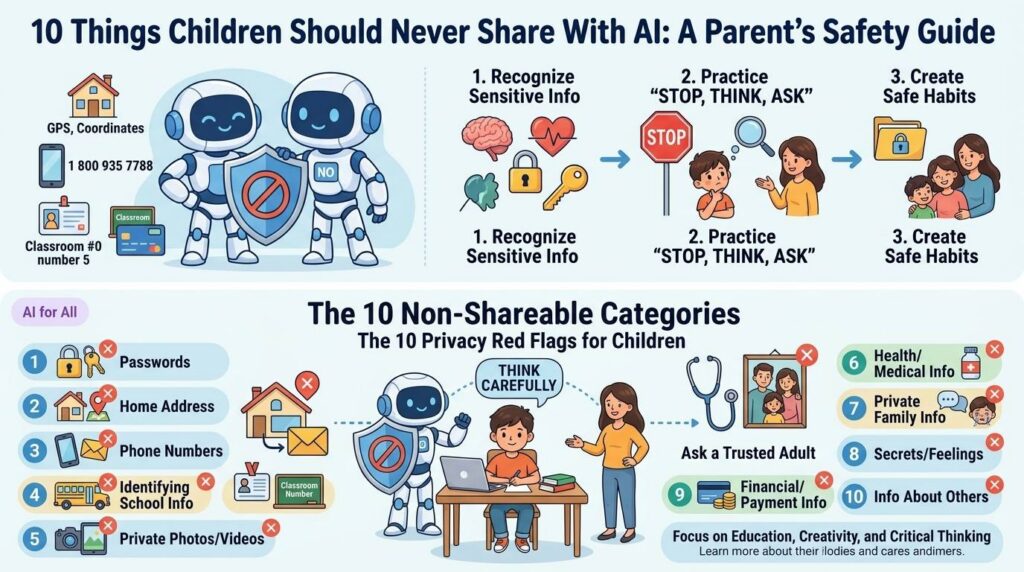
4. Teach Children to Protect Their Privacy
AI education should include privacy from the beginning.
Children need to understand that personal information has value.
Teach them to think carefully before entering information into an online service.
Depending on their age, explain that information such as:
- Full name
- Home address
- Phone number
- Passwords
- School details
- Personal photographs
- Location
- Family information
should not automatically be shared with online systems.
Parents should also explain that not every AI tool is designed for children.
Common Sense Education notes that many AI tools have age restrictions and that parents should consider privacy, misinformation, bias, mature content, and other risks when deciding how children interact with AI.
UNICEF likewise identifies children’s data privacy and safety as important elements of child-centred AI.
The exact rules should depend on the child’s age and the particular service.
5. Encourage Questions Instead of Passive Consumption
Children should not simply consume AI-generated content.
They should question it.
When your child encounters an AI-generated image, ask:
“How do you know this picture is real?”
When they receive an AI-generated answer, ask:
“What evidence supports that answer?”
When an algorithm recommends something, ask:
“Why do you think the system chose this?”
This develops an investigative mindset.
It also teaches an important principle:
Technology should be questioned, not blindly trusted.
That principle will remain useful even as AI systems become significantly more capable.
6. Use AI for Creativity, Not Just Answers
AI education becomes more valuable when children use technology as a creative partner rather than an answer machine.
Depending on age and appropriate supervision, children can explore:
- Story ideas
- Drawing concepts
- Character design
- Brainstorming
- Simple puzzles
- Creative writing
- Classification activities
- Image recognition concepts
- Design challenges
The parent should remain involved.
Instead of saying:
“Ask AI to write your story.”
Try:
“Create your own story first. Then let’s see how an AI system approaches the same idea.”
Now the child can compare human creativity with machine-generated content.
This approach protects an important part of learning: the child’s own thinking.
7. Make AI Learning a Family Activity
Parents do not need to be AI experts.
They can learn alongside their children.
Set aside 20–30 minutes each week for an AI-related activity.
One week could focus on recommendations.
The next could explore patterns.
Another could examine AI-generated images.
Another could discuss privacy.
Another could involve an AI-related creative project.
This makes AI education a conversation rather than another homework assignment.
Common Sense Education offers a free AI Literacy Toolkit for Families containing videos, family activities, conversation guides, and resources for parents and caregivers.
How Parents Can Help Children Learn AI Without Giving Them Unlimited AI Access
Learning about AI and using AI are not the same thing.
A child can learn how machine learning works without independently using a generative AI chatbot.
This distinction is particularly important for younger children.
Parents can introduce concepts through:
- Offline games
- Books
- Classroom activities
- Educational videos
- Supervised demonstrations
- Hands-on projects
- Discussions
- Simple experiments
For young learners, understanding the concept is more important than accessing the latest AI tool.
Common Sense Education’s guidance for families recommends foundational AI literacy and notes that generative AI tools may have age restrictions and other risks that parents should consider.
Parents should therefore check the age requirements and privacy policies of individual services before allowing children to use them.
What Should Parents Teach About AI Safety?
AI safety should be treated as part of AI literacy, not as a separate topic.
Children should gradually learn five core principles.
Privacy
Do not share sensitive personal information with AI systems or unknown online services.
Verification
Important information should be checked against trustworthy sources.
Human Judgment
AI can provide suggestions, but people remain responsible for decisions.
Fairness
AI systems can reflect problems in the data or assumptions used to create them.
Digital Citizenship
Technology should be used in ways that respect other people.
These ideas become increasingly important as children encounter AI-generated images, videos, text, recommendations, and conversational systems.
UNICEF’s AI guidance specifically highlights safety, privacy, fairness, transparency, accountability, inclusion, and children’s well-being as core considerations.
Choose Age-Appropriate AI Learning
Parents should also avoid treating every child as if they need the same AI curriculum.
Kindergarten to Grade 3
Younger children benefit from exploration and play.
At this stage, parents can focus on:
- What AI is
- Where smart technology appears
- Patterns
- Classification
- Creativity
- Communication
- Problem-solving
- Teamwork
- Safe technology habits
ChimpVine’s AI Curriculum for Kindergarten–Grade 3 is designed around this type of age-appropriate exploration. The program uses hands-on projects, creative activities, games, and challenges to introduce AI concepts while developing critical thinking, communication, creativity, confidence, and teamwork.
For parents looking for a structured starting point:
Explore ChimpVine’s AI Curriculum for Kindergarten–Grade 3
Grades 4–5
Older elementary students can begin investigating how AI works in greater depth.
They can explore:
- How AI learns from data
- Human versus AI capabilities
- Patterns and predictions
- AI decision-making
- Privacy
- Fairness
- Deepfakes
- Responsible technology use
- Creative AI projects
ChimpVine’s AI Curriculum for Grades 4–5 uses hands-on activities, games, debates, puzzles, and real-world scenarios. The curriculum covers AI capabilities and limitations, data and patterns, fairness and safety, privacy, deepfakes, and responsible AI use.
For parents of older elementary learners:
Explore ChimpVine’s AI Curriculum for Grades 4–5
The advantage of a structured curriculum is that children do not have to learn AI randomly.
They can progress from basic concepts toward more sophisticated ideas in an age-appropriate sequence.
Parents Do Not Need to Be AI Experts
One concern many parents have is:
“I don’t know enough about AI to teach my child.”
That should not stop the conversation.
Parents do not need to explain the mathematics behind a neural network to help a child develop AI literacy.
Your role is often to ask good questions.
For example:
What do you think AI is doing here?
How could we check that answer?
What information might this system need?
Could the AI be wrong?
Is this fair?
Should we share this information?
Would you make the same decision without AI?
These questions encourage children to think critically.
In fact, learning alongside your child can be more effective than presenting yourself as the person with every answer.
If you don’t know something, say:
“I don’t know. Let’s investigate it together.”
That models exactly the kind of curiosity and responsible technology use you want your child to develop.
How Schools and Parents Can Work Together?
AI education should not exist only at home.
Parents can ask schools:
- Does the school have an AI policy?
- How is AI taught?
- Which AI tools are permitted?
- How are students taught to verify AI-generated information?
- How does the school address privacy?
- How does the school handle AI-assisted assignments?
Common Sense Education recommends that schools make AI expectations clear to families and involve parents and caregivers in AI literacy efforts.
UNESCO’s competency framework also provides a useful reference for understanding how AI learning can progress from basic understanding to application and creation.
When parents and schools use consistent language around responsible AI use, children receive clearer guidance.
A Simple Weekly AI Learning Plan for Parents
Parents do not need to dedicate hours every week.
A simple 30-minute routine can work well.
Week 1: Find AI
Ask your child to identify five examples of AI or algorithmic technology they encounter during the day.
Week 2: Find Patterns
Play a pattern-recognition game and discuss how computers can learn patterns from examples.
Week 3: Test an AI Answer
Take an AI-generated answer and verify it using reliable sources.
Week 4: Explore Creativity
Create a story, drawing, invention, or design and compare it with an AI-generated alternative where appropriate and age-safe.
Week 5: Discuss Privacy
Talk about what information should and should not be shared online.
Week 6: Discuss Fairness
Give your child a simple scenario involving an automated decision and ask whether the decision seems fair.
Week 7: Become an AI Detective
Show examples of generated or manipulated content and discuss how people can determine whether something is trustworthy.
Week 8: Build Something
Let your child create an AI-inspired project, presentation, poster, story, or game.
The purpose is not to turn children into AI engineers overnight.
The purpose is to build familiarity, curiosity, skepticism, and confidence.
Common Mistakes Parents Should Avoid
Making AI Sound Like Magic
AI is impressive, but it is not magic.
Explain that AI systems are created by people and operate using data, algorithms, models, and computing systems.
Giving AI Too Much Authority
Children should never learn that an AI answer is automatically correct.
Teach verification.
Using AI to Do All the Work
If AI writes every story, solves every problem, and answers every question, children lose opportunities to develop their own skills.
AI should support learning, not replace learning.
Ignoring Ethics
AI education should not focus exclusively on tools and technical abilities.
Children should also learn about fairness, privacy, misinformation, safety, and human responsibility.
Introducing Tools Without Checking Age Requirements
Before allowing a child to use an AI service, parents should review the service’s age requirements, privacy practices, and safety controls.
Treating AI Education as a One-Time Lesson
AI will continue changing.
Children need an ongoing learning process rather than a single introduction.
External Resources Parents Can Explore
Parents who want to go deeper can use several reliable resources.
UNESCO – AI Competency Framework for Students
A framework covering human-centred thinking, AI ethics, AI techniques and applications, and AI system design.
Read the UNESCO AI Competency Framework
UNICEF – Guidance on AI and Children
A comprehensive resource covering children’s safety, privacy, fairness, transparency, inclusion, well-being, and preparation for AI.
Read UNICEF’s Guidance on AI and Children
Common Sense Education – AI Literacy Toolkit for Families
A practical collection of videos, activities, and conversation guides for families.
Explore the AI Literacy Toolkit for Families
Common Sense Education – When Families Ask About AI
A useful guide covering common questions parents have about children and AI.
Read When Families Ask About AI