AI Games and Activities: 7 Fun, Easy Ideas to Try at Home
Introduction
Rainy afternoon, long car ride, or just a slow weekend — these are exactly the moments when AI games and activities can turn into genuinely fun family time, not just screen time. Best of all, most of these ideas need little to no technology at all.
Unlike homework-focused AI learning, home-based AI games and activities are all about curiosity and play. Kids get comfortable with how AI “thinks” — patterns, instructions, guesses, and mistakes — without ever feeling like they’re being taught a lesson.
Here are 7 fun, easy AI games and activities the whole family can try at home this week.
Why Play-Based AI Games and Activities Work So Well
Games are one of the most natural ways children learn new ideas, and AI games and activities are no exception. Playing builds understanding in ways that lectures can’t:
- Mistakes feel like part of the fun, not failure
- Concepts get repeated naturally through replay
- Parents and kids learn together, side by side
- Curiosity leads the activity instead of a worksheet
Organizations like AI4K12, a U.S. initiative developing national AI literacy guidelines for kids, emphasize exactly this kind of hands-on, age-appropriate exposure as a foundation for later AI understanding.
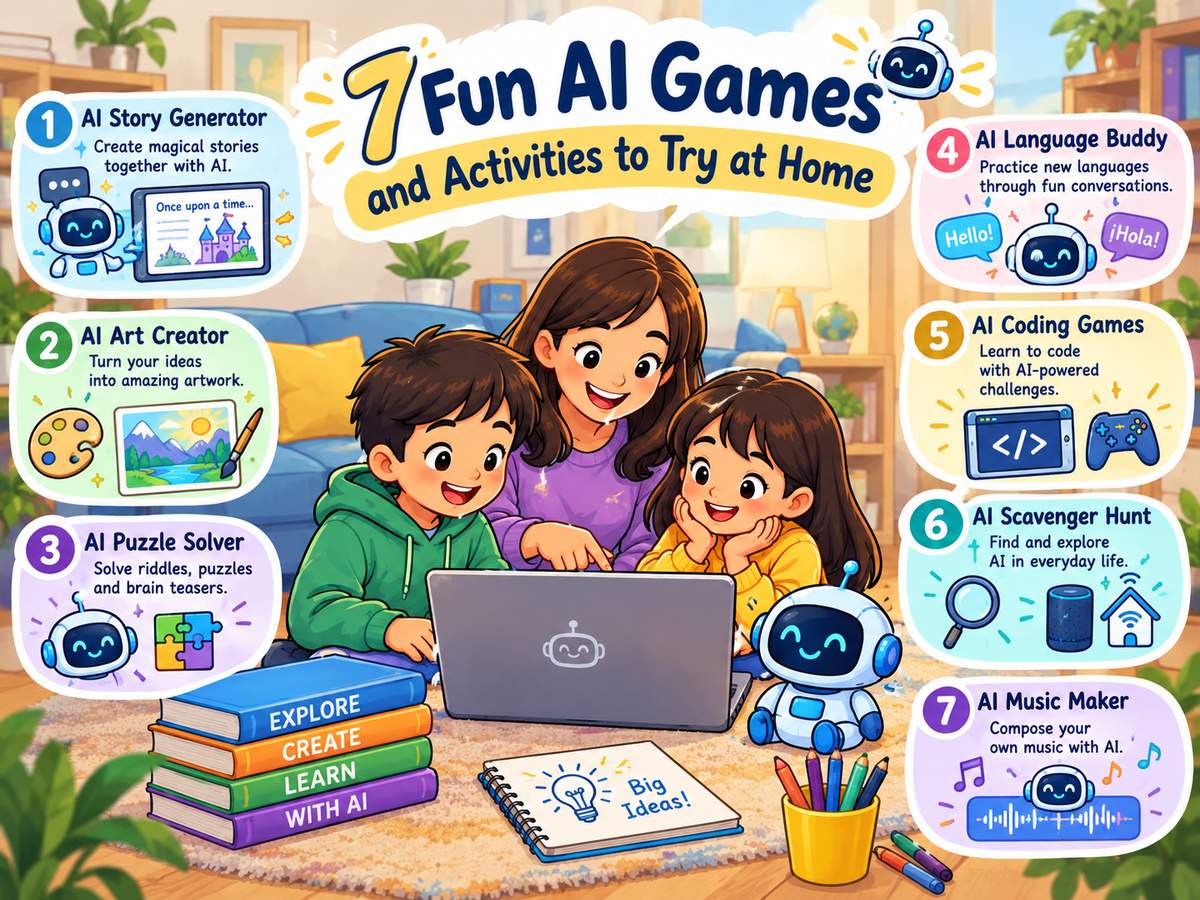
7 Fun AI Games and Activities to Try at Home
1. “Guess the Pattern” Card Game
Lay out a sequence of cards, colors, or objects with a hidden pattern (like red-blue-blue-red-blue-blue) and have your child guess what comes next.
After a few rounds, explain that this is very similar to how some AI tools “learn” — by looking at lots of examples and finding patterns, then making a prediction.
What you’ll need: A deck of cards, colored blocks, or even household objects.
Why it’s fun: It plays like a simple guessing game, but sneaks in a real AI concept — pattern-based prediction.
2. Robot Says (A Twist on Simon Says)
Play a version of “Simon Says” where the “robot” (one player) can only follow instructions exactly as worded — no interpreting, no assuming.
If someone says “jump” without saying how many times, the robot jumps just once and stops, waiting for a clearer instruction. This playful twist teaches kids that AI systems follow instructions literally, which is why clear input matters.
What you’ll need: Nothing — just open space to move around.
Why it’s fun: The literal-instruction twist creates funny, unexpected moments that make the lesson memorable.
3. AI Voice Assistant Trivia Night
Turn a household voice assistant into a mini game show host. Take turns asking it trivia questions, then guess as a family whether the answer is correct before checking.
This turns “was the AI right?” into a genuinely fun guessing game, while quietly building the habit of double-checking AI answers.
What you’ll need: Any voice assistant device, plus a simple list of trivia questions and answers to check against.
Why it’s fun: It has the energy of a real trivia night, with an extra twist of fact-checking the “AI contestant.”
4. Build-a-Robot Craft Challenge
Using recycled materials — boxes, bottle caps, string — challenge kids to build a “robot” that solves a specific problem, like reminding someone to drink water or helping tidy a room.
Ask them to explain what their robot would need to “know” or “sense” to do its job. This introduces the idea that AI systems need data and sensors to function.
What you’ll need: Recycled craft materials, tape, and markers.
Why it’s fun: It combines hands-on crafting with imaginative problem-solving — a favorite combination for most kids.
5. “Human or AI?” Guessing Game
Read out a mix of short, simple statements or short answers — some written by a person, some by an AI tool — and have family members guess which is which.
This works especially well with silly, kid-friendly writing prompts, like describing a pet’s daily routine.
What you’ll need: A few pre-written examples from both a person and an AI tool (with parent supervision when generating AI examples).
Why it’s fun: The reveal moment is genuinely entertaining, and it’s often surprising how tricky the guessing turns out to be.
6. AI Art Guess-and-Draw
With parental supervision, use an age-appropriate AI image tool to generate a picture from a simple description, then have your child try to draw the same description themselves before seeing the AI’s version.
Compare the two afterward — what’s similar, what’s different, what surprised them.
What you’ll need: A supervised, school-appropriate AI image tool and drawing supplies.
Why it’s fun: Comparing a child’s imagination to the AI’s interpretation almost always leads to laughter and interesting conversation.
7. Family “Would AI Get This Right?” Challenge
Pick a handful of everyday questions — some AI is good at (like simple math), some it can struggle with (like understanding a joke or a feeling) — and have the family predict which ones an AI would answer well.
Then test a few, if you have access to a supervised AI tool, and see how the predictions held up.
What you’ll need: A short list of prepared questions, and optionally a supervised AI tool to test answers.
Why it’s fun: It turns “AI’s strengths and weaknesses” into a prediction game with a satisfying reveal.
Keeping AI Games and Activities Safe and Age-Appropriate
A few simple guardrails make these AI games and activities work well for any family:
Supervise anything involving open AI tools Activities using AI image generators or open chat tools should be adult-led, especially with younger children.
Match activities to your child’s age Younger children do best with fully unplugged games like Robot Says and the pattern card game; older kids can handle the AI art comparison and trivia-checking activities more independently.
Keep the tone playful, not test-like The goal is curiosity, not correct answers — resist the urge to turn these into quizzes with “right” and “wrong.”
Talk about what you notice together The conversation after each activity — what was surprising, what was funny, what the AI got wrong — often builds more understanding than the activity itself.
If you’re looking for a more structured, classroom-style approach, our AI Activities for Primary School Students guide covers additional ideas designed for school settings. And if these games spark a broader conversation at home about screen time and technology use, our AI and Homework guide covers how to navigate AI use for schoolwork specifically.
Turning AI Games and Activities Into a Regular Habit
A single fun afternoon is a great start, but AI games and activities tend to build the most understanding when they become a small, recurring habit rather than a one-off.
A few easy ways to keep it going:
- Pick one activity a week. Rotate through the list above instead of trying everything at once — repetition helps ideas like “pattern prediction” or “literal instructions” really sink in.
- Let kids pick the next one. Giving children a say in which activity comes next builds ownership and keeps enthusiasm high.
- Keep a simple “AI notebook.” After each activity, jot down one thing that surprised everyone. Over time, this becomes a fun record of how your family’s understanding of AI has grown.
- Mix in real-world spotting. Between activities, casually point out AI in daily life — a map suggesting a route, a photo app organizing pictures — to reinforce that these games connect to the real world, not just game night.
None of this needs to feel structured or school-like. The goal is simply making AI curiosity a normal, ongoing part of family life, the same way you might build any other shared hobby.
Conclusion
AI games and activities don’t need special equipment, coding skills, or a lot of planning to be genuinely fun and genuinely educational. A pack of cards, a bit of imagination, and a willingness to play alongside your kids is often all it takes to build real curiosity about how AI works.
Try just one of these ideas this week — there’s a good chance it becomes a repeat request.
Related Source
AI4K12 — AI Literacy Guidelines for Kids AI4K12 is a U.S. initiative, developed with the American Association for Artificial Intelligence and the Computer Science Teachers Association, focused on age-appropriate AI literacy guidelines for children.
Frequently Asked Questions
What are good AI games and activities for young kids? Fully unplugged options like Robot Says, pattern-guessing card games, and build-a-robot craft challenges work well for younger children and require no screens at all.
Do these AI games and activities require special apps or tools? No. Most of the ideas here use everyday household items. A few, like the AI art comparison, use a supervised AI tool, but that’s optional.
How much adult supervision do these activities need? Fully unplugged games can be played independently once explained, but any activity involving an open AI tool (like AI image generation or an open chat assistant) should always be supervised by an adult.
Can these activities be adapted for older kids too? Yes. Older children can handle more open-ended versions, like guessing human vs. AI writing, or predicting where AI tools are likely to succeed or struggle.
Why play AI games instead of just explaining how AI works? Play builds understanding through direct experience rather than explanation alone, which tends to be more memorable and enjoyable for children, especially at a young age.