AI and Homework: 7 Smart, Proven Tips for Parents
Introduction
It usually starts with a simple question at the kitchen table: “Can I just ask the AI?” For many parents, AI and homework has quickly become one of the trickiest new parts of helping with schoolwork not because AI is inherently bad, but because the line between “helpful support” and “doing it for them” isn’t always obvious.
The good news is that AI and homework don’t have to be at odds with real learning. With a few clear habits, parents can help their children use AI in ways that build understanding instead of replacing it.
This guide covers 7 practical, parent-tested tips for navigating AI and homework plus how to recognize when AI use has quietly crossed into cheating. For broader background on how kids are using generative AI day to day, Common Sense Media’s Parents’ Ultimate Guide to Generative AI is a solid starting point.
Why AI and Homework Is a Gray Area for Parents
AI and homework raises a genuinely new kind of question for parents. Looking over a shoulder to check spelling is clearly help. Copying an AI-written paragraph word-for-word into an essay is clearly cheating. But most real situations fall somewhere in between, such as:
- Asking AI to explain a concept before attempting the problem
- Using AI to check an answer after finishing the work
- Asking AI to “make this sound better” on a already-written paragraph
- Having AI generate practice questions similar to homework
Understanding where each of these falls is the first step to helping your child use AI and homework responsibly.
7 Smart, Proven Tips for AI and Homework
1. Learn the “Explain, Don’t Do” Rule Together
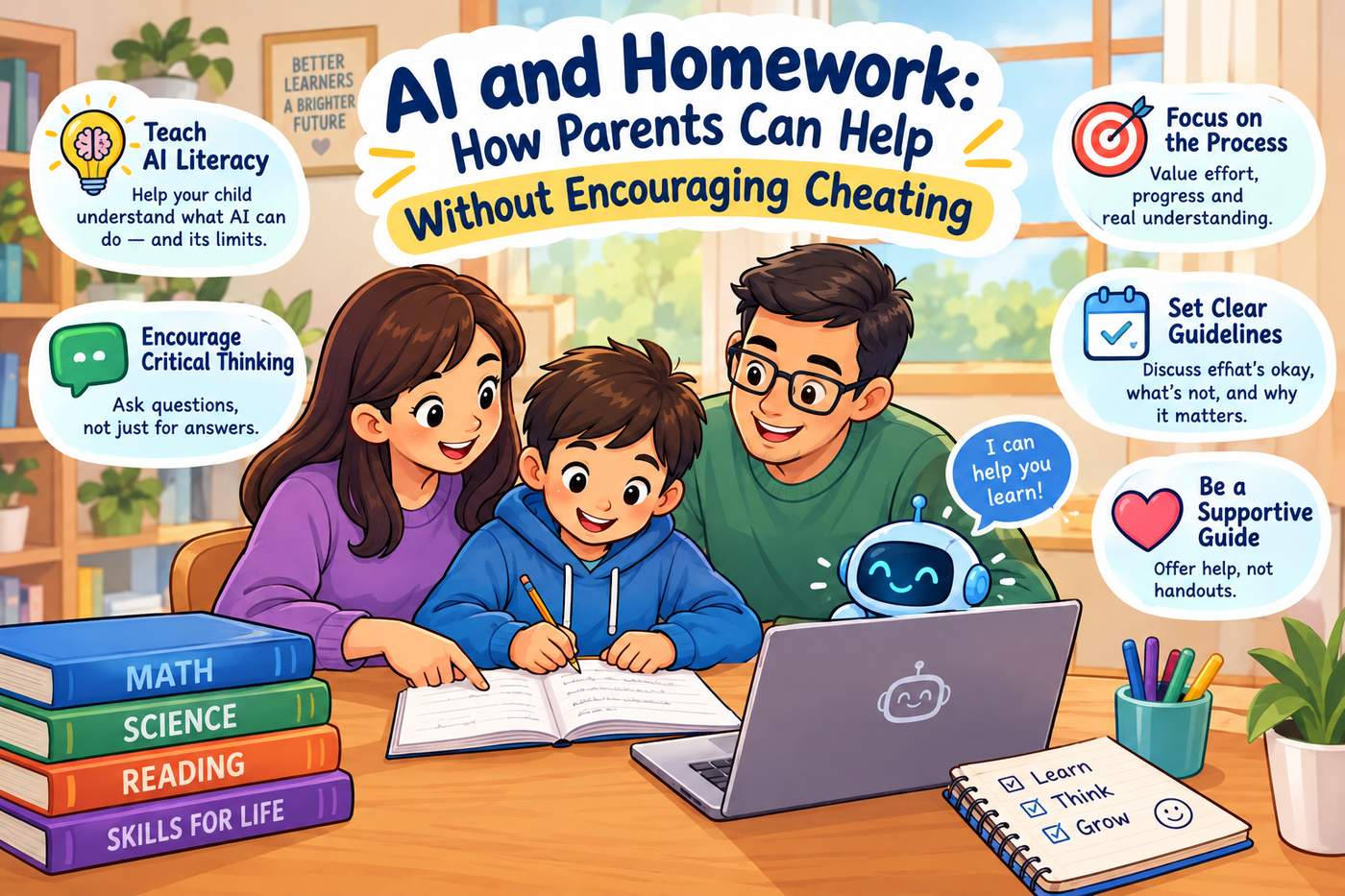
The simplest guideline for AI and homework is this: AI should explain a concept, not complete the assignment.
Sit down with your child and agree on this together for example, “You can ask AI to explain how fractions work, but you write and solve the actual problems yourself.” Having this rule stated clearly, rather than assumed, makes a real difference in how kids apply it.
Why it works: A shared, explicit rule is much easier for a child to follow consistently than a vague sense of “don’t overdo it.”
2. Ask to See the Process, Not Just the Answer
Instead of just checking if homework is “done,” ask your child to walk you through how they got an answer.
If AI was used, ask what it explained and how your child applied that explanation themselves. If they can’t explain their own homework, that’s a signal AI and homework use has tipped too far toward AI doing the work.
Why it works: This makes understanding visible, rather than assuming a completed worksheet means real learning happened.
3. Check Your School’s Specific AI Policy
Policies on AI and homework vary significantly between schools, teachers, and even individual assignments. Some allow AI for brainstorming but not writing; others ban it entirely for graded work.
Ask your child’s teacher directly, or check the school’s handbook, rather than guessing. This also models to your child that AI use has real rules to follow, not just personal judgment calls.
Why it works: Kids are far more likely to respect a rule they know is coming from the school, not just from a parent.
4. Use AI Together, at Least Sometimes
Sitting with your child while they use an AI tool for homework even occasionally gives you a much clearer picture of how they’re actually using it than checking finished work alone.
This also gives you natural opportunities to ask questions like “Is that explanation making sense to you?” or “How would you double-check that?”
Why it works: Co-using AI and homework tools together turns a private, hard-to-monitor habit into a shared, teachable moment.
5. Teach the “Would I Understand This If Asked?” Test
A simple self-check for kids: after finishing homework, could they explain it to a friend, a sibling, or a teacher without looking at their notes?
If an AI tool helped write or solve something they can’t explain themselves, that’s a clear sign the AI did too much of the work.
Why it works: This shifts the focus from “did I finish it” to “do I actually understand it,” which is the real goal of homework in the first place.
6. Watch for Warning Signs, Not Just Rule-Breaking
A few signs that AI and homework use may have crossed into cheating:
- Homework quality suddenly jumps far above a child’s usual writing level or vocabulary
- Your child can’t answer basic follow-up questions about their own work
- Assignments are finished unusually quickly with little visible effort
- Your child becomes defensive or evasive when asked how they completed something
None of these alone is proof of a problem, but together they’re worth a calm conversation rather than an accusation.
Why it works: Watching for patterns, not just policing individual assignments, catches problems earlier and with less conflict.
7. Frame AI as a Tool, Not a Shortcut or a Threat
How parents talk about AI and homework shapes how kids think about it. Framing AI purely as “cheating” can push kids to hide their use of it; framing it purely as a shortcut can encourage over-reliance.
A more balanced framing: AI is a tool that can help you understand something faster, but it can’t do the learning for you that part is still yours to do.
Why it works: Kids are more likely to use AI responsibly when they understand why the rule exists, not just that it exists.
What Real Learning Still Requires
Even with the best AI and homework habits in place, a few things AI genuinely can’t replace:
- Practicing a skill enough times to build real fluency
- Making and correcting your own mistakes
- Struggling with a hard problem long enough to build persistence
- Developing a personal writing voice through your own drafts
Parents can gently reinforce this by asking, after AI is used to explain something, “Now show me you can do it yourself.” For younger children, our AI Activities for Primary School Students guide offers age-appropriate ways to build this kind of AI literacy from an early age. For older students juggling more independent studying, our AI for Learning guide covers how to use AI as a genuine study partner rather than a shortcut.
A Simple Conversation Starter for Parents
If you haven’t talked with your child about AI and homework yet, a low-pressure way to start is asking:
- “Have you used AI for homework? What was that like?”
- “What do you think is okay to ask AI, and what isn’t?”
- “Has a teacher said anything about using AI for assignments?”
These open questions tend to get more honest answers than starting with rules or warnings, and they give you a clearer sense of where your child already stands.
How Much AI Help Is Appropriate, by Age
The right amount of AI and homework support looks different depending on a child’s age and grade level.
Elementary school At this age, AI and homework use should be heavily supervised, if used at all. Simple, guided uses like a parent asking a voice assistant a fact-check question together are appropriate. Independent AI use for actual assignments generally isn’t, both because of app age requirements and because foundational skills are still being built. Our AI Activities for Primary School Students guide has age-appropriate, mostly unplugged ways to build AI awareness at this stage instead.
Middle school Middle schoolers can typically handle more independent AI and homework use, but still benefit from clear household rules and regular check-ins. This is a good age to introduce the “explain, don’t do” rule directly and to start asking them to talk through their homework process rather than checking finished work alone.
High school Older students often use AI and homework tools with real independence, which makes the earlier habits explaining their own work, following school policy, self-checking with the “would I understand this if asked” test even more important. At this stage, conversations about academic integrity and long-term skill-building (not just finishing assignments) matter more than close supervision.
Regardless of age, the same core idea holds: appropriate AI and homework support should shrink as a child’s ability to explain and apply the material on their own grows.
Frequently Asked Questions
Is it cheating if my child uses AI for homework? It depends on how it’s used and what the school or teacher allows. Using AI to understand a concept is generally considered acceptable; having AI complete the assignment itself is generally considered cheating. Always check your specific school’s policy.
How can I tell if my child is over-relying on AI for homework? Warning signs include work quality that doesn’t match their usual level, an inability to explain their own homework, and unusually fast completion times. A calm conversation is a better first step than assuming the worst.
Should I ban AI and homework use completely? Not necessarily. A complete ban can push AI use underground and miss the chance to teach responsible habits. Clear, specific guidelines are usually more effective than an outright ban.
What’s a simple rule I can set for AI and homework? A widely useful starting rule is “AI can explain, but it can’t do the assignment for you” then check understanding by asking your child to explain their own work.
Do different subjects need different AI and homework rules? Yes. Writing assignments often need stricter limits on AI-generated text, while math or science may allow more AI use for step-by-step explanations, since the final work still needs to be done by the student.