AI Prompts for Students: 20 Amazing, Easy Ideas to Try
Introduction
The difference between a frustrating AI response and a genuinely useful one usually comes down to one thing: the prompt. Good AI prompts for students turn a vague, one-line question into a clear, specific request that actually gets you a helpful answer.
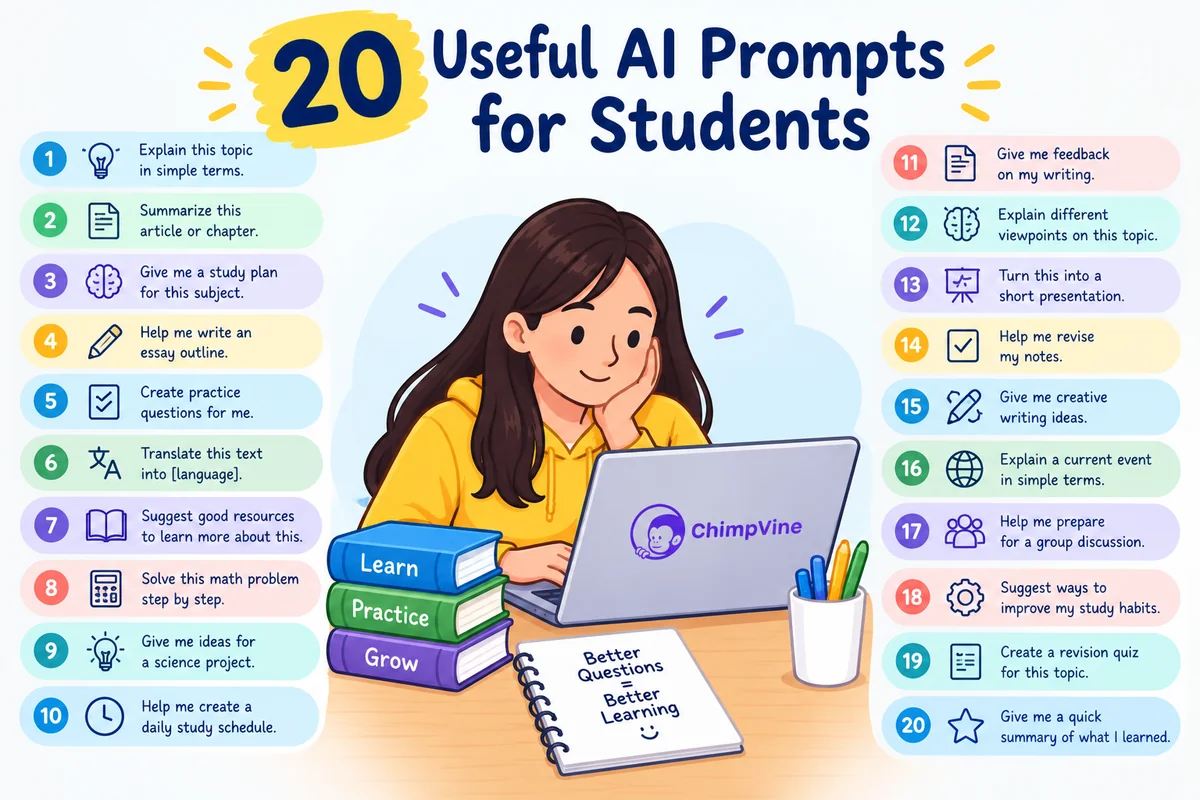
This guide collects 20 useful AI prompts for students, organized by what you’re trying to do — studying, writing, research, exam prep, and more. Each one is written so you can copy it, swap in your own topic or subject, and use it right away.
Why Good AI Prompts for Students Actually Matter
Vague prompts get vague answers. Compare these two requests:
- “Help me study for my history test.”
- “Quiz me on 5 key causes of World War I, one question at a time, and explain the correct answer after each guess.”
The second one — a clearer, more specific version of AI prompts for students — will almost always produce something far more useful. Being specific about the subject, the format, and what you actually want is the single biggest factor in getting a genuinely helpful response.
This matters more than it might seem. Research on student AI use has found that a large share of prompts students actually type are quite general, missing the detail, context, or clear goal that would make the response genuinely useful for learning rather than just quick. Treating prompt-writing as a skill worth practicing — not just typing whatever comes to mind first — is often the real difference between AI helping you learn and AI just doing the work for you.
20 Useful AI Prompts for Students
AI Prompts for Studying and Understanding Concepts
1. “Explain [topic] like I’m learning it for the first time, using a simple real-world example.”
2. “Quiz me on [topic] with 5 questions, one at a time, and explain the answer after each one.”
3. “What are the 3 most important things to remember about [topic] before a test?”
4. “I understand [concept A] but not [concept B] — explain how they’re different.”
5. “Create 5 flashcard-style question-and-answer pairs for [topic].”
AI Prompts for Essays and Writing
6. “Give me 3 possible thesis statement options for an essay about [topic].”
7. “Review this paragraph for clarity and flow, and suggest specific improvements: [paste paragraph].”
8. “Help me outline an essay structure for arguing [position], with an intro, 3 body sections, and a conclusion.”
9. “What are some counterarguments I should address in an essay about [topic]?”
10. “Suggest a stronger opening sentence for this essay introduction: [paste sentence].”
AI Prompts for Research and Reading
11. “Summarize the main argument of this article in 3 sentences: [paste text].”
12. “What questions should I ask while researching [topic] to make sure I’m covering it well?”
13. “Explain the difference between a primary source and a secondary source, with an example related to [topic].”
14. “List 5 subtopics I should consider researching within the broader topic of [topic].”
15. “What’s a simpler way to explain this sentence: [paste confusing sentence]?”
AI Prompts for Exam and Test Prep
16. “Create a practice test with 5 multiple-choice questions about [topic], and include the answer key at the end.”
17. “What’s a memory trick or analogy that could help me remember [specific fact or formula]?”
18. “Walk me through how to solve this type of problem step-by-step, without giving me the final answer: [paste problem].”
19. “Help me build a 5-day study schedule for a test on [topic] happening in one week.”
AI Prompts for Organization and Planning
20. “Help me break this project into smaller weekly tasks: [describe the project and deadline].”
Bonus AI Prompts for Group Work and Presentations
21. “Help me prepare 5 likely questions the class might ask after my presentation on [topic].”
22. “Suggest a clear, simple way to divide this group project into fair roles: [describe the project].”
How to Customize These AI Prompts for Students
Each of these AI prompts for students works as a starting template — the real value comes from swapping in your own specific details:
- Replace [topic] with your actual subject, chapter, or assignment
- Add your grade level or course level for a better-matched explanation (“explain this at a high school level”)
- Specify a format you want, like a list, a table, or a short paragraph
- Ask a follow-up prompt if the first answer isn’t quite right — refining a prompt is completely normal and often necessary
What AI Prompts Can’t Replace
Even the best AI prompts for students are a starting point, not a finish line. A few things worth remembering:
- Verify facts. AI can generate confident-sounding but incorrect information, especially for specific dates, numbers, or citations.
- Do the practice yourself. Using a prompt to get a practice quiz is very different from using AI to write your actual answers for you.
- Check your school’s AI policy. Different teachers and assignments have different rules about how much AI assistance is acceptable — always check before using AI prompts for graded work.
- Keep your own voice. For writing assignments, use AI prompts to get feedback and structure ideas, not to generate your final wording wholesale.
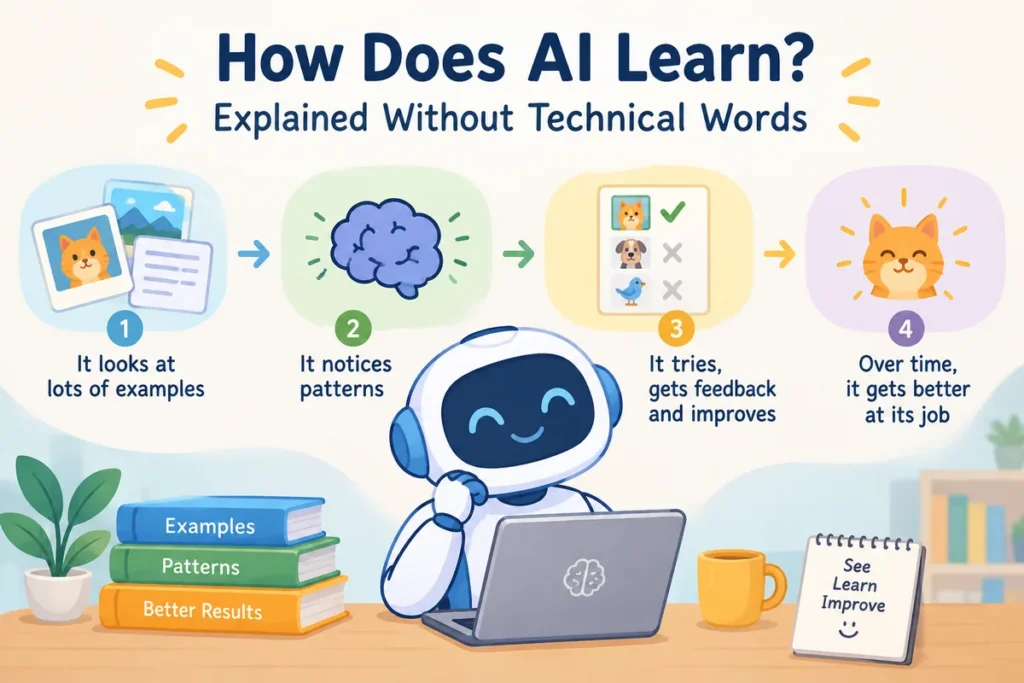
For more on using AI in a way that supports real learning rather than replacing it, our AI for Learning guide covers this in more depth, and our How Does AI Learn guide explains what’s actually happening behind the response you get back.
A Simple Framework for Writing Your Own AI Prompts
If you want to go beyond this list and write your own AI prompts for students, a simple framework to follow is:
- Be specific about the topic — name the exact subject, not just the general area.
- State the format you want — a list, a quiz, a summary, a table.
- Add context that matters — your grade level, what you already understand, what you’re struggling with.
- Ask one thing at a time — combining too many requests in one prompt often produces a muddled answer.
This same framework works whether you’re studying, writing, or planning — it’s the pattern behind every prompt in this guide.
Common Mistakes When Writing AI Prompts for Students
Even with a good list of AI prompts for students to start from, a few habits tend to weaken the results:
Being too vague. “Help me with my essay” gives an AI very little to work with. Naming the specific topic, assignment type, and what kind of help you want (structure, feedback, brainstorming) produces far better results.
Asking for too much at once. A prompt that asks for a full outline, a thesis statement, and feedback on grammar all in one request often produces a rushed, shallow answer to each part. Breaking these into separate prompts usually works better.
Not providing context. The same question can need a very different answer depending on grade level, course, or how much you already understand. Mentioning this upfront saves you from having to ask again.
Accepting the first answer without follow-up. Treating an AI conversation like a single question-and-answer exchange, rather than a back-and-forth, misses one of the most useful parts of using AI prompts for students — the ability to refine and clarify.
Using AI prompts to skip understanding entirely. If a prompt’s output is used without genuinely reading and understanding it, the entire point of using AI to support learning is lost — and it becomes much harder to explain your own work later, whether in class discussion or on a test.
Related Source
Elon University & AAC&U — Student Guide to Artificial Intelligence This free, university-developed guide covers responsible academic AI use, ethical prompting, and practical strategies for students navigating AI in their coursework.
Read the Student Guide to Artificial Intelligence
Frequently Asked Questions
What makes a good AI prompt for students? A good prompt is specific about the topic, states the format you want (like a quiz, summary, or outline), and includes relevant context such as grade level or what you already understand.
Is it okay to use AI prompts for homework? It depends on the assignment and your school’s policy. Using AI prompts to understand a concept or generate practice questions is generally more acceptable than using AI to write graded work directly — always check your specific rules.
Can I use the same AI prompt for different subjects? Yes. Most of the prompts in this guide are templates — swap out the topic or subject, and the same structure works across math, history, science, language arts, and more.
What should I do if an AI prompt gives me a bad or confusing answer? Try refining your prompt with more specific details, or ask a follow-up question. It’s normal to need 2-3 attempts before getting a genuinely useful response.
Do AI prompts for students work the same across different AI tools? Mostly yes — the underlying principles (being specific, stating format, adding context) work across most AI chat tools, though exact wording may need small adjustments depending on the tool.