7 Benefits of ChatGPT in Schools: Should Students Use AI?
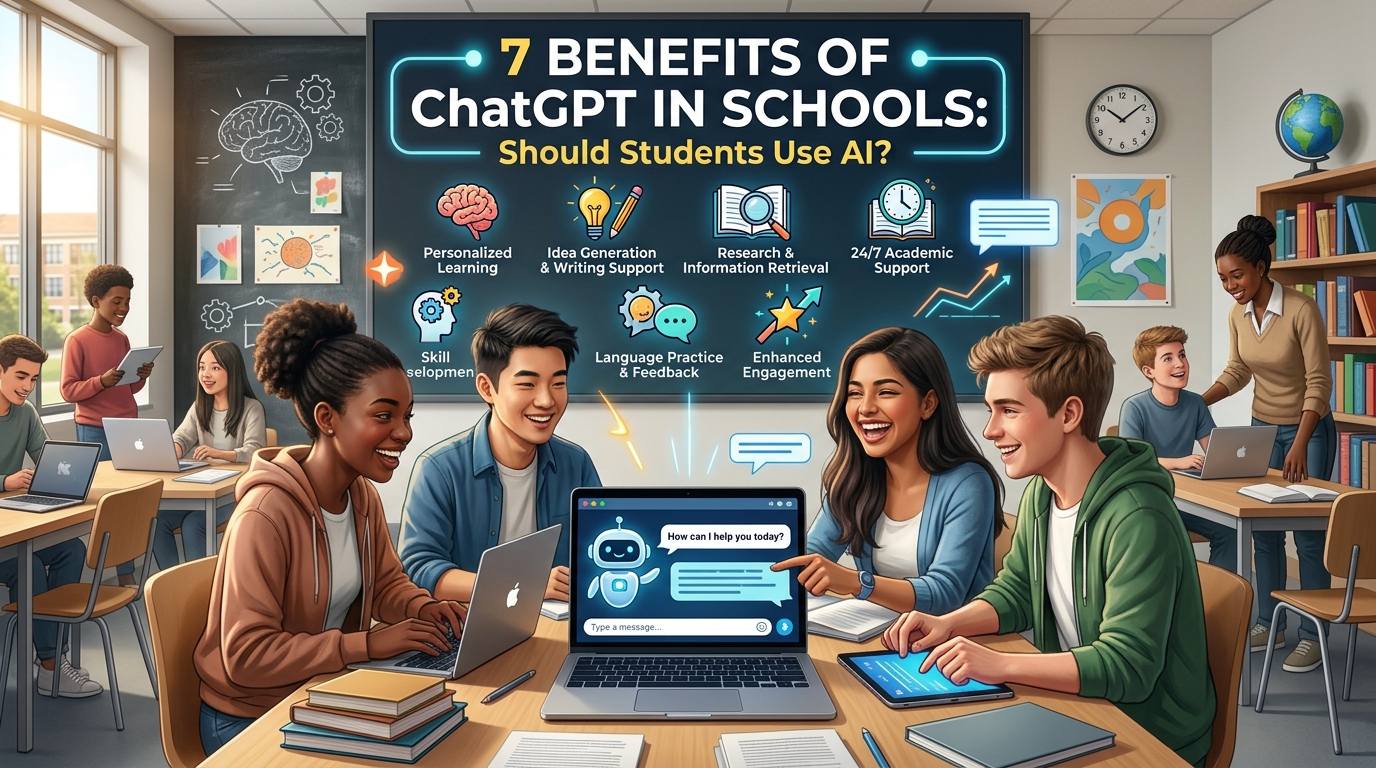
ChatGPT in schools has become an important topic in modern education. As artificial intelligence becomes easier to access, students are increasingly using AI tools to study, research, write, practice questions, and understand difficult subjects.
This has created an important question for teachers, parents, and school administrators: Should schools allow ChatGPT?
The answer does not have to be a simple yes or no. ChatGPT in schools can provide valuable learning support when students use it responsibly. However, schools also need clear rules to prevent cheating, misinformation, excessive dependence, and privacy problems.
Rather than completely banning artificial intelligence, schools can teach students how to use AI as a learning assistant while keeping teachers and students at the center of education.
This article explores 7 benefits of ChatGPT in schools, the potential risks, and practical ways schools can introduce AI responsibly.
1. ChatGPT in Schools Can Help Students Understand Difficult Subjects
One of the biggest advantages of ChatGPT in schools is its ability to explain difficult concepts in different ways.
Students do not all learn at the same speed. A student may understand a lesson immediately, while another student may need several additional explanations.
With ChatGPT, students can ask for:
- Simple explanations
- Step-by-step guidance
- Real-world examples
- Practice questions
- Different explanations of the same concept
- Revision exercises
- Definitions of difficult terms
For example, a student studying photosynthesis could ask ChatGPT to explain the process using an everyday example.
A mathematics student could ask for a simpler explanation of an algebraic concept before attempting practice problems.
This makes ChatGPT in schools potentially useful as an additional learning resource.
However, students should still verify important information with teachers, textbooks, and reliable sources because AI can sometimes produce incorrect information.
2. ChatGPT in Schools Can Support Personalized Learning
Another important benefit of ChatGPT in schools is personalized learning support.
Every student has different strengths, weaknesses, interests, and learning speeds. A teacher may not always have enough time to provide an individualized explanation to every student during a lesson.
AI can provide additional explanations when students are studying independently.
For example, a student could ask:
“Explain photosynthesis like I am a Grade 6 student.”
After understanding the basic concept, the student could ask:
“Now explain photosynthesis at a Grade 9 level.”
This allows students to adjust explanations according to their learning needs.
However, personalized AI support should complement teachers rather than replace them.
Teachers understand students’ emotional needs, classroom behavior, learning progress, and educational goals in ways that an AI system cannot fully replicate.
3. ChatGPT in Schools Can Help Students Practice
Practice is an essential part of learning.
Students can use ChatGPT in schools to generate additional practice questions after learning a topic.
For example, instead of asking ChatGPT to solve a mathematics homework problem, students can ask:
“Give me five similar problems and let me solve them myself.”
This encourages active participation.
Students can also use ChatGPT to create:
- Mathematics quizzes
- Science questions
- Vocabulary exercises
- Programming problems
- Grammar exercises
- Exam-style questions
- Revision tests
This can be especially helpful when students need extra practice outside regular classroom hours.
The important difference is whether the AI is helping students practice or simply doing the work for them.
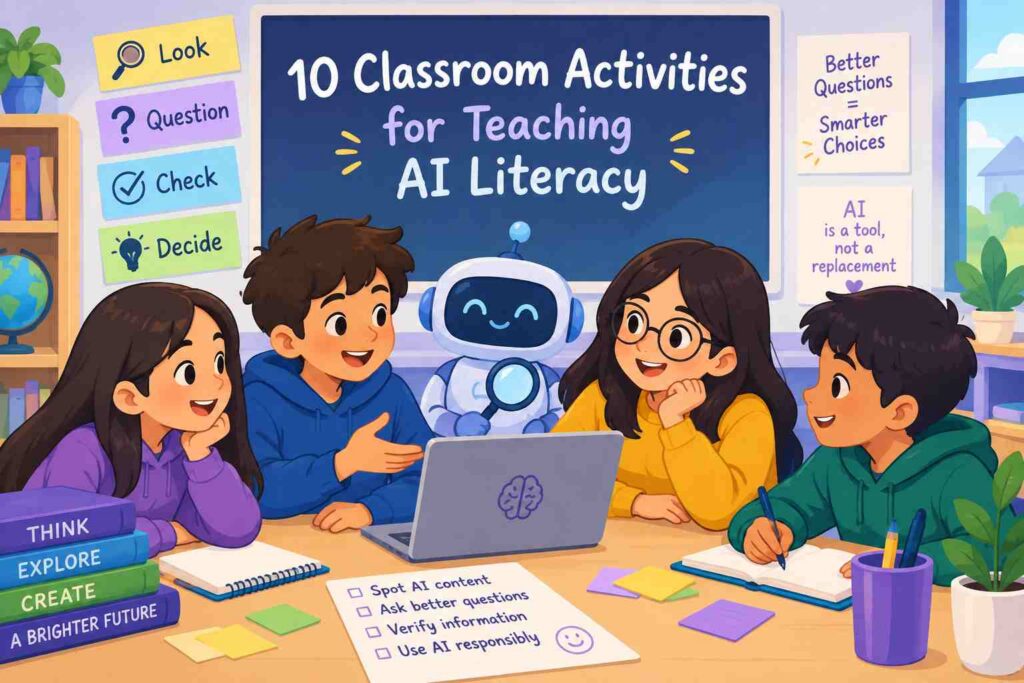
4. ChatGPT in Schools Can Improve AI Literacy
AI literacy is becoming an important part of digital education.
Students are likely to encounter artificial intelligence in higher education, workplaces, businesses, software, search engines, and everyday digital services.
This makes ChatGPT in schools an opportunity to teach students how AI actually works and how it should be used responsibly.
Schools can teach students:
- How to write effective prompts
- How to check AI-generated information
- How to recognize AI mistakes
- How to protect personal information
- How to identify biased information
- When AI should and should not be used
- How to acknowledge AI assistance
UNESCO’s Guidance for Generative AI in Education and Research recommends a human-centered approach to generative AI and highlights issues such as privacy, appropriate use, and educational safeguards.
Teaching students about AI is therefore more useful than simply pretending AI does not exist.
5. ChatGPT in Schools Can Support Creativity and Brainstorming
Students often struggle with the first stage of an assignment: deciding where to begin.
ChatGPT in schools can help students brainstorm possible ideas without necessarily creating the final work for them.
For example, a student working on an environmental science project could ask ChatGPT for possible research topics about pollution.
The student could then choose an appropriate topic, conduct independent research, evaluate reliable sources, and create the final project.
ChatGPT can help students brainstorm:
- Essay topics
- Project ideas
- Research questions
- Presentation topics
- Story ideas
- Debate questions
- Science experiments
- Business ideas
The student should remain responsible for evaluating and developing the final idea.
This makes AI a brainstorming assistant rather than a replacement for creativity.
6. ChatGPT in Schools Can Encourage Critical Thinking
It may seem strange to say that AI can help develop critical thinking, but ChatGPT in schools can actually create opportunities for students to question information.
Teachers can deliberately provide students with AI-generated answers and ask them to find mistakes.
For example, a teacher could ask students:
“Is this ChatGPT answer correct? Find three things that should be changed.”
Students would then need to research the topic and compare the AI response with reliable information.
This teaches students an important lesson:
AI-generated information should not automatically be accepted as fact.
Students can learn to ask:
- Is this answer accurate?
- What evidence supports it?
- Can another source confirm it?
- Is the information outdated?
- Does the answer contain an assumption?
- Is there another perspective?
This type of activity can turn ChatGPT in schools into a tool for developing information-literacy skills.
7. ChatGPT in Schools Can Prepare Students for the Future
The final major benefit of ChatGPT in schools is future preparation.
Artificial intelligence is becoming increasingly important across education, technology, business, research, healthcare, marketing, and many other industries.
Students therefore need more than traditional digital skills. They also need to understand how to work responsibly with AI.
Future-ready students should be able to:
- Communicate effectively with AI tools
- Evaluate AI-generated information
- Solve problems independently
- Use AI ethically
- Protect digital privacy
- Combine human creativity with technology
- Understand the limitations of AI
The purpose of introducing ChatGPT in schools should not be to create students who depend on AI.
Instead, schools should create students who know when AI is useful and when human judgment is more important.
What Are the Risks of ChatGPT in Schools?
Although ChatGPT in schools can provide many benefits, there are also serious concerns that schools should address.
Academic Cheating
The most obvious concern is cheating.
Students could ask ChatGPT to write essays, solve homework, complete projects, or answer questions and then submit the results as their own work.
This can prevent students from developing important skills.
Schools should therefore clearly explain the difference between using AI for learning and using AI to avoid learning.
Good use:
“Explain this topic and give me hints so I can solve the problem.”
Poor use:
“Complete my entire assignment so I can submit it.”
Clear rules can help students understand acceptable ChatGPT in schools practices.
Incorrect Information
ChatGPT can sometimes generate incorrect information.
Students should therefore verify important claims through textbooks, teachers, academic sources, and reliable websites.
Teachers can use this limitation as a learning opportunity by asking students to fact-check AI responses.
Overdependence on AI
Another concern is that students may become too dependent on AI.
If students use ChatGPT every time they face a difficult question, they may lose opportunities to develop independent problem-solving skills.
A useful classroom principle is:
Think → Try → Ask → Check → Create
Students should first think about a problem, try to solve it, ask AI for guidance when necessary, check the information, and then create their own final work.
Privacy Concerns
Privacy is another important issue surrounding ChatGPT in schools.
Students should never be encouraged to enter unnecessary personal or sensitive information into AI tools.
Schools should teach students not to share:
- Passwords
- Private student records
- Sensitive personal information
- Private information about classmates
- Confidential school documents
UNESCO also highlights privacy and data protection as important considerations when using generative AI in education.
How Should Schools Introduce ChatGPT?
Schools do not need to choose between completely banning AI and giving students unlimited access.
A better solution is to create clear categories of acceptable AI use.
AI Not Allowed
Schools may prohibit AI during:
- Examinations
- Certain tests
- Individual assessments
- Assignments designed to measure independent knowledge
AI Allowed With Restrictions
Students may use ChatGPT in schools for:
- Brainstorming
- Concept explanations
- Practice questions
- Research planning
- Feedback
- Revision
AI Encouraged
Teachers can also deliberately use AI for educational activities such as:
- Fact-checking AI answers
- Comparing human and AI responses
- Identifying AI mistakes
- Discussing AI ethics
- Learning effective prompting
This gives students practical experience instead of simply telling them that AI is good or bad.
Teachers Should Remain at the Center of Education
Introducing ChatGPT in schools does not mean replacing teachers.
Teachers should remain responsible for deciding how AI fits into their classrooms.
Teachers can use AI to help prepare:
- Lesson ideas
- Practice questions
- Classroom activities
- Revision materials
- Discussion questions
However, teachers should review AI-generated content before providing it to students.
AI can provide assistance, but teachers provide educational judgment, human interaction, encouragement, and guidance.
For more information about developing digital skills for educators, schools can also explore Digital Skills for Teachers and learn more about AI literacy for teachers and students.
Should Students Disclose Their Use of ChatGPT?
Schools should consider requiring students to disclose AI assistance when appropriate.
For example, a student could write:
“ChatGPT was used to brainstorm ideas and explain difficult concepts. The final assignment was researched, written, and edited by the student.”
This encourages honesty and helps teachers understand how AI contributed to the work.
However, disclosure rules should depend on the assignment. A teacher may allow brainstorming but prohibit AI-generated writing for an essay designed to assess writing ability.
A Simple Rule for ChatGPT in Schools
Schools can teach students one simple principle:
Use ChatGPT to improve learning, not to avoid learning.
This principle can be applied to almost every situation.
If ChatGPT helps a student understand a difficult concept, it can be useful.
If ChatGPT completes an assignment that the student is supposed to complete independently, it becomes a problem.
The goal of ChatGPT in schools should always be to improve learning while keeping students responsible for their own education.
Final Verdict: Should Schools Allow ChatGPT?
ChatGPT in schools can be beneficial when it is introduced responsibly.
Schools should not necessarily ban AI completely. Instead, they should establish clear policies, teach AI literacy, protect student privacy, and explain when AI can and cannot be used.
Students can use ChatGPT to understand difficult subjects, practice skills, brainstorm ideas, receive explanations, and learn about artificial intelligence.
At the same time, students must understand that ChatGPT can make mistakes and should not replace independent thinking.
The future of education is unlikely to be completely human or completely AI-powered. It will involve people working alongside technology.
The real goal of ChatGPT in schools should therefore be simple:
Use AI to support learning while keeping human thinking, creativity, judgment, and responsibility at the center.