Beyond Coding: Why Prompt Engineering Is the Next Big Skill for K–12 Students
Introduction
For years, coding has been one of the main technology skills students were encouraged to learn. Coding still matters. But students are now also using AI tools that respond to everyday language. This creates another useful skill: prompt engineering.
Prompt engineering simply means learning how to give AI clear instructions so it better understands what you want. For students, the real value goes beyond getting a better AI answer. It can also practise communication, problem-solving, and critical thinking.
What Is Prompt Engineering in Simple Words?
A prompt is the instruction or question you give an AI tool.
For example:
“Explain photosynthesis.”
That is a prompt.
But a student could make it clearer:
“Explain photosynthesis to a Grade 7 student in simple English. Use one everyday example and then ask me three questions to test my understanding.”
Both prompts ask about the same topic. The second one gives the AI more information about the learner, the level, and the expected result. That process of improving instructions is prompt engineering.
Good Prompting Starts With Good Thinking
Prompt engineering is not just about finding special words that make AI work better. Before students can write a useful prompt, they need to decide:
- What am I trying to learn?
- What information does AI need?
- How difficult should the answer be?
- What type of response do I want?
- How will I know if the answer is good?
That makes prompting a thinking exercise. If a student cannot clearly explain what they need, it becomes harder for AI—or even another person—to provide the right help. Learning to prompt well can therefore support a wider skill: learning to communicate a problem clearly.
Prompt Engineering Does Not Replace Coding
The phrase “beyond coding” should not mean “coding no longer matters.” Coding and prompting teach different things.
Coding helps students understand logic, algorithms, structure, debugging, and how software works.
Prompt engineering helps students communicate goals, give context, break a task into steps, and work with AI systems.
Students may eventually use both. For example, a student building a simple game might write some code themselves, ask AI to explain an error, improve the prompt when the answer is unclear, and then check whether the suggested code actually works.
The important skill is not blindly accepting what AI creates. It is staying in control of the problem.
A Simple Prompt Formula Students Can Use
Students do not need complicated prompt-engineering techniques (check medimu).
A useful starting formula is:
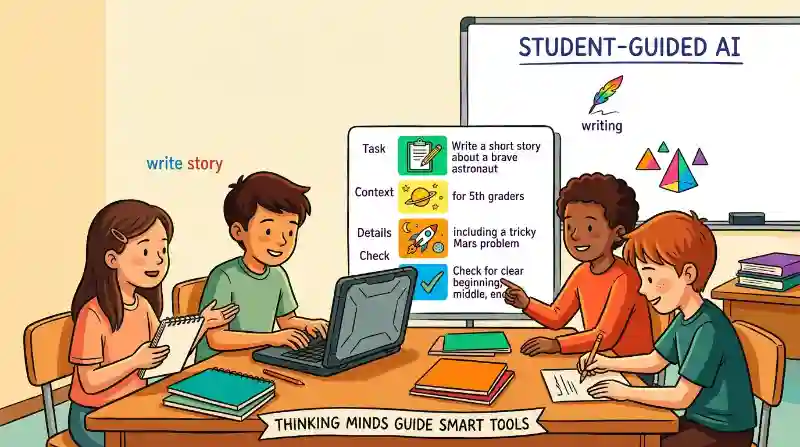
Task + Context + Details + Check
Task: What do you want AI to do?
“Explain the water cycle.”
Context: Who is the answer for?
“I am a Grade 6 student.”
Details: How should AI explain it?
“Use simple words and a short example related to rainy weather in Nepal.”
Check: How will you test your learning?
“Then give me three questions without showing the answers.”
This structure turns AI from an answer machine into a learning assistant. Teachers can use the same method in science, English, social studies, coding, project work, and revision.
Students Must Also Learn to Check AI
Writing a strong prompt does not guarantee a correct answer. AI can still produce incorrect facts, weak explanations, biased information, or answers that do not match a student’s course material.That is why prompt engineering should be taught together with AI literacy.
Students should learn to:
- Ask clearly.
Give AI enough useful information. - Read carefully.
Do not automatically accept the response. - Check important facts.
Compare them with textbooks, teachers, reliable websites, or other trusted sources. - Improve the prompt.
If the answer is unclear, explain what needs to change. - Do their own thinking.
AI should support learning, not replace it.
For schools in Nepal, this makes prompt engineering useful as part of broader digital and AI literacy rather than as a stand-alone technical subject.
Conclusion
Prompt engineering is becoming an important skill because students are increasingly communicating with AI using everyday language. But good prompting is about much more than typing clever commands.
Students need to think clearly, explain what they need, improve their instructions, and question the result.
Coding teaches students how to build with technology. Prompt engineering can help teach them how to work thoughtfully with AI. Both skills can prepare students to become creators—not just users—of technology.
Related Sources
- https://felix-pappe.medium.com/9-best-prompting-frameworks-to-supercharge-your-everyday-research-with-llms-9b5383a3eb7a (medium.com)
- https://www.cs.cmu.edu/news/2025/prompt-training (Carnegie Mellon University School of Computer Science)
- [PDF] https://arxiv.org/abs/2410.11123 (arxiv.org)
- [PDF] https://doi.org/10.3126/madhyabindu.v10i1.75619 (Devkota, Mahadev)
- https://www.ibm.com/think/topics/prompt-engineering (ibm)
Frequently Asked Questions
No. Students can practise prompt engineering using normal language. Coding knowledge can become useful later for more technical AI and software projects.
A good prompt clearly explains the task, the student’s level or situation, the type of answer needed, and any important limits or instructions.
No. Better prompts can make an answer more relevant, but AI can still make mistakes. Students should always check important information.