What Is AI? A Simple Guide to Artificial Intelligence for Everyone
Introduction
Artificial intelligence, or AI, is becoming part of many tools we use every day. You may see it in search engines, smartphones, recommendation systems, writing tools, image generators, and services such as ChatGPT. But what is AI in simple words? AI is technology that allows computer systems to process information and produce useful results, such as predictions, recommendations, answers, or content. Understanding the basics can help you use these tools more effectively while recognizing their limitations.
What Is AI?
Artificial Intelligence (AI) is technology that helps computers and machines learn, understand, solve problems, make decisions, and perform tasks like humans. AI can recognize objects, understand language, and learn from new information and experiences. AI is not one single program, and it is not limited to chatbots. Different AI systems are built for different jobs.
For example, AI can help:
- Recommend a movie or song you might enjoy.
- Detect unwanted email or spam.
- Translate text between languages.
- Generate text, images, or videos.
- Help organize or summarize information.
ChatGPT is one example of a generative AI tool that can answer questions and help people write, learn, brainstorm, create images, and work with information.
How Does AI Work?
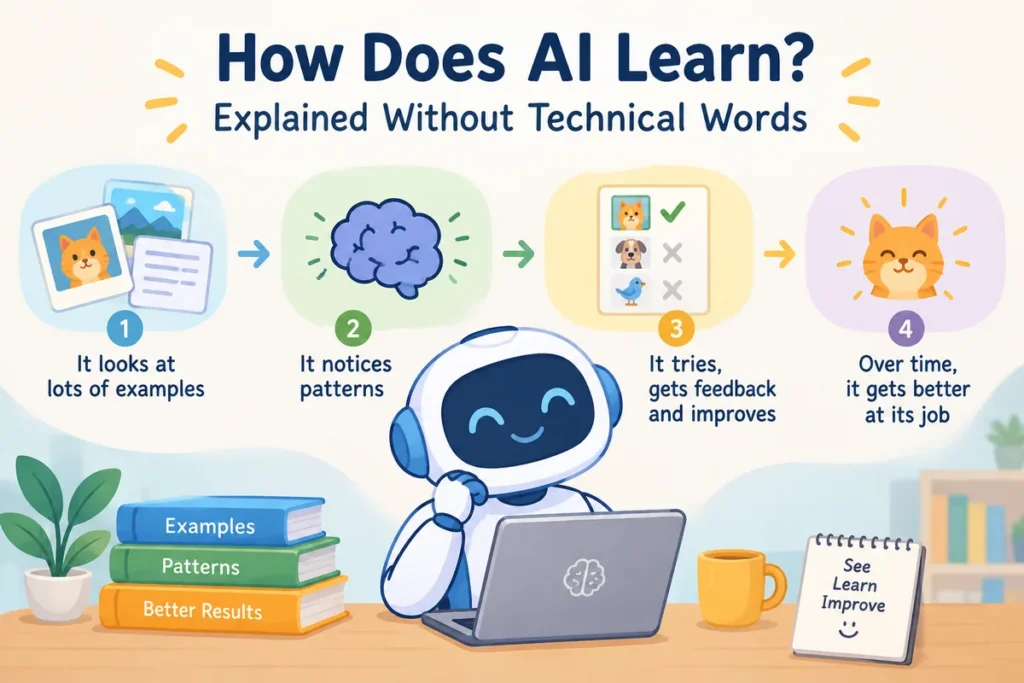
Many modern AI systems use machine learning. Machine learning is a way of training computer software, called a model, using data so that it can recognize patterns and produce predictions or content.
The process can be understood simply:
- The system is trained using examples or data.
- It identifies useful patterns in that data.
- A user gives it new information or a question.
- The AI uses what it learned to produce an output.
Simple Example: Imagine an AI system trained to recognize pictures of cats and dogs. During training, it sees many examples of dogs and cats images and learns patterns (shape, features, size and portion, fur and so on) that help distinguish them.
When it later receives a new picture, it can predict using the previously trained data whether the image is more likely to contain a cat or a dog.
Generative AI works differently in detail, but the basic idea is similar: it learns patterns from data and uses those patterns to generate new content.
Benefits and Limitations
AI can be useful because it can help people complete certain tasks faster, explore ideas, organize information, and work with large amounts of content.
For everyday users, it may help with:
- Creating a first draft of an email.
- Summarizing a long document.
- Explaining a difficult idea in simpler language.
- Brainstorming ideas.
- Creating images or other content.
However, AI also has important limitations.
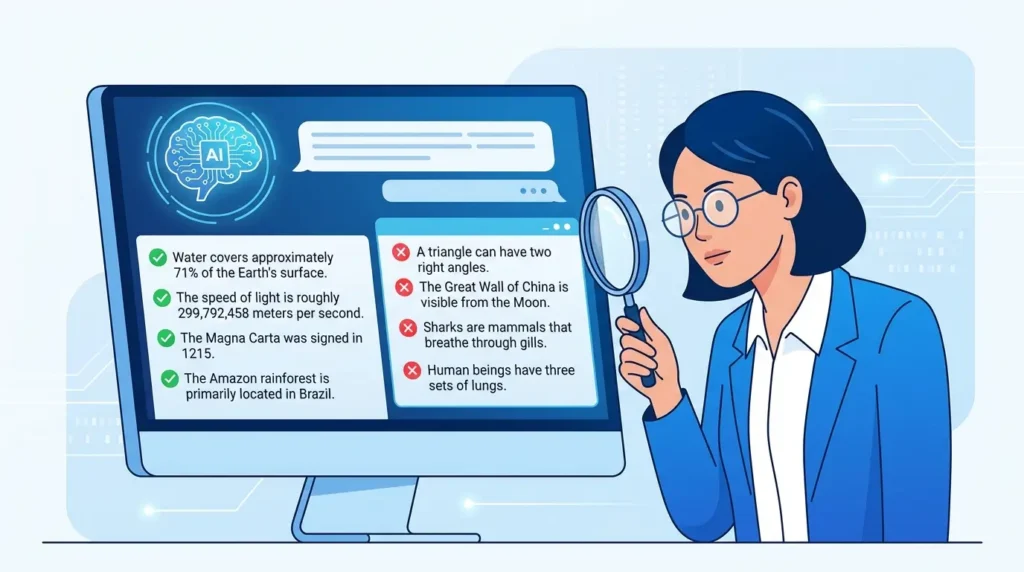
Generative AI can sometimes produce information that sounds believable but is incorrect. NIST describes this type of false or inaccurate output as confabulation, also commonly called an AI hallucination.
AI can also reflect problems in its data or design, and privacy should be considered before sharing personal or confidential information with an AI service.
For this reason, AI should be treated as a useful tool—not as an unquestionable source of truth.
Practical Tips
You do not need to understand advanced computer science to use AI responsibly. A few simple habits can make a major difference.
- Give clear instructions: Explain what you want, who the answer is for, and how you want the information presented.
- Check important information: If an AI answer affects health, money, safety, schoolwork, business decisions, or another important area, verify it using a trusted source.
- Protect private information: Avoid entering passwords, financial details, confidential business information, or other sensitive data unless you understand how the service handles that information.
- Use AI to support your thinking: AI can suggest ideas or create a starting point, but you should still review, edit, and make the final decision.
- Understand that different tools have different purposes: A chatbot, image generator, AI video tool, and AI agent may work in different ways. Choose the tool that fits the task rather than assuming every AI system can do everything.
Conclusion
AI is simply a set of technologies that help computer systems recognize patterns, process information, and produce useful outputs. It can support learning, productivity, creativity, and everyday tasks, but it can also make mistakes. The most important skill is not simply knowing how to use AI. It is knowing when to trust it, when to check it, and when human judgment should come first.
Related Sources
- https://www.ibm.com/think/topics/artificial-intelligence (IBM)
- https://developers.google.com/machine-learning/intro-to-ml/what-is-ml (developers.google.com)
- https://openai.com/chatgpt/overview/ (openAI)
- https://labs.google/fx/tools/flow (Google Labs)