How Can I Help My Child Learn AI?
Introduction
Your child may already be using AI without realizing it. It can appear in games, video recommendations, phone cameras, search tools, and chatbots. As a parent, you do not need to understand coding or complicated technology. A better approach is to explore AI together. Help your child understand what AI can do, where it can make mistakes, and how to use it without stopping their own thinking.
Start With Things Your Child Already Uses
Keep the first conversation simple.
Ask:
“Where do you think AI is used?”
Your child might mention YouTube, games, maps, voice assistants, or chatbots. You can explain AI like this:
“AI is a computer system that learns patterns from lots of information and uses them to make guesses or create things.”
You do not need to explain difficult technical words. The goal is simply to help your child notice that AI is already part of everyday technology.
Learn by Creating Something Together
Children often understand technology better when they can try it. Sit together and use AI for a small creative activity.
For example, you could:
- Create a funny story
- Design a superhero
- Make a short quiz
- Create ideas for a school project
- Ask for a simple explanation of a science topic
Afterwards, ask:
- “What did you like?”
- “Did AI make any mistakes?”
- “What would you change?”
This keeps your child involved instead of letting AI do everything.
Teach Them Not to Believe Every AI Answer
One of the most useful habits children can learn is to check information. AI can sometimes give an answer that sounds correct even when it is wrong. Try a simple challenge. Ask AI a question. Then check the answer using a schoolbook, teacher, parent, or trusted website.
Teach your child to ask:
- Is this answer correct?
- Can I check it somewhere else?
- Does this make sense?
- Who should I ask if I am unsure?
This helps build critical thinking.
Create Simple Family Rules for AI
You do not need complicated rules. Start with a few clear ones:
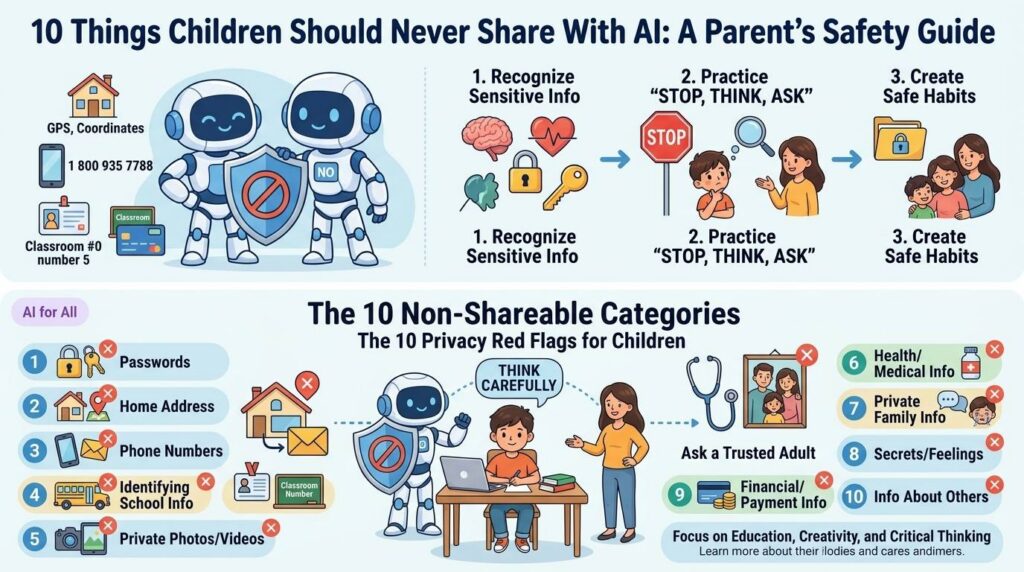
- Keep private information private.
Do not share passwords, phone numbers, home addresses, school IDs, or other personal information. - Try first, ask AI second.
Children should attempt homework or problems before asking AI for help. - Ask an adult when unsure.
If something feels confusing, strange, or uncomfortable, children should talk to a trusted adult.
For younger children, exploring AI together with a parent or teacher is a good starting point.
Keep Your Child Thinking
AI should make learning easier to explore—not remove the need to learn. If AI writes every story, answers every question, or solves every homework problem, children lose valuable practice.
A better habit is:
Try → Ask for help → Check → Improve
Reading, writing, solving problems, asking questions, and creating original ideas are still important. The goal is not to teach children how to make AI do everything. It is to teach them when AI can help and when they should think for themselves.
Conclusion
Helping your child learn AI can start with simple everyday activities. Explore AI together, let them create, encourage questions, check answers, and set a few clear safety rules. You do not need to know everything about AI. The most useful thing you can teach your child is how to use it with curiosity, care, and their own thinking.
Related Sources
- https://oxfordlearning.com/9-ways-to-help-kids-navigate-the-world-of-ai/ (Oxford Learning)
- https://www.apa.org/topics/artificial-intelligence-machine-learning/tips-to-keep-teens-safe.html (American Psychological Association)
- https://www.commonsensemedia.org/articles/helping-kids-navigate-the-world-of-artificial-intelligence (Common Sense Media)
Frequently Asked Questions
No. You can learn together. Start with simple activities and conversations instead of technical lessons.
AI can help explain ideas or create practice questions, but children should still do their own work and follow school rules.
Yes. Children should learn to check important answers using trusted sources or an adult.