AI Literacy Activities for Students: 10 Powerful Classroom Ideas
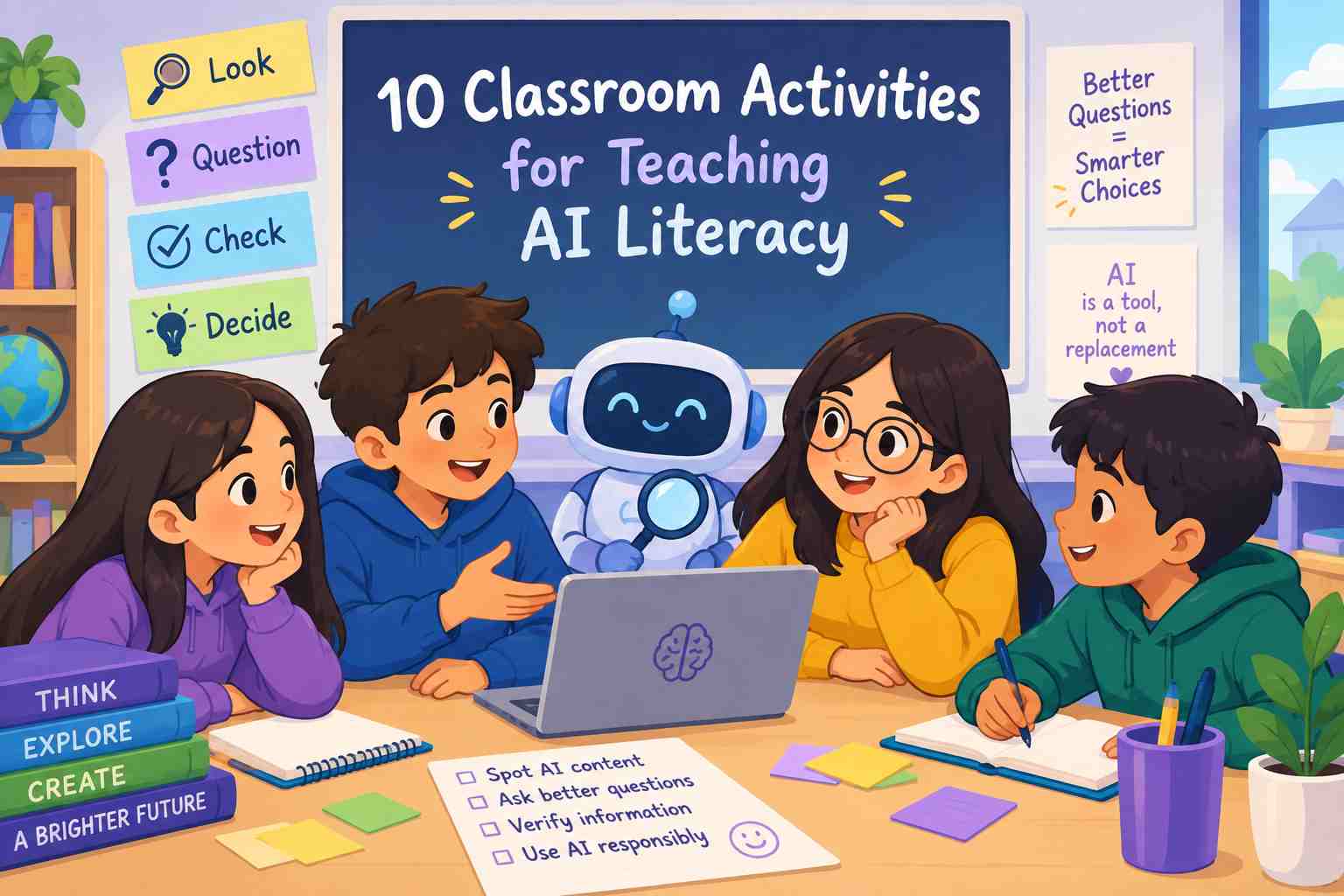
AI literacy activities for students can help children understand artificial intelligence in a simple, practical, and engaging way.
Students are already encountering AI through search engines, recommendation systems, games, social media, chatbots, image generators, and learning platforms.
But using AI is only one part of being AI literate.
Students also need to understand what AI can do, recognize when it can make mistakes, question information, protect their privacy, and make responsible decisions about when to use AI.
The good news?
You do not need a computer science lab or advanced technical knowledge to introduce AI literacy in your classroom.
Why AI Literacy Matters in the Classroom
AI literacy is more than learning how to use a chatbot.
Students need opportunities to understand AI, question its outputs, and think about its impact.
UNESCO’s AI Competency Framework for Students highlights areas such as human-centred thinking, AI ethics, AI techniques, and AI system design. It also encourages students to move from understanding AI to applying and creating with it.
This means classroom AI education can include much more than coding.
Simple discussions, games, experiments, and fact-checking activities can all help students develop AI literacy.
1. AI or Not AI?
Start with a quick guessing game.
Show students examples of technologies they may already know:
- Voice assistants
- YouTube recommendations
- Face filters
- Chatbots
- A calculator
- A digital alarm clock
- Google Maps
- Online shopping recommendations
Ask:
“Do you think AI is being used here?”
Students can vote by raising their hands or moving to different sides of the classroom.
After each answer, discuss why they think AI is or is not involved.
Teacher tip
Do not focus only on getting the correct answer.
The goal is to help students begin noticing where AI appears in everyday life.
2. What Can AI Do?
Divide students into small groups.
Give each group a list of different tasks:
- Write a story
- Translate a sentence
- Recognize an image
- Solve a math problem
- Cook a meal
- Give advice
- Create a picture
- Choose a student’s final grade
Ask students to sort them into three categories:
AI can help.
AI can help, but a human should check.
A human should decide.
Have each group explain one interesting choice.
This activity introduces an important idea:
AI can assist people, but it does not automatically replace human judgment.
3. Human or AI?
Prepare two short pieces of content.
They could be:
- Two short stories
- Two poems
- Two images
- Two descriptions of the same object
Tell students that one may have been created using AI.
Ask:
“Which one do you think was made by AI?”
Let students explain their reasoning.
Then reveal the answer.
The discussion afterward is more important than the guessing game.
Ask:
“What clues did you use?”
“Could you be wrong?”
“Can we always identify AI-generated content just by looking at it?”
Students learn that appearance alone is not always enough to verify information.
4. Become an AI Fact-Checker
Give students an AI-generated answer containing a few mistakes.
For example:
“Mount Everest is located in India and is 5,000 metres tall.”
Ask students to become AI fact-checkers.
Their mission is to:
- Find the incorrect information.
- Explain what is wrong.
- Find a reliable source.
- Write the correct information.
You can make this a small competition.
Give each team points for finding mistakes and providing evidence.
What students learn
Students discover an important lesson:
AI can sound confident even when its answer is incorrect.
That is why checking information is an important part of AI literacy.
5. The Prompt Challenge
Introduce students to the word prompt.
Explain:
A prompt is the instruction or question we give an AI tool.
Give everyone the same basic task:
“Write a story about a robot.”
Now ask students to improve the instruction.
For example:
“Write a funny 300-word story about a friendly robot who gets lost in a school.”
Compare the results.
Ask students:
“Which prompt gives clearer instructions?”
“What extra information did you add?”
This activity shows students that better instructions can lead to more useful AI responses.
6. Turn a Bad Prompt Into a Great Prompt
Write a weak prompt on the board:
“Tell me about pollution.”
Ask students to improve it.
Encourage them to add:
- A specific topic
- Their grade level
- The desired length
- The format
- Examples
- The type of language they want
For example:
“Explain three causes of air pollution in Kathmandu for a Grade 7 student using simple language and local examples.”
Now compare the two prompts.
Ask:
“Which one gives the AI a clearer job?”
This is one of the easiest ways to teach students that AI literacy begins with asking better questions.
7. Become an AI Bias Detective
AI systems learn patterns from data.
Sometimes those patterns can contain unfair assumptions or stereotypes.
Give students a simple example.
Ask an AI tool:
“Describe a scientist.”
Read the response together.
Then ask:
“Who did you imagine when you heard the word scientist?”
Discuss whether the description included assumptions about:
- Gender
- Age
- Appearance
- Nationality
- Job roles
The goal is not to make students distrust AI.
Instead, help them understand that AI outputs should sometimes be questioned.
Classroom message
AI can reflect patterns from the information it learns from.
That is why fairness and critical thinking matter.
8. Should AI Do This?
Give each group a classroom scenario.
For example:
Scenario A:
A student uses AI to brainstorm ideas for a story.
Scenario B:
A student asks AI to write the entire assignment and submits it.
Scenario C:
A teacher uses AI to create practice questions.
Scenario D:
A school uses AI to decide whether a student should be punished.
Scenario E:
A student uses AI to check spelling.
Ask groups to place each scenario into:
YES
AI can help.
MAYBE
AI can help, but a human should be involved.
NO
A human should make the decision.
Students must explain their choices.
This activity moves AI literacy beyond technology and into responsible decision-making.
9. The AI Source Detective
Give students an AI-generated answer about a familiar topic.
For example:
“The Kathmandu Valley has three major cities.”
Ask students to investigate the answer.
They can use textbooks, trusted websites, library resources, or teacher-approved sources.
Give them this simple table:
| AI said | Source says | Correct? |
|---|---|---|
| __________ | __________ | Yes / No / Partly |
| __________ | __________ | Yes / No / Partly |
| __________ | __________ | Yes / No / Partly |
This turns fact-checking into a detective game.
Students learn that an AI response should not automatically become their final source of information.
10. Create Your Own AI Rules
End the lesson by asking students to create three to five classroom AI rules.
For example:
- I will check important AI answers.
- I will not share private information with AI tools.
- I will not use AI to cheat.
- I will think before accepting an AI answer.
- I will use AI as a helper, not as a replacement for my own thinking.
- I will be honest about when AI has helped me.
Write the best ideas on the board.
Then turn them into a class AI Agreement.
Students can sign it or decorate it and display it in the classroom.
A Simple AI Literacy Formula
After completing these activities, give students four words to remember:
Understand → Question → Check → Use Responsibly
Before accepting an AI answer, students can ask:
What is AI doing here?
Could this answer be wrong?
How can I check it?
Is using AI appropriate for this task?
These four questions can become a simple routine students use whenever they interact with AI.
Make AI Literacy Hands-On
The best AI literacy activities for students do not need to be complicated.
Students can learn by:
- Making predictions
- Testing AI
- Finding mistakes
- Comparing answers
- Improving prompts
- Checking sources
- Discussing fairness
- Making responsible decisions
You can also connect AI activities to subjects students already study.
In English
Ask students to compare an AI-generated story with their own writing.
In Science
Ask students to fact-check an AI explanation of a scientific concept.
In Social Studies
Ask students to investigate an AI-generated historical claim.
In Mathematics
Give students an AI-generated solution containing a mistake and ask them to find it.
In Computer Science
Ask students to explore how an AI system might recognize patterns in data.
This makes AI literacy part of everyday learning rather than a separate topic.
Helpful Resources for Teachers
Teachers who want to explore AI literacy further can look at UNESCO’s AI Competency Framework for Students, which provides a broader framework for developing students’ understanding, practical skills, ethics, and responsible use of AI.
UNICEF also highlights the importance of preparing children with AI literacy skills while protecting their safety, privacy, rights, and well-being.
Conclusion
AI literacy activities for students do not have to involve complicated programming or advanced technology.
Start small.
Ask students questions.
Let them experiment.
Give them an AI answer that contains a mistake.
Ask them to improve a prompt.
Let them debate whether AI should be used for a particular task.
Most importantly, give students opportunities to think for themselves.
The goal of AI education is not to make students afraid of AI.
It is to help them become confident, curious, critical, and responsible users of technology.
AI can be a powerful classroom tool.
But students should always remember:
Use AI to support your thinking — not to replace it.
Frequently Asked Questions
What are AI literacy activities for students?
AI literacy activities are classroom tasks that help students understand, use, question, and evaluate artificial intelligence. They can include games, fact-checking challenges, prompt activities, discussions, and responsible AI decision-making.
Why should students learn AI literacy?
Students are increasingly encountering AI in education, entertainment, search, social media, and everyday technology. AI literacy helps them understand these systems, recognize limitations, evaluate information, and make responsible choices.
Do students need coding skills to learn AI literacy?
No. Students can begin learning AI literacy without coding. Simple activities such as identifying AI, testing AI answers, improving prompts, and fact-checking information can build strong foundations.
What is the best age to start teaching AI literacy?
AI literacy can be introduced at different ages. Younger students can explore simple concepts through games and discussions, while older students can explore topics such as bias, privacy, misinformation, ethics, and responsible generative AI use.
How can teachers make AI literacy fun?
Turn learning into challenges. Try activities such as AI Detective, Prompt Challenge, Human or AI?, Find the AI Mistake, and Should AI Do This?. Group competitions and real-world examples can make the topic more engaging.
Explore More
10 Fun Things Kids Can Create With AI
How to Use AI to Study Without Cheating: A Student Guide
How Can Schools Start Teaching AI to Students?
How to Explain Artificial Intelligence to a 10-Year-Old With Simple Analogies