AI in Everyday Life: 10 Amazing Examples You Must See
Introduction
From the moment you check a map to the moment you scroll through a shopping app at night, artificial intelligence is already helping people complete everyday tasks.
You may interact with AI in everyday life without even realizing it. When a map recommends a faster route, a streaming platform suggests a video, your phone improves a photograph, or an email service identifies spam, AI may be working quietly behind the scenes.
Understanding AI in everyday life is important because AI is becoming part of how we communicate, learn, work, and make decisions.
In this guide, we explore 10 surprising examples of AI in everyday life, explain how they work, and look at why AI literacy matters for everyone. If you’re new to the topic, our beginner’s guide to how AI actually works is a good place to start before diving in.
What Is Artificial Intelligence?
Artificial intelligence, commonly called AI, refers to technology that enables computers and software to perform tasks that can involve human-like abilities.
These abilities can include:
- Recognizing patterns
- Understanding language
- Identifying images
- Making predictions
- Recommending information
- Generating content
- Analyzing large amounts of data
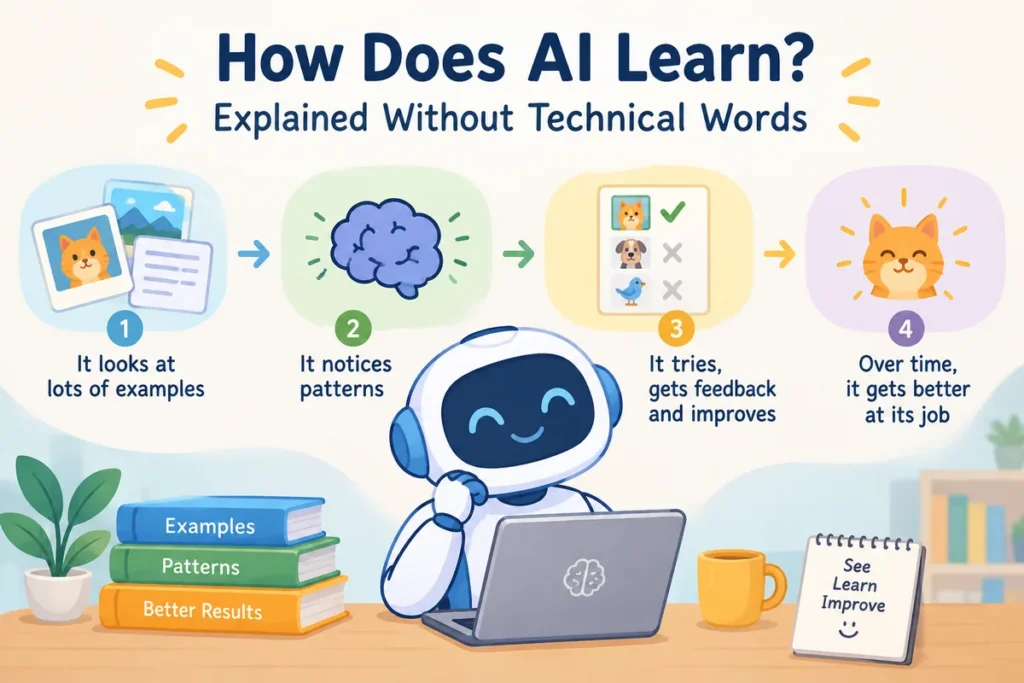
AI systems are trained using data and examples to identify patterns and produce useful results.
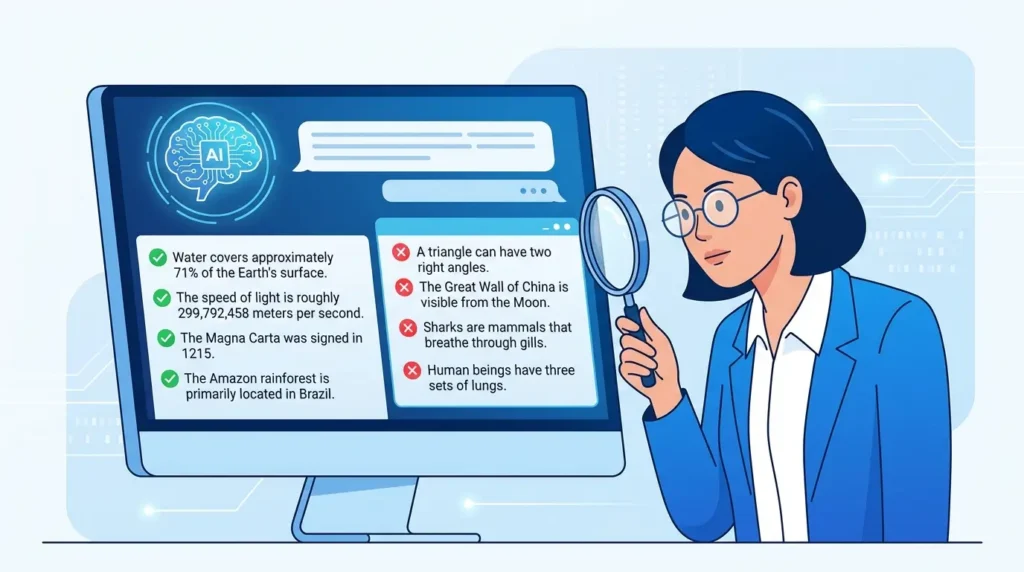
However, AI does not understand the world exactly as humans do. It can sometimes produce incorrect, incomplete, or misleading information.
That is why understanding AI in everyday life involves more than simply learning how to use AI tools.
10 Surprising Examples of AI in Everyday Life
1. AI in Maps and Navigation
Navigation is one of the easiest examples of AI in everyday life to recognize.
Modern map applications can analyze information such as traffic, travel times, road conditions, and possible delays.
When an application recommends a different route because of traffic, intelligent systems may be helping analyze the available information.
Example: You are traveling to a destination and your navigation app recommends another route because the usual road is busy.
AI can make navigation more convenient by helping people make better-informed route choices.
2. AI in Video and Music Recommendations
Recommendation systems are another common example of AI in everyday life.
Video and music platforms can analyze patterns in user activity, including:
- What you watch
- What you listen to
- What you search for
- What you interact with
- What content you skip
The system can then recommend content that may match your interests.
This explains why two people using the same platform can receive very different recommendations.
3. AI in Voice Assistants
Voice assistants allow people to communicate with devices using spoken language.
AI technologies can help these systems recognize speech, interpret requests, and provide responses.
Voice assistants can help users:
- Set reminders
- Set alarms
- Play music
- Answer questions
- Set timers
- Control compatible smart devices
This is a useful example of how AI can help computers interact with human language.
4. AI in Translation
Translation tools are another practical example of AI in everyday life.
AI-powered translation systems can process text or speech and convert information between different languages.
People use translation tools for:
- Traveling
- Studying
- Reading websites
- Communicating internationally
- Learning languages
AI translation can make communication easier, although it may not always understand cultural context, tone, or specialized terminology perfectly.
For important communication, human review can still be valuable.
5. AI in Smartphone Cameras
Many modern smartphones use AI-based technology to improve photography.
AI can assist with:
- Face detection
- Object recognition
- Scene recognition
- Image enhancement
- Portrait effects
- Photo organization
For example, your smartphone may recognize a person, animal, food item, or landscape and automatically adjust the image.
This is one of the most common forms of AI in everyday life because the technology often works quietly in the background.
6. AI in Social Media
Social media platforms use algorithms and AI-based systems to personalize the content people see.
These systems can analyze patterns in activities such as:
- Videos you watch
- Posts you interact with
- Accounts you follow
- Topics you search for
- Content you spend time viewing
This information can influence recommendations and the content displayed in your feed.
Understanding how AI influences digital content is an important part of digital literacy for students and parents.
7. AI in Email and Spam Detection
AI can also help organize your inbox.
Email services can analyze patterns in incoming messages to identify emails that may be unwanted, suspicious, or potentially harmful.
Messages that match certain patterns can automatically be moved to a spam or junk folder.
This is a simple but useful example of AI in everyday life because the technology operates mostly in the background.
8. AI in Online Shopping
Online shopping platforms often use AI-powered recommendation systems to personalize the customer experience.
You may see suggestions such as:
- “Recommended for you”
- “You may also like”
- “Similar products”
- “Customers also viewed”
These recommendations can be influenced by browsing activity, previous interactions, product information, and other patterns.
AI can therefore help shoppers discover products while also influencing what products they see.
9. AI in Education and Learning
Education is another important area where AI in everyday life is becoming increasingly visible.
Students can use AI tools to:
- Understand difficult concepts
- Generate ideas
- Practice languages
- Create study materials
- Explore topics
- Receive explanations
Teachers can also use AI to assist with lesson planning, educational resources, activities, and feedback.
However, AI should support learning rather than replace independent thinking.
Students should still ask questions, verify important information, solve problems, and develop their own understanding.
Related Reading: Learn more about AI education and real-world applications through ChimpVine’s AI curriculum, or explore why understanding the foundations of AI matters for a deeper look at what’s happening under the hood.
10. AI in Work and Business
AI is also changing how people work.
Businesses and professionals can use AI to assist with:
- Data analysis
- Customer support
- Research
- Document processing
- Content creation
- Scheduling
- Repetitive tasks
- Business forecasting
For example, a professional might use AI to summarize a long document before reviewing the original information.
AI can improve productivity, but people should remain responsible for important decisions.
AI Is Often Working Behind the Scenes
One interesting thing about AI in everyday life is that we do not always see it.
AI does not have to look like a humanoid robot or a chatbot.
Sometimes AI simply works in the background to:
Recognize → Analyze → Predict → Recommend → Assist
For example, when your phone recognizes an object in a photograph, an email service identifies spam, or a streaming platform recommends content, you may never see the AI system itself.
AI is increasingly becoming part of the digital infrastructure people interact with every day.
Why Is AI Literacy Important?
As AI in everyday life becomes more common, understanding AI is becoming important for people of all ages and backgrounds.
- Students need to understand how AI can affect learning.
- Teachers need to understand how AI can support education.
- Professionals need to understand how AI can change their work.
- Parents need to understand how children interact with AI.
- Businesses need to understand both the opportunities and risks associated with AI.
UNESCO’s AI Competency Framework for Students emphasizes the knowledge and skills learners need to understand and use AI responsibly.
You can also explore our AI learning paths for students and educators to dig deeper into AI literacy.
How to Use AI Responsibly
Whether you are a student, teacher, parent, professional, or general technology user, a few simple practices can make AI use more responsible.
Check important information AI can provide incorrect information. Verify important facts using reliable sources.
Protect personal information Avoid sharing sensitive personal, financial, or confidential information with AI tools unless you understand how that information is handled.
Question AI-generated results An AI-generated answer may sound confident without necessarily being correct.
Keep humans involved AI can assist with tasks, but people should remain responsible for important decisions.
Use AI as an assistant AI can be most useful when it helps people learn, explore, create, and work more efficiently while human judgment remains involved.
Try an AI Spotting Challenge
You can explore AI in everyday life without using advanced technology.
For one day, pay attention to the digital tools you use.
Look for examples in:
- Maps and navigation
- Video recommendations
- Music applications
- Smartphone cameras
- Voice assistants
- Translation tools
- Online shopping
- Video games
- Learning platforms
Choose one example and ask: What is the AI doing?
Then consider:
- What information does it use?
- What result does it provide?
- Can the result be wrong?
- How does it make the technology more useful?
This simple activity can help children, students, parents, teachers, and professionals understand how AI affects everyday activities.
What Does the Future of AI Look Like?
AI will likely become even more integrated into the technologies people use.
It may create new opportunities in:
- Education
- Healthcare
- Business
- Communication
- Science
- Transportation
- Entertainment
- Creative work
At the same time, greater use of AI creates important questions about privacy, accuracy, fairness, safety, and human responsibility.
Understanding these issues will become just as important as knowing how to use AI tools.
The future of AI is not only about creating more capable technology. It is also about helping people use that technology wisely.
Conclusion
AI is already part of everyday life. It helps power navigation, recommendations, translation, cameras, social media, email filtering, shopping platforms, education tools, and many other services.
The important thing is not simply knowing that AI exists. We should understand where AI is used, what it can do, where it can make mistakes, and how to use it responsibly.
As AI continues to become part of everyday life, AI literacy will become useful for everyone — not just technology experts.
AI is a tool. Understanding how to use that tool wisely is what matters.
Related Source
For readers who want to explore the topic further:
UNESCO — AI Competency Framework for Students UNESCO’s framework explains the knowledge, skills, ethics, and human-centred competencies learners need to understand and use AI responsibly.
Read the UNESCO AI Competency Framework for Students
Frequently Asked Questions
What is AI in everyday life? AI in everyday life refers to the use of artificial intelligence in common technologies and services such as maps, recommendation systems, smartphone cameras, translation tools, voice assistants, shopping platforms, and educational applications.
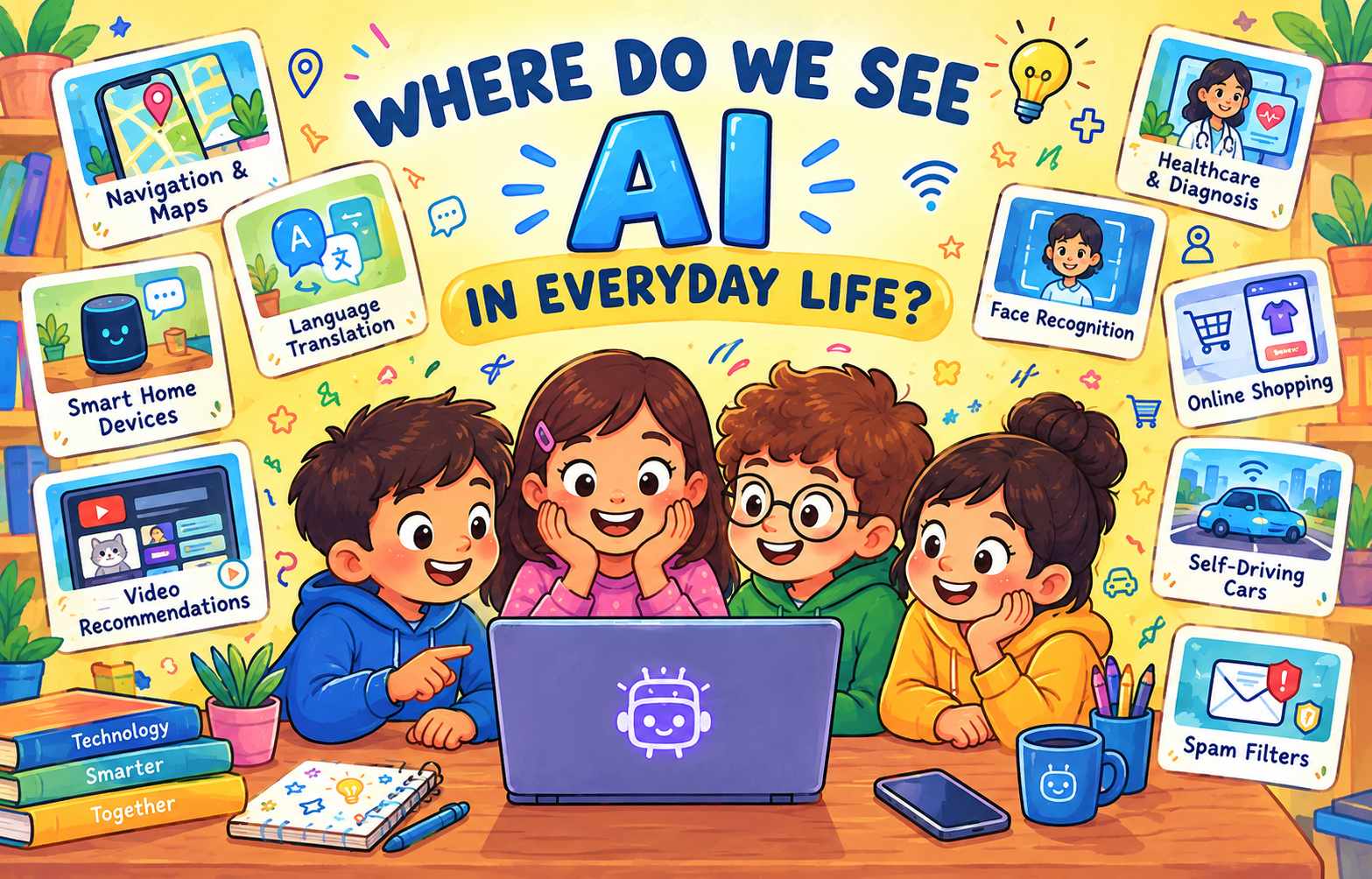
Where do we commonly see AI? AI can be found in navigation apps, social media, video and music recommendations, smartphones, online shopping, email services, games, education platforms, and many smart devices.
Do smartphones use AI? Yes. Many smartphones use AI or machine-learning technologies for features such as face recognition, photo enhancement, voice recognition, image organization, and personalized features.
Is AI only for technology professionals? No. AI affects people across different ages, professions, and backgrounds. Basic AI literacy can help anyone understand how AI affects everyday activities, education, work, and decision-making.
Can AI make mistakes? Yes. AI systems can produce incorrect, incomplete, biased, or misleading results. Important information should therefore be checked against reliable sources.
Why is AI literacy important? AI literacy helps people understand how AI works, recognize its limitations, make informed decisions, and use AI safely and responsibly. UNESCO specifically emphasizes the importance of AI awareness and literacy for society.
Is AI replacing human thinking? AI can automate or assist with many tasks, but it does not replace human judgment, creativity, empathy, common sense, and responsibility. A strong approach is to use AI as an assistant while keeping humans involved in important decisions.