Is AI Always Right? Understanding AI Mistakes
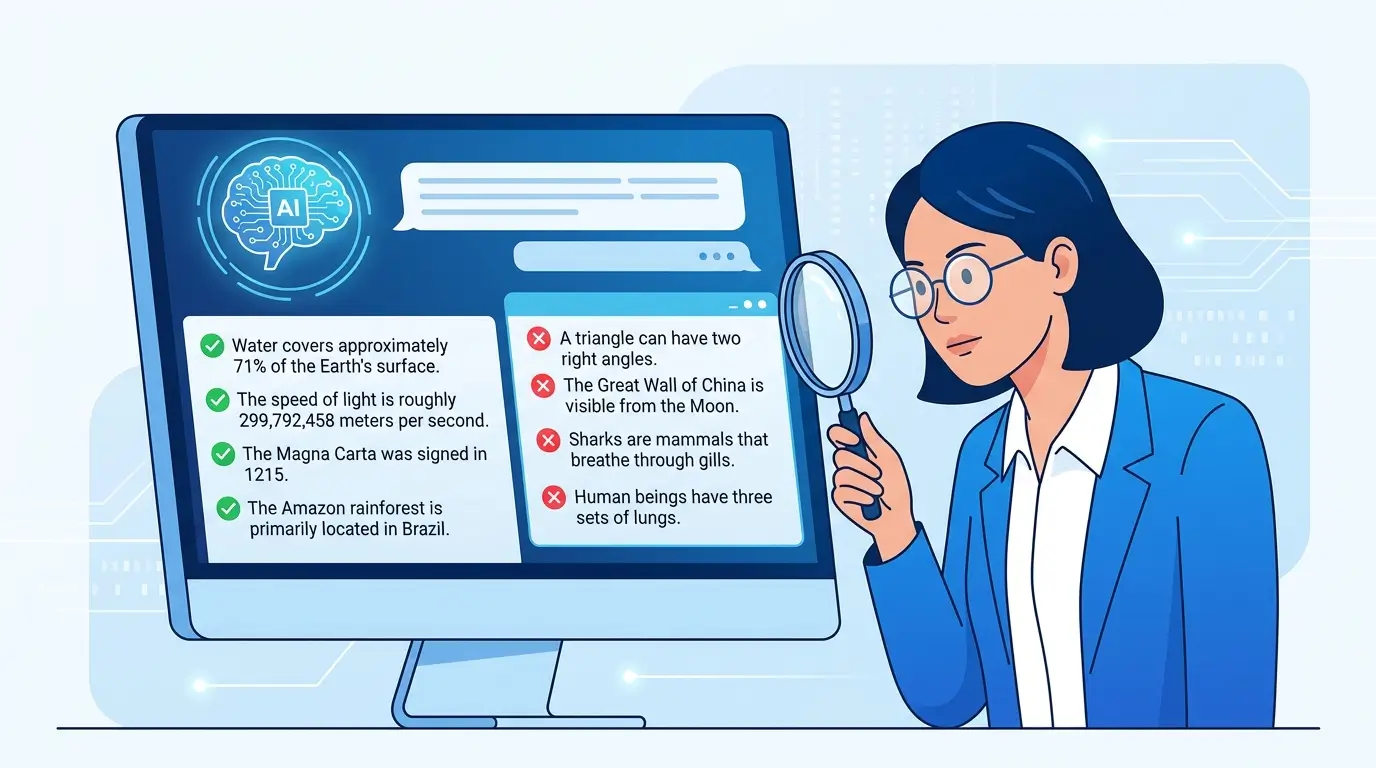
Is AI always right? If you use artificial intelligence regularly, this is one of the most important questions you should ask.
AI tools can answer questions in seconds, summarize long documents, write articles, generate code, analyze data, and explain complicated subjects. Modern AI systems can often produce remarkably detailed and convincing responses.
But convincing does not always mean correct.
AI can make mistakes.
Sometimes the mistake is obvious. Other times, AI can provide an incorrect answer with a confident explanation, making the error difficult to recognize. It may invent a citation, provide an outdated fact, misunderstand a question, or combine several pieces of information into an answer that sounds reasonable but is not actually supported by evidence.
The U.S. National Institute of Standards and Technology (NIST) describes this problem as confabulation, where generative AI systems can confidently present erroneous or false information. These outputs are also commonly called AI hallucinations. Read the NIST Generative AI Profile.
Understanding why AI makes mistakes is therefore just as important as understanding what AI can do.
Is AI Always Right?
No, AI is not always right.
AI should not be treated as an automatic source of truth. It is a technology designed to process information and generate useful outputs, but its responses can contain errors.
This distinction becomes especially important with generative AI.
When you ask an AI chatbot a question, the system does not necessarily search a perfect database of verified facts and retrieve the correct answer. Depending on the system and its available tools, it may generate a response based on patterns learned during training, information retrieved from external sources, or a combination of different processes.
That means an AI-generated answer can be fluent, detailed, and completely wrong.
For example, an AI might answer a historical question with an incorrect date. It might recommend a software function that no longer exists. It could provide a citation that looks legitimate but cannot be found anywhere.
This is why asking “Is AI always right?” should lead to another question:
“How can I verify what AI tells me?”
The answer is not to stop using AI. Instead, users need to understand where AI is reliable and where human verification is necessary.
Why Does AI Make Mistakes?
There are several reasons AI systems can produce incorrect information.
Some mistakes come from limitations in training data. Others come from ambiguity, outdated information, reasoning difficulties, or the way generative models produce responses.
AI Learns Patterns From Data
Large language models learn patterns from enormous quantities of data.
During training, models learn relationships between words, concepts, sentences, and other information. This allows them to generate remarkably natural responses.
However, generating statistically plausible language is not exactly the same as verifying whether every statement is true.
NIST explains that generative AI models approximate statistical patterns in their training data. This can produce accurate information, but it can also result in factually incorrect or internally inconsistent content.
This helps explain why AI can sound intelligent even when it is wrong.
Imagine asking an AI about a relatively obscure historical event. If the model has insufficient reliable information about that event, it may still attempt to construct a response using related patterns.
The resulting answer might sound perfectly reasonable.
That does not make it factual.
AI Does Not Always Know When It Is Wrong
Another reason people ask “Is AI always right?” is because AI does not always communicate uncertainty effectively.
A human who does not know an answer might simply say:
“I don’t know.”
A generative AI system may instead attempt to answer the question.
OpenAI’s research on hallucinations explains that language models can confidently generate answers that are not true. The research also discusses how evaluation methods can sometimes encourage models to guess instead of acknowledging uncertainty. Read OpenAI’s research on AI hallucinations.
This is a critical point.
AI confidence should not be confused with factual accuracy.
An answer can be written with certainty while the underlying claim remains uncertain.
AI Can Misunderstand the Question
AI mistakes can also happen because the question is unclear.
Consider the question:
“When was Java created?”
What does “Java” mean?
It could refer to the Java programming language, the Indonesian island, or something else.
If there is insufficient context, AI may make an assumption and provide a technically well-written answer to the wrong question.
This is why clear prompts matter.
Instead of asking:
“Tell me about Java.”
you could ask:
“Explain the history of the Java programming language, including when it was first released and who developed it.”
Providing context reduces ambiguity and makes the expected answer clearer.
AI Can Have Outdated Information
Information changes constantly.
Software frameworks release new versions. Companies change executives. Laws change. Prices change. Scientific understanding develops. New research is published.
An AI system without access to current information may provide an answer that was once accurate but is no longer current.
This is particularly important when asking questions about:
- Software versions
- Current events
- Laws and regulations
- Product specifications
- Prices
- Company information
- Sports results
- Medical recommendations
- Financial information
So when asking “Is AI always right?”, you should also ask whether the information is current.
For time-sensitive topics, verify the answer against an up-to-date primary or authoritative source.
7 Common AI Mistakes You Should Know
Understanding the most common AI mistakes makes it easier to recognize when an answer requires verification.
1. Factual Errors
The simplest AI mistake is a factual error.
AI may provide the wrong:
- Date
- Name
- Location
- Statistic
- Definition
- Historical event
- Technical specification
The answer may contain mostly correct information while one important detail is wrong.
That single error can be enough to make the final answer misleading.
2. AI Hallucinations
AI hallucinations are among the most widely discussed problems with generative AI.
A hallucination occurs when an AI generates information that appears plausible but is false, unsupported, or fabricated.
For example, an AI could invent a research paper and provide:
- A realistic title
- An author’s name
- A publication date
- A journal
- A DOI-like reference
Everything may look legitimate.
But the paper may not exist.
NIST uses the term confabulation for this type of behavior and notes that such outputs can occur because generative models predict patterns rather than directly verifying every claim against reality.
OpenAI also identifies hallucinations as a continuing challenge for large language models, even as newer models become more capable.
This is one of the strongest reasons you should not assume that AI is always right simply because the response looks professional.
3. Misleading or Incomplete Answers
An answer does not have to be completely false to be misleading.
AI can provide information that is technically correct while leaving out important context.
For example, imagine asking:
“What are the advantages of using AI in education?”
AI could provide ten legitimate advantages.
But if the answer does not discuss privacy, overreliance, inaccurate information, or the need for teacher oversight, the result may provide an incomplete picture.
A good answer should not only contain correct facts. It should also provide the context necessary to interpret those facts properly.
4. Outdated Information
An AI response may be accurate for the past but inaccurate today.
This is particularly common in technology.
A developer might ask an AI for instructions for a framework. The AI could provide code based on an older version.
The code might look perfectly reasonable but fail when used with the latest release.
The same issue can appear in business, law, finance, education, and current affairs.
Always check the publication date and version when current information matters.
5. Calculation and Reasoning Errors
AI can also make mistakes when solving complex mathematical or logical problems.
Modern reasoning models have improved significantly, but no model should automatically be assumed to produce perfect calculations.
For important calculations, use appropriate tools such as:
- Calculators
- Spreadsheets
- Programming languages
- Statistical software
- Specialized scientific tools
If a financial calculation affects a real decision, verify the numbers independently.
6. Misunderstanding Context
Context can dramatically change an answer.
A question asked by a school student may require a very different explanation from the same question asked by a software engineer.
Similarly, an AI-generated answer may fail to account for a user’s country, industry, technical environment, or specific requirements.
Providing relevant context helps reduce this problem.
7. Biased or Unbalanced Answers
AI systems learn from data created by people and organizations.
That data can contain biases, missing perspectives, cultural assumptions, and unequal representation.
Consequently, AI outputs can sometimes reproduce or amplify those limitations.
UNESCO’s guidance on generative AI emphasizes a human-centered approach and discusses issues including inclusion, equity, cultural and linguistic diversity, ethics, and human agency. Read UNESCO’s Guidance for Generative AI in Education and Research.
This does not mean every AI answer is biased.
It means users should understand that AI output is influenced by the data and systems behind it.
Why Does AI Sound So Confident When It Is Wrong?
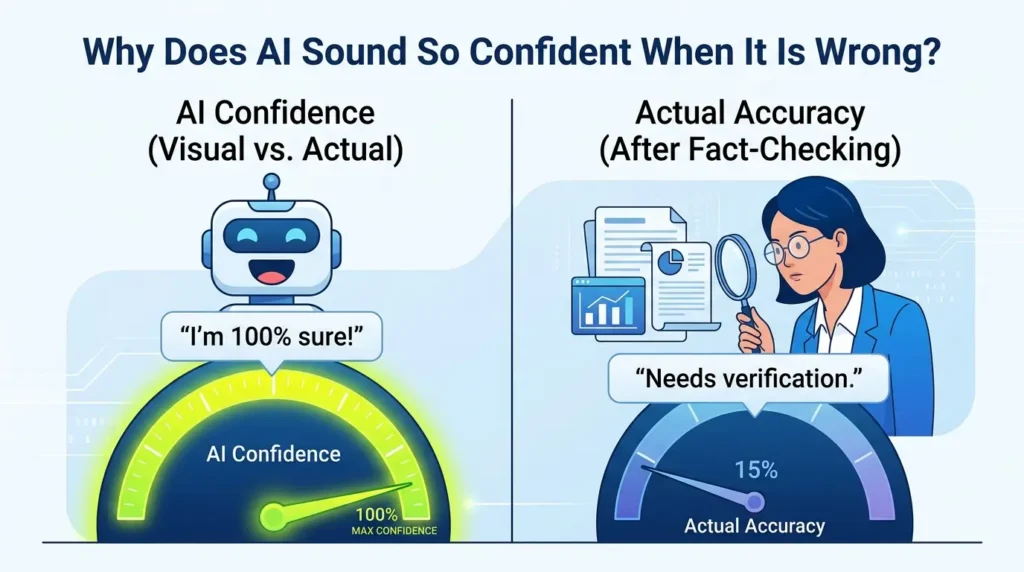
One of the most confusing aspects of AI is the way incorrect information can be presented.
An AI may say:
“According to research…”
and then provide a detailed explanation.
That language can create the impression that the information has been verified.
But the wording itself is not evidence.
This is why “Is AI always right?” is ultimately a question about trust and verification.
Consider two statements:
“This is definitely the answer.”
and
“This is supported by an authoritative source.”
The first statement expresses confidence.
The second provides evidence.
They are not equivalent.
OpenAI’s research explains that hallucinations can involve confident answers that are not true, and that models can benefit from being encouraged to express uncertainty rather than simply guessing.
When using AI, always distinguish between confidence, plausibility, and evidence.
How Can You Tell When AI Is Wrong?
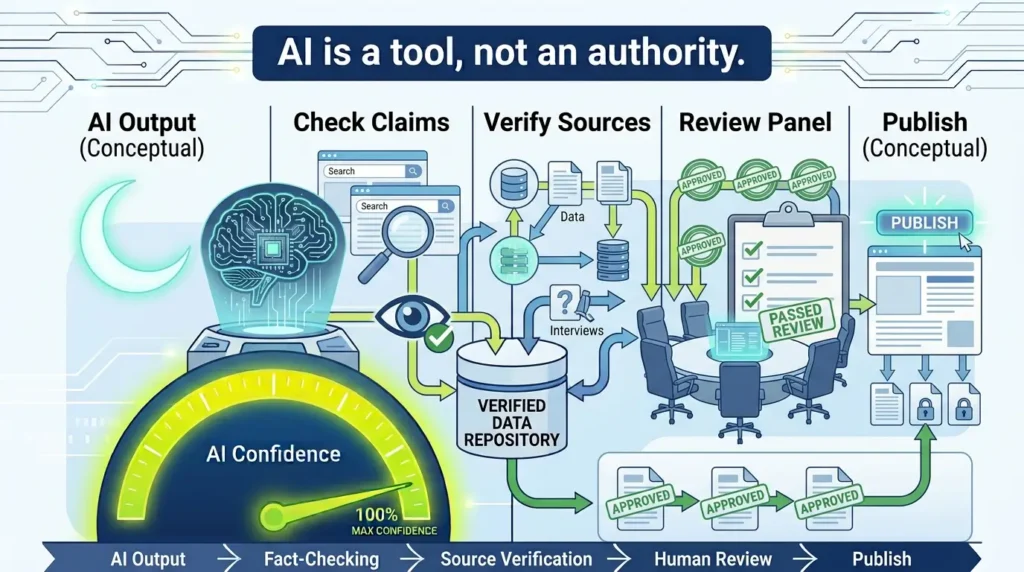
There is no perfect method for identifying every AI mistake.
However, you can significantly reduce the risk of accepting incorrect information by following a verification process.
Check Specific Claims
Pay special attention to claims involving:
- Exact numbers
- Dates
- Statistics
- Quotes
- Research findings
- Legal rules
- Medical information
- Financial information
- Names and credentials
These details are easy to verify and can have significant consequences when incorrect.
Check the Sources
If an AI provides a source, check it yourself.
Do not assume that a citation is genuine simply because it has a professional-looking format.
AI can sometimes generate nonexistent citations or incorrectly describe what a real source says.
OpenAI’s guidance also recommends verifying important information rather than assuming that an AI response is automatically accurate.
Whenever possible, open the original source.
Then ask:
Does this source actually support the claim AI made?
Compare Multiple Reliable Sources
For important questions, compare the AI response with independent sources.
Good sources can include:
- Government agencies
- Universities
- Scientific journals
- Official product documentation
- Professional organizations
- Research institutions
Do not simply look for several websites repeating the same information.
Look for independent evidence.
Ask AI to Separate Facts From Assumptions
You can also improve your prompts.
For example:
“Separate verified facts from assumptions. Identify claims that require external verification and tell me where uncertainty exists.”
This does not guarantee that the AI will be correct.
However, it encourages a more critical interaction and makes it easier to identify information that deserves additional checking.
When Should You Not Trust AI Without Verification?
Not every AI response needs the same level of scrutiny.
If you ask AI for blog title ideas, you probably do not need to verify every suggestion.
If you ask it to explain a basic concept, checking important facts is still useful, but the consequences of a minor mistake may be relatively low.
The situation changes when the answer could affect someone’s health, finances, education, legal position, safety, or professional work.
Medical Information
AI can help explain medical terminology or provide general educational information.
However, it should not replace qualified medical professionals or authoritative medical resources when making diagnosis or treatment decisions.
Legal Information
Laws differ between countries and jurisdictions.
They also change over time.
Legal information generated by AI should therefore be checked against current legislation, official government resources, or qualified legal professionals.
Financial Information
Financial decisions can have real consequences.
Investment decisions, taxation, loans, insurance, and business finances should not be based solely on an AI-generated answer.
Academic Research
Students and researchers should verify AI-generated citations, statistics, quotations, and research claims against the original sources.
A fabricated citation can damage the credibility of an entire paper.
Software Development
AI can produce useful code, but generated code still needs testing and review.
This is particularly important for:
- Authentication
- Payments
- Database access
- Encryption
- APIs
- Infrastructure
- Security-sensitive applications
A small coding mistake can create a serious vulnerability.
How to Use AI Without Relying on It Blindly
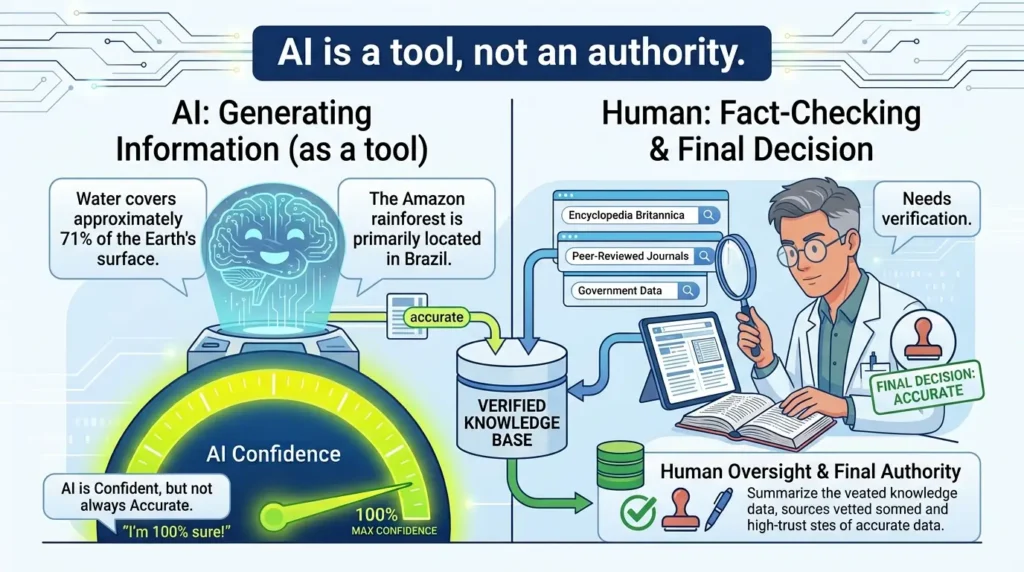
The solution to AI mistakes is not to stop using AI.
Instead, use AI as a tool rather than an authority.
A practical workflow looks like this.
Step 1: Ask AI
Use AI to brainstorm ideas, explain concepts, summarize information, generate drafts, analyze data, or create a starting point.
Step 2: Identify Important Claims
Review the answer and identify statements that matter to your decision.
Step 3: Verify Those Claims
Check important information against reliable and current sources.
Step 4: Review the Context
Ask whether the information actually applies to your specific situation.
Step 5: Make the Final Decision
Use human judgment and professional expertise where appropriate.
This workflow allows you to benefit from AI’s speed while reducing the risk of accepting incorrect information.
Is AI Getting Better at Avoiding Mistakes?
Yes, AI systems are improving.
Developers and researchers are working on better training methods, retrieval systems, evaluation techniques, reasoning capabilities, and approaches for reducing hallucinations.
NIST’s Generative AI Profile provides a framework for identifying and managing risks associated with generative AI systems. Explore NIST’s AI Risk Management Framework.
Research into hallucination detection and uncertainty estimation is also continuing.
However, improvement does not mean perfection.
Even highly capable models can produce incorrect information.
In fact, more sophisticated AI may make some errors harder to identify because the output becomes increasingly polished and persuasive.
That makes AI literacy increasingly important.
What Should Students Learn About AI Mistakes?
Students should learn more than how to operate AI tools.
They should learn how to evaluate AI-generated information.
A basic AI literacy approach can teach students to ask:
- Who created this information?
- Where did the information come from?
- Can I verify it independently?
- Is the information current?
- Does another reliable source support the claim?
- Could AI have misunderstood the question?
- What happens if the information is wrong?
These questions develop critical thinking rather than technological dependence.
UNESCO’s work on AI competency frameworks for students and teachers emphasizes the development of competencies needed to use AI appropriately and critically. Explore UNESCO’s AI and Education resources.
The objective is not to teach students that AI is bad.
It is to teach them when AI is useful, when it may be unreliable, and when human judgment is essential.
AI Is a Tool, Not an Authority
So, is AI always right?
No.
AI can be incredibly useful while still making mistakes.
It can help people write, research, code, learn, analyze information, and solve problems. But none of those capabilities mean every AI-generated statement should automatically be treated as fact.
The most important lesson is simple:
Confidence is not proof. Fluency is not accuracy. And an AI-generated answer is not automatically a verified fact.
The right approach is to match your level of verification to the consequences of being wrong.
For casual brainstorming, a quick AI response may be enough.
For academic research, verify the sources.
For production software, test and review the code.
For medical, legal, financial, or safety-critical decisions, consult appropriate authoritative sources and qualified professionals.
AI does not have to be perfect to be useful.
But users need to understand its limitations.
The future of effective AI use will not depend only on building more capable models. It will also depend on people becoming better at questioning, verifying, and critically evaluating AI-generated information.
Frequently Asked Questions
Can AI give wrong answers?
Yes. AI systems can produce factual errors, outdated information, misleading explanations, reasoning mistakes, and fabricated sources. Generative AI can also produce confident but false statements, commonly described as hallucinations or confabulations.
Why does AI make mistakes?
AI can make mistakes because it generates responses from learned patterns and available information rather than functioning as a perfect truth-verification system. Ambiguous questions, incomplete information, outdated data, and uncertainty can all contribute to errors.
What is an AI hallucination?
An AI hallucination is an output that appears plausible but contains information that is false, unsupported, or fabricated. Examples include invented citations, incorrect facts, nonexistent research papers, and fabricated quotations.
Should I trust information generated by AI?
AI-generated information can be useful, but important claims should be independently verified. The amount of verification needed depends on the importance of the information and the consequences of an incorrect answer.
How can I reduce AI mistakes?
Give AI clear context, ask specific questions, request sources when appropriate, use current information when necessary, verify important claims, and apply human judgment before acting on the result.
Is AI becoming more accurate?
AI systems are becoming more capable, and researchers are developing better methods for reasoning, retrieval, evaluation, uncertainty estimation, and hallucination reduction. However, AI systems can still make mistakes and should not be treated as infallible.
Final Takeaway
If you remember only one thing from this article, remember this:
AI is powerful, but it is not always right.
Use AI to accelerate your work, generate ideas, explain concepts, and explore possibilities.
But when accuracy matters, verify before you trust.
That simple habit can help you get the benefits of artificial intelligence without becoming overly dependent on its answers.