How Does AI Learn? 5 Amazing, Easy Steps Explained Simply
Introduction
If you’ve ever wondered how does AI learn, you’re not alone and you don’t need a computer science degree to understand it. Underneath all the technical language, the basic idea is surprisingly simple: AI learns the way most of us learn, just much, much faster and with far more examples.
This guide breaks down how does AI learn into 5 easy steps, using everyday comparisons instead of technical jargon. No code, no math, no confusing terms just a clear picture of what’s actually happening.
Why Understanding How Does AI Learn Matters
You don’t need to build an AI system to benefit from understanding how does AI learn. A basic grasp of the process helps you:
- Judge when to trust an AI answer and when to double-check it
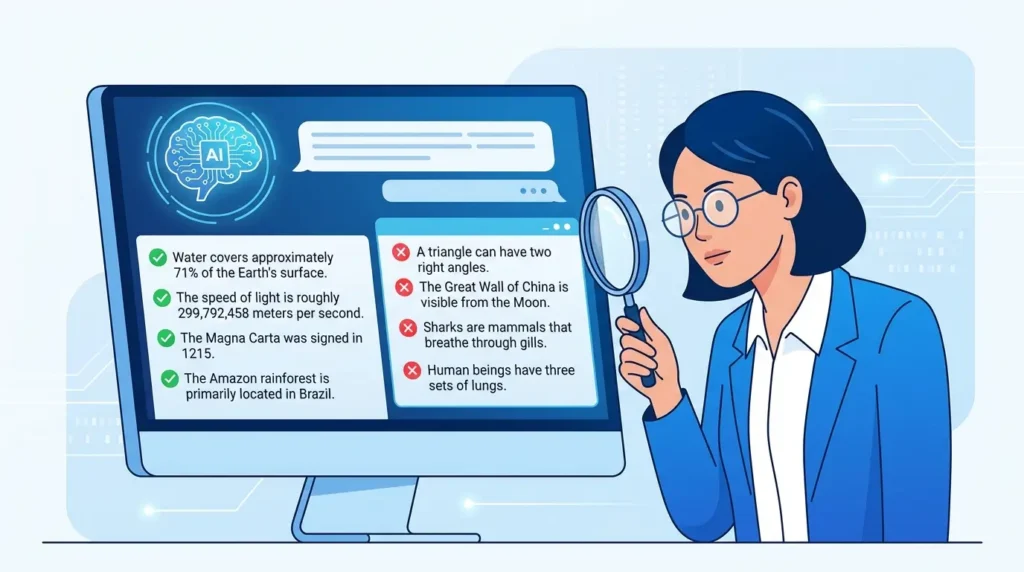
- Understand why AI sometimes gets things confidently wrong
- Have informed conversations about AI at work, school, or home
- Feel less intimidated by a technology that’s becoming part of daily life
How Does AI Learn? 5 Easy Steps
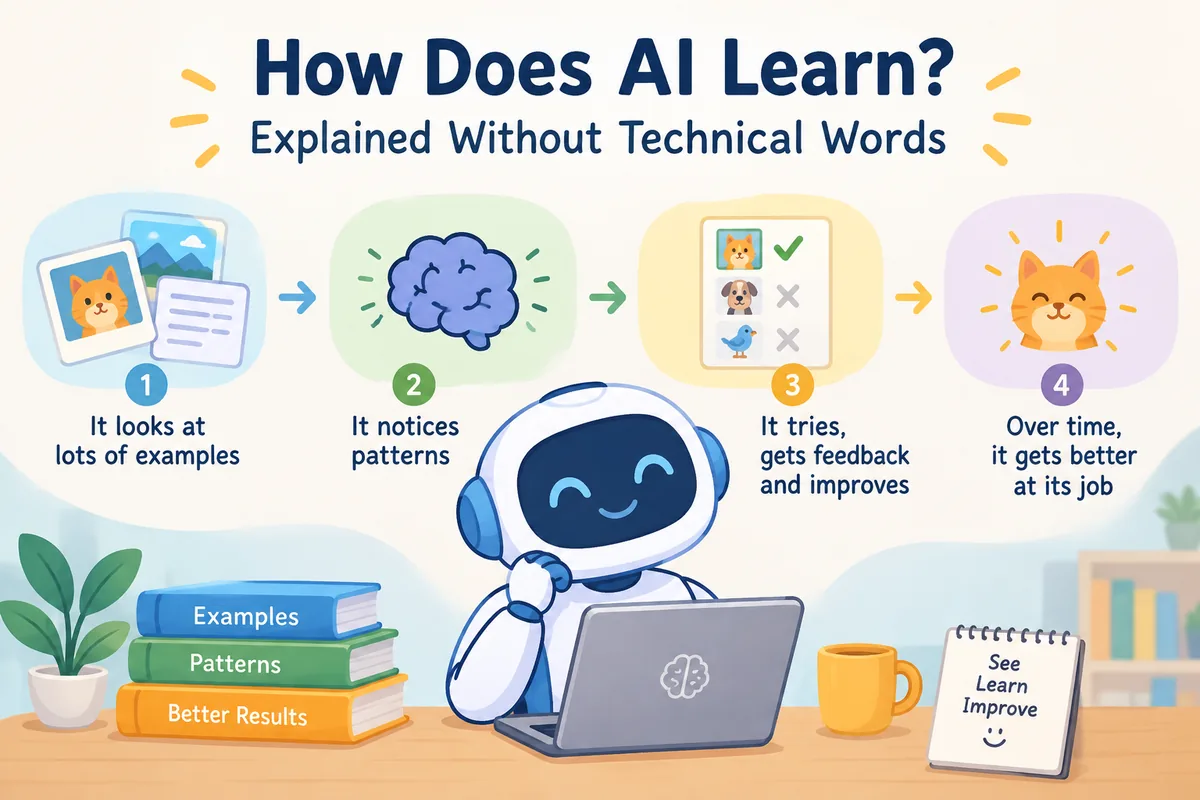
Step 1: It Starts With a Huge Pile of Examples
AI doesn’t start out knowing anything. It starts with a massive collection of examples photos, text, sounds, or other information that humans have gathered.
Think of it like showing a child thousands of pictures of dogs before asking them to identify one on their own. The more (and more varied) examples an AI sees, the better it can learn to recognize patterns in new situations.
In plain terms: No examples, no learning. Everything an AI “knows” traces back to the data it was shown.
Step 2: It Looks for Patterns, Not Rules
Instead of being told explicit rules (“a cat has pointy ears and whiskers”), AI is left to notice patterns on its own by comparing thousands of examples.
This is a lot like how you might recognize a friend’s handwriting without being able to explain exactly what makes it recognizable you’ve just seen enough of it to know.
In plain terms: AI finds patterns in data the same way you might notice a pattern without being able to fully explain it in words.
Step 3: It Makes a Guess and Checks Itself
Once it has looked at enough examples, the AI starts making guesses is this a cat or a dog? Is this sentence positive or negative? Each guess gets compared against the correct answer.
This is similar to taking a practice test, checking your answers, and seeing where you went wrong.
In plain terms: Guessing and checking is the core “learning” moment not memorizing, but adjusting based on right and wrong answers.
Step 4: It Adjusts and Tries Again Thousands of Times
When the AI’s guess is wrong, small internal adjustments are made so it’s a little more likely to get a similar question right next time. Then it tries again. And again. Often millions of times.
Imagine practicing free throws in basketball. Your first shot might miss badly. Your hundredth shot is closer. Your thousandth shot might be pretty reliable. AI goes through an extreme, sped-up version of the exact same process.
In plain terms: “Training” an AI really just means repeating the guess-check-adjust cycle an enormous number of times.
Step 5: It Gets Tested on Things It Hasn’t Seen Before
Finally, the AI is tested using new examples it has never encountered during training to check whether it actually learned the pattern, rather than just memorizing the specific examples it was shown.
This is similar to a final exam covering material slightly different from the practice problems it tells you whether real understanding happened, not just memorization.
In plain terms: A well-trained AI should perform reasonably well on new, unseen situations, not just the exact examples it studied.
A Simple Analogy for How Does AI Learn
If you want one mental picture to hold onto: AI learning is a lot like learning to ride a bike by wobbling, falling, adjusting, and trying again except an AI can “practice” millions of times in the time it takes a person to try a few dozen times.
The core ingredients are always the same: examples, pattern-spotting, guessing, feedback, and repetition. Everything more advanced builds on this same basic loop.
What This Explains About AI’s Limitations
Understanding how does AI learn also explains some of its most common weaknesses:
- It can be confidently wrong. AI makes its best statistical guess based on patterns it doesn’t “know” the way a person knows, so a wrong guess can still sound very sure of itself.
- It reflects its examples. If the examples it learned from were biased, incomplete, or outdated, its answers will reflect that.
- It struggles with truly new situations. Anything very different from what it was trained on is harder for it to handle well, since it has nothing similar to compare it to.
This is exactly why double-checking important AI answers is a healthy habit, not a sign of distrust — it’s simply understanding how the process works. If you want to see how does AI learn play out in real, everyday situations, our AI in Everyday Life guide walks through 10 common examples. And if you’re curious how this same idea applies to fun, hands-on practice at home, our AI Games and Activities guide has ideas the whole family can try.
How Does AI Learn Compared to How People Learn?
The comparison isn’t perfect, but it’s a genuinely useful starting point:
| People | AI |
|---|---|
| Learn from relatively few examples | Learn from massive numbers of examples |
| Understand meaning and context | Recognizes patterns, without true understanding |
| Can learn from a single strong experience | Usually needs repeated exposure to learn a pattern |
| Adjusts slowly, over years | Adjusts extremely quickly, over repeated training cycles |
This is part of why AI can outperform people at narrow, pattern-heavy tasks (like sorting huge amounts of data) while still struggling with things a five-year-old finds easy, like understanding a joke.
Try This Simple Explanation Test
A fun way to check your own understanding of how does AI learn: try explaining it to someone else using only the basketball free-throw analogy or the bike-riding analogy from this guide, without using any technical terms at all.
If you can do that, you already understand the core idea better than most people do and that’s really all “how does AI learn” means at its heart.
Common Myths About How Does AI Learn
A few misunderstandings tend to come up when people first learn how does AI learn:
Myth: AI understands things the way people do. In reality, AI is matching patterns based on examples it doesn’t have beliefs, feelings, or true comprehension, even when its answers sound confident and natural.
Myth: AI is learning constantly, in real time, from every conversation. Most AI tools you interact with day to day aren’t updating themselves from your individual conversations. Their core learning happened earlier, during a separate training process, using a large, pre-gathered set of examples.
Myth: More training always means a smarter, more correct AI. More examples generally help, but quality and variety of data matter just as much as quantity. Extensive training on flawed or narrow examples can still produce an AI that’s confidently wrong in predictable ways.
Myth: If AI can learn one thing well, it can learn anything well. AI systems are typically trained for specific types of tasks. One that’s excellent at recognizing images may perform poorly at understanding language, because each was trained on very different examples for a very different purpose.
Clearing up these myths is often just as useful as learning the basic steps — it sets realistic expectations for what AI can and can’t do well.
Related Source
IBM — What Is Machine Learning? IBM’s overview explains machine learning as a branch of AI focused on using data and algorithms to imitate how humans learn, gradually improving accuracy over time.
Read IBM’s explanation of machine learning
Frequently Asked Questions
How does AI learn without being explicitly programmed for every situation? AI learns by studying large numbers of examples and finding patterns in them, rather than following a fixed set of pre-written rules for every possible situation.
Does AI learn the same way people do? Not exactly. AI usually needs far more repeated examples than a person would, and it doesn’t understand meaning the way people do it recognizes statistical patterns instead.
Why does AI sometimes get things wrong even after all that training? AI’s answers are only as good as the patterns in the data it learned from. If a situation is very different from its training examples, or the data itself was flawed, mistakes are more likely.
Do I need to understand how does AI learn to use AI tools safely? No, but a basic understanding helps you know when to trust an answer and when to double-check it which makes you a more informed, confident AI user.
Is “how does AI learn” the same question as “how does AI work”? They’re closely related. “How AI works” is often broader (covering how it processes a request), while “how does AI learn” focuses specifically on how it improved during training.