How to Explain Artificial Intelligence to a 10-Year-Old With Simple Analogies
Introduction
If your 10-year-old asks, “What is AI?”, you do not need to explain algorithms, neural networks, or computer science. Start with something familiar. You might say: “AI is a computer system that learns patterns from lots of examples and uses those patterns to make guesses, answers, or decisions.”
Then use everyday comparisons. Simple analogies can help children understand what AI does without making it sound magical or more intelligent than it really is.
Analogy 1: AI Is Like a Pattern Detective
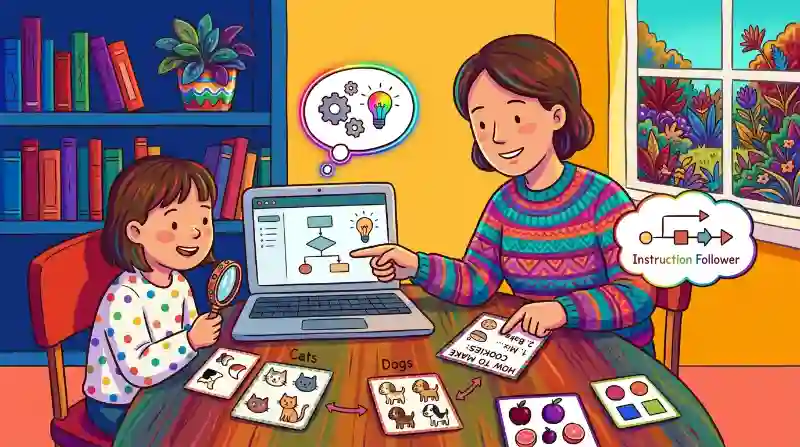
Imagine showing a child 20 pictures of dogs and 20 pictures of cats. After looking at them, the child may notice patterns:
- Dogs often have certain face shapes.
- Cats may have different ears or features.
- Some features appear again and again.
AI can also learn patterns from examples. You can tell your child: “AI is like a detective that looks for clues in lots of examples.”
If you later show it a new animal picture of cat or a dog, it can use the patterns it learned to make a guess. Machine-learning activities for children use this same basic idea: examples help a computer find patterns and make predictions.
Analogy 2: AI Is Like Learning From Flashcards
Think about learning multiplication tables with flashcards. The more examples you practise, the easier it becomes to notice what usually happens. (training.chimpvie.com)
AI also learns from data. For a child, you can simply explain data as:
“Information and examples that a computer can learn from.”
If an AI learns from poor, incomplete, or one-sided examples, its answers can also be poor. That is an important lesson for children: AI does not automatically know everything. What it learns depends partly on the information used to teach it.
Analogy 3: AI Is Like Following a Recipe
A recipe needs instructions. If the recipe says:
“Make something tasty.”
you would not know exactly what to make. But if it says:
“Make a vegetable momo filling using cabbage, carrot, onion, and simple spices.”
the task becomes much clearer. AI works better when people also give it clear instructions. You can tell your child: “Talking to AI is a little like giving someone a recipe. Clear instructions help it understand what you want.” This is why asking a clear question often gives a more useful answer than asking something very vague.
Analogy 4: AI Is a Guessing Machine, Not a Know-Everything Brain
This may be the most important analogy. Ask your child to imagine a friend playing a guessing game.
The friend studies the clues and gives the answer they think is most likely.
Sometimes they are right.
Sometimes they are wrong.
AI can work in a similar way.
It can produce an answer that sounds very confident even when the answer is not correct.
So explain:
“AI can be very good at guessing from patterns, but we still need to check important answers.”
Children should understand that AI is a tool, while people remain responsible for deciding whether its answer makes sense.
Show Your Child AI They Already Know
Once your child understands the analogies, ask: “Where do you think you have already seen AI?”
They may think of:
- Video recommendations
- Maps suggesting routes
- Voice assistants
- Phone cameras
- Games
- Chatbots
This makes AI feel less mysterious.
You can even turn it into a small family game: find three examples of AI during the week and discuss what each one might be trying to predict or decide. Children can learn AI concepts effectively through everyday examples, discussion, role-play, and hands-on activities rather than technical explanations alone.
Conclusion
You do not need to explain every technical detail of AI to a 10-year-old. Start with four simple ideas: AI looks for patterns, AI learns from examples, AI follows instructions, AI can make mistakes. Most importantly, remind your child that AI is a tool made by people. We can use it to learn and create, but our own curiosity, judgment, and thinking still matter.
Related Sources
- https://dayofai.org/units/what-is-artificial-intelligence (Day of AI)
- https://dayofai.org/units/ai-literacy-in-15-minutes-or-less (Day of AI)
- https://www.commonsensemedia.org/articles/helping-kids-navigate-the-world-of-artificial-intelligence (Common Sense Media)
- https://www.chimpvine.com/ai-detective-challenge/ (training.chimpvie.com)
- https://www.chimpvine.com/how-ai-learns-patterns/ (training.chimpvie.com)
Frequently Asked Questions
Not at first. A 10-year-old can understand basic AI ideas through examples, games, and analogies before learning the technical side.
No. AI can recognize patterns and produce useful answers, but it does not think and understand the world exactly as a person does.
Start with patterns. Show your child groups of pictures or objects and explain how examples can help a computer learn to recognize similarities.