Should Children Use ChatGPT? What Parents Need to Know
Artificial intelligence is becoming part of everyday life, and children are encountering AI earlier than ever. From homework help and creative writing to answering questions and explaining difficult topics, tools such as ChatGPT can be useful learning companions. But this also raises an important question for parents: Should children use ChatGPT?
The answer is not simply yes or no. ChatGPT can provide educational benefits when it is used appropriately, but children also need guidance around accuracy, privacy, screen time, emotional dependence, and age-appropriate use.
In this guide, we explain what parents should know about children using ChatGPT, including the potential benefits, risks, age considerations, and practical rules for safer AI use at home.
Should Children Use ChatGPT?
Children can benefit from AI when it is used as a learning and thinking tool rather than a replacement for teachers, parents, or independent thinking.
ChatGPT can explain difficult concepts, help children brainstorm ideas, practice languages, generate examples, and answer questions in an interactive way. However, AI can also provide incorrect information, produce inappropriate content, or encourage children to rely on instant answers instead of developing their own problem-solving skills.
OpenAI states that ChatGPT is not intended for children under 13, while users aged 13–18 require parental consent. In educational settings involving children under 13, the actual interaction with ChatGPT should be conducted by an adult. OpenAI’s age guidance for ChatGPT
Therefore, the better question is not simply “Should children use ChatGPT?” but rather:
“How can children use ChatGPT safely, responsibly, and in a way that supports learning?”
Is ChatGPT Safe for Children?
ChatGPT is not automatically safe for every child simply because it is an educational tool.
AI systems can sometimes generate inaccurate, confusing, biased, or age-inappropriate responses. Children may also assume that an answer sounds trustworthy simply because it is written confidently.
UNICEF’s guidance on AI and children emphasizes several important areas, including child safety, privacy, fairness, transparency, well-being, and preparing children for an AI-powered future.
Parents should therefore treat ChatGPT like other powerful digital tools: use it with appropriate boundaries and teach children how to use it responsibly.
What Are the Benefits of ChatGPT for Children?
When used appropriately, ChatGPT can support children’s learning in several ways.
1. It Can Explain Difficult Topics
Children often struggle because a textbook explanation is too complicated or moves too quickly.
A child can ask ChatGPT to explain a topic using simpler language, examples, analogies, or step-by-step explanations.
For example:
“Explain photosynthesis like I am 10 years old.”
This can make complicated concepts easier to understand.
2. It Can Help With Homework
ChatGPT can help children understand homework questions without simply giving them the final answer.
For example, instead of asking:
“Give me the answer to this math problem.”
Children can ask:
“Show me how to solve this problem step by step.”
This encourages learning rather than copying.
3. It Can Encourage Creativity
Children can use AI to brainstorm stories, characters, poems, science-project ideas, and creative activities.
The important distinction is that the child should remain the creator.
AI can provide suggestions, while the child decides what to use, changes the ideas, and creates the final work.
4. It Can Support Language Learning
ChatGPT can help children practice vocabulary, grammar, sentence construction, and conversational skills.
For example, a child learning English could ask ChatGPT to have a simple conversation and correct mistakes.
5. It Can Encourage Questions
Children naturally ask lots of questions. AI can provide an interactive way to explore subjects that interest them.
However, parents should also encourage children to compare AI answers with books, teachers, trusted websites, and other reliable sources.
What Are the Risks of ChatGPT for Children?
The benefits of AI do not eliminate the risks.
Parents should understand several important concerns before allowing children to use ChatGPT.
1. ChatGPT Can Make Mistakes
One of the biggest misconceptions children can have is that AI always knows the correct answer.
It does not.
ChatGPT can generate incorrect information while presenting it confidently. This is particularly important when children ask questions about science, history, health, current events, or other subjects where accuracy matters.
Teach children a simple rule:
AI answers should be checked, not automatically trusted.
2. Children May Become Too Dependent on AI
If children use ChatGPT for every homework question, they may gradually stop trying to solve problems independently.
Instead of asking:
“Can ChatGPT do this for me?”
Encourage children to ask:
“Can ChatGPT help me understand this?”
That small difference can change AI from an answer machine into a learning tool.
3. Privacy Can Be a Concern
Children may not understand what information should remain private.
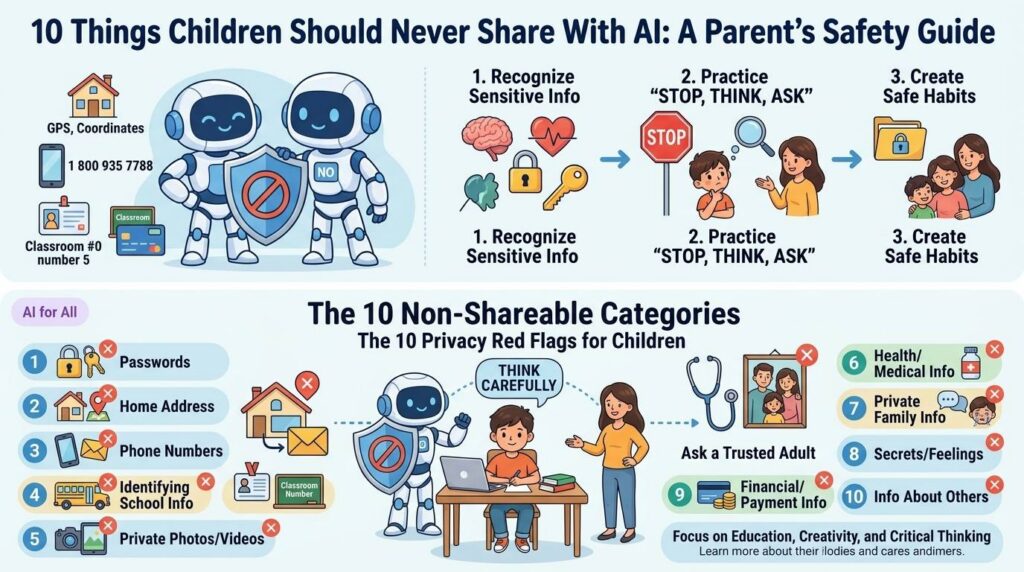
Parents should teach children never to enter sensitive information into AI tools, such as:
- Full home addresses
- Passwords
- Phone numbers
- Financial information
- Private family information
- School account credentials
- Personal information about other children
UNICEF specifically identifies children’s data and privacy as important considerations for child-centered AI.
4. AI Can Produce Inappropriate Content
Although AI systems have safety measures, children may still encounter content that is confusing or inappropriate.
Parents should not assume that an AI chatbot will always respond exactly as a human teacher or parent would.
This is one reason age-appropriate safeguards and adult guidance matter.
5. Emotional Dependence Can Develop
Some AI systems are designed to feel conversational and personal. Children may begin treating chatbots like friends, advisors, or people they can rely on emotionally.
UNICEF has specifically highlighted concerns around children forming relationships with AI chatbots and companion-like systems.
Children should understand that an AI chatbot is a technology system, not a human friend, therapist, parent, or trusted adult.
If a child has a serious emotional or personal problem, they should be encouraged to speak with a parent, teacher, counselor, or another trusted adult.
What Age Can Children Use ChatGPT?
Age is one of the most important considerations when deciding whether children should use ChatGPT.
OpenAI currently states that ChatGPT is not intended for children under 13. Users aged 13 to 18 need parental consent. In educational situations involving children under 13, the actual interaction with ChatGPT should be conducted by an adult.
OpenAI also introduced ChatGPT for Teens in August 2026. Eligible users identified as under 18 can receive additional safeguards designed for teens, including age-appropriate protections.
This means parents should not treat every age group in the same way.
A five-year-old, a ten-year-old, and a sixteen-year-old have very different levels of independence, digital literacy, and ability to evaluate information.
Should Younger Children Use ChatGPT With Parents?
For younger children, supervised use is generally a better approach than giving them unrestricted access to an AI chatbot.
Parents can sit with children while they use AI and turn the experience into a learning activity.
For example, a parent could ask:
Child: “Why is the sky blue?”
AI: Provides an explanation.
Parent: “Does that explanation make sense? Let’s check it together.”
This teaches children an important digital skill:
AI can help you learn, but you should still think and verify.
For children under 13, OpenAI specifically says that interaction with ChatGPT in educational contexts should be conducted by an adult.
How Parents Can Teach Children to Use ChatGPT Safely
Parents do not necessarily need to ban AI. Instead, they can establish clear rules.
Rule 1: Never Share Private Information
Teach children that an AI chatbot does not need to know their address, passwords, school account details, or private family information.
Rule 2: Check Important Answers
For important information, children should verify AI responses using teachers, textbooks, official websites, or other trusted sources.
Rule 3: Use AI to Learn, Not Cheat
Make it clear that using ChatGPT to understand homework is different from asking it to complete an assignment and submitting the response as your own.
Rule 4: Think Before Trusting
Teach children to ask:
- Does this answer make sense?
- Where did this information come from?
- Could the AI be wrong?
- Can I confirm it somewhere else?
Rule 5: Keep Humans Involved
AI should not replace conversations with parents, teachers, friends, counselors, or other trusted people.
Rule 6: Set Healthy Boundaries
Parents can establish limits around when and how AI can be used.
For example:
- No AI during family meals
- No AI late at night
- Homework first, AI second
- Verify important information
- Ask an adult when something feels confusing or uncomfortable
OpenAI’s current parental controls for linked teen accounts allow parents and guardians to manage selected settings, set quiet hours, and receive limited safety notifications. Importantly, parental controls do not provide parents with access to the teen’s conversations or real-time activity.
How Teachers and Parents Can Encourage Better AI Habits
The best way to prepare children for AI is not simply to tell them what they cannot do.
They need to learn AI literacy.
AI literacy means understanding what AI can do, where it can make mistakes, how to use it responsibly, and when human judgment is necessary.
Parents can practice this by asking children to:
- Ask ChatGPT a question.
- Read its answer carefully.
- Identify anything that might be incorrect.
- Check the information using another reliable source.
- Explain the answer in their own words.
This turns AI use into a critical-thinking exercise.
UNICEF’s current guidance emphasizes preparing children with the skills they need to navigate AI while protecting their safety, privacy, rights, and well-being.
ChatGPT for Homework: Good or Bad?
ChatGPT for homework can be both helpful and harmful depending on how it is used.
Good Use
A student doesn’t understand fractions and asks ChatGPT:
“Explain fractions using a pizza example and then give me three practice questions.”
The student works through the questions independently.
Poor Use
A student copies an entire essay generated by ChatGPT and submits it as their own work.
The first example supports learning.
The second can prevent learning and may violate a school’s academic-integrity rules.
Parents should therefore focus less on whether AI is being used and more on how it is being used.
A Simple AI Safety Checklist for Parents
Before allowing a child to use ChatGPT, parents can ask:
Is the child old enough to use the service?
Does the child understand that AI can make mistakes?
Does the child know not to share private information?
Is the child using AI to learn rather than simply copy answers?
Can the child recognize when they need help from a real person?
Are there reasonable limits on screen time and AI use?
Is a parent or teacher involved when the child needs additional guidance?
If the answer to these questions is yes, AI can become a useful part of a child’s digital education.
The Future of Children and AI
The question of whether children should use ChatGPT is becoming increasingly important because AI is not disappearing.
Children are already encountering artificial intelligence through search engines, educational applications, recommendation systems, games, social platforms, and chatbots.
UNICEF reported in 2026 that children are adopting AI rapidly, with children in its research using AI for learning, homework, and advice.
The goal should therefore not simply be to keep children away from AI.
Instead, parents, schools, and technology companies need to help children develop the skills to use AI safely and responsibly.
Final Thoughts: Should Children Use ChatGPT?
So, should children use ChatGPT?
For young children, direct and unsupervised use is not appropriate. For older children and teens who meet the applicable age requirements, ChatGPT can be a useful educational tool when parents and educators establish clear boundaries.
The key is responsible use.
ChatGPT should help children ask better questions, understand difficult ideas, practice skills, and explore their creativity. It should not replace teachers, parents, friendships, independent thinking, or real-world experiences.
The most valuable lesson parents can teach is simple:
Use AI as a tool, not as a replacement for your own thinking.
As AI becomes a bigger part of childhood, teaching children how to use it safely may be just as important as teaching them how to use the internet responsibly.