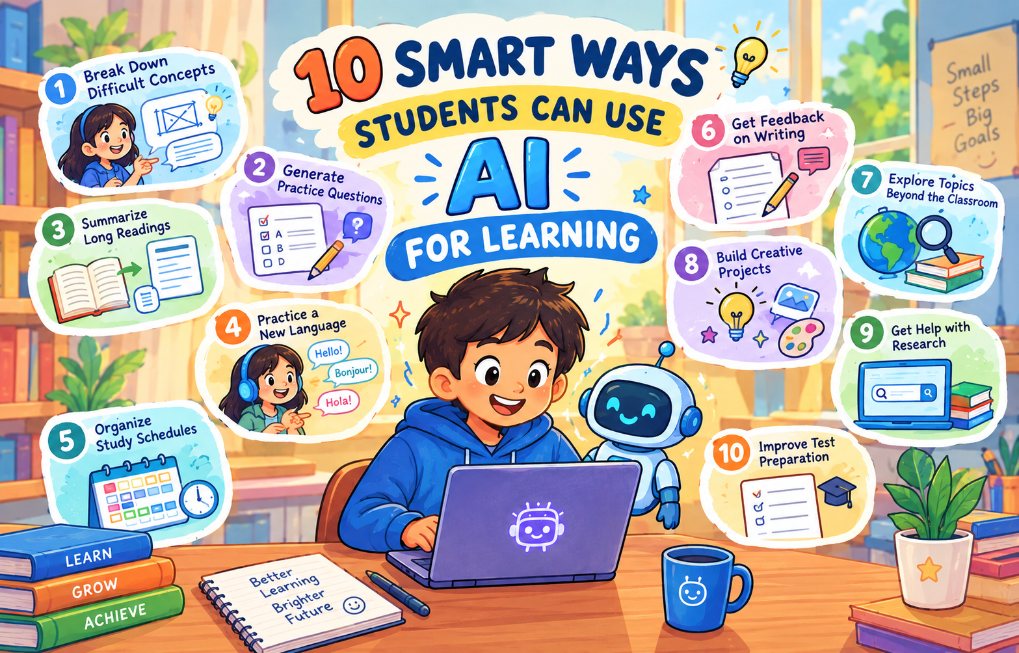
How to Use ChatGPT to Understand Difficult Subjects: 7 Powerful Tips for Easier Learning

Some subjects can feel impossible to understand, especially when textbooks use complicated language or a topic contains several difficult concepts at once. Fortunately, AI tools such as ChatGPT can make learning more interactive and easier to understand.
Knowing how to use ChatGPT to understand difficult subjects can help students turn confusing topics into simple explanations, examples, practice questions, quizzes, and step-by-step lessons.
However, ChatGPT works best as a learning assistant rather than a tool for simply copying answers. When used correctly, it can support independent learning, critical thinking, and active recall.
In this guide, we will explore how to use ChatGPT to understand difficult subjects, along with practical prompts and strategies that students can start using immediately.
What Is ChatGPT?
ChatGPT is an AI-powered conversational tool that can answer questions, explain concepts, generate examples, summarize information, and help users practice different skills.
Students can use ChatGPT to approach the same topic from different angles. For example, instead of asking only for an answer to a mathematics problem, a student can ask ChatGPT to explain the method step by step and then create similar problems for practice.
For more information about ChatGPT, visit OpenAI’s official ChatGPT website.
Why Learn How to Use ChatGPT to Understand Difficult Subjects?
The biggest advantage of ChatGPT is that students can ask follow-up questions whenever something remains unclear.
A textbook normally presents information in a fixed format. ChatGPT can adapt its explanation based on the learner’s questions.
For example, a student can ask:
“Explain photosynthesis in simple language.”
If that explanation is still difficult, the student can continue with:
“Explain it as if I am 12 years old.”
Then:
“Give me a real-world example.”
Then:
“Give me five questions to test whether I understood it.”
This interactive process makes how to use ChatGPT to understand difficult subjects much more practical than simply asking for an answer.
How to Use ChatGPT to Understand Difficult Subjects Step by Step
1. Ask ChatGPT to Explain the Topic in Simple Language
One of the easiest ways to use ChatGPT for learning is to ask for a simpler explanation.
Instead of asking:
“What is recursion?”
Try:
“Explain recursion in simple language with a small programming example.”
You can also specify your education level:
“Explain recursion to a beginner who has never studied it before.”
This helps reduce unnecessary technical terminology.
2. Ask for Multiple Explanations
Sometimes one explanation isn’t enough.
When learning how to use ChatGPT to understand difficult subjects, ask ChatGPT to explain the same concept in different ways.
For example:
“Explain operating systems using a real-world analogy.”
Then:
“Explain the same concept using a technical definition.”
Then:
“Compare the two explanations in a simple table.”
Seeing a difficult concept from multiple perspectives can make it easier to remember.
3. Break Large Topics Into Smaller Parts
Large chapters can become overwhelming when studied all at once.
Instead, ask ChatGPT to divide the topic into smaller sections.
For example:
“Break database normalization into five smaller concepts and teach them one at a time.”
After understanding the first concept, continue to the next one.
This approach is particularly useful for subjects such as programming, mathematics, database systems, physics, economics, and computer science.
4. Use ChatGPT as a Personal Tutor
One powerful way to learn how to use ChatGPT to understand difficult subjects is to turn the conversation into a tutoring session.
Try this prompt:
“Act as my personal tutor. Teach me this topic step by step. Do not give me the complete answer immediately. Ask me questions and correct my mistakes.”
This encourages active participation instead of passive reading.
You can also ask ChatGPT to:
- Ask questions one at a time
- Wait for an answer before continuing
- Give hints instead of solutions
- Correct mistakes
- Increase difficulty gradually
- Review concepts at the end
This makes the learning process more interactive.
5. Ask for Real-World Examples
Abstract concepts can be difficult to remember.
Real-world examples can connect theory with something familiar.
For example, when studying database management systems, ask:
“Explain database normalization using an example of a university student database.”
When studying networking:
“Explain client-server architecture using a restaurant analogy.”
When studying algorithms:
“Explain sorting algorithms using a real-world example.”
Examples can make unfamiliar concepts easier to visualize and remember.
6. Use ChatGPT to Create Practice Questions
Understanding something once doesn’t necessarily mean you can reproduce it during an exam.
Practice is essential.
Ask ChatGPT:
“Create 10 practice questions about operating systems. Start with easy questions and gradually increase the difficulty.”
You can also request different question types:
- Multiple-choice questions
- Short-answer questions
- Long-answer questions
- True/false questions
- Problem-solving questions
- Exam-style questions
After answering them yourself, ask ChatGPT to evaluate the responses.
7. Ask ChatGPT to Find and Explain Mistakes
Another useful method for how to use ChatGPT to understand difficult subjects is using it as a mistake checker.
For example:
“Here is my solution to this problem. Check it carefully and tell me where my reasoning went wrong. Do not immediately give me the correct answer.”
This approach is better than simply asking:
“What is the answer?”
Understanding the mistake helps build stronger problem-solving skills.
How to Write Better ChatGPT Prompts for Learning
The quality of a ChatGPT response often depends on how clearly the question is written.
A weak prompt might be:
“Teach me DBMS.”
A stronger prompt would be:
“I am a beginner studying DBMS. Explain normalization from 1NF to 3NF using a simple university database example. Explain each step and give me three practice questions at the end.”
A useful learning prompt can include:
- Topic – What needs to be learned?
- Level – Beginner, intermediate, or advanced?
- Goal – Understanding, revision, or exam preparation?
- Format – Examples, table, quiz, explanation, or practice?
- Difficulty – Easy, medium, or challenging?
The more specific the prompt, the more useful the response can become.
Best Prompts for How to Use ChatGPT to Understand Difficult Subjects
Here are several prompts students can copy and customize.
Simple Explanation Prompt
“Explain [TOPIC] in very simple language. Assume I am a beginner and have no previous knowledge of the subject.”
Step-by-Step Prompt
“Teach me [TOPIC] step by step. Explain one concept at a time and give me a simple example after each concept.”
Analogy Prompt
“Explain [TOPIC] using a real-world analogy that is easy to remember.”
Tutor Prompt
“Act as my personal tutor for [TOPIC]. Ask me questions, wait for my answers, identify my mistakes, and give hints instead of immediately giving me the solution.”
Exam Preparation Prompt
“Teach me [TOPIC] for an upcoming exam. Explain the important concepts, common questions, key points, and mistakes students should avoid.”
Quiz Prompt
“Create a 10-question quiz about [TOPIC]. Ask one question at a time and don’t reveal the answer until I respond.”
Revision Prompt
“Help me revise [TOPIC] in 15 minutes. Give me the most important concepts, definitions, examples, and five questions to test my understanding.”
Use ChatGPT to Build a Study Plan
Students can also use ChatGPT to organize their study sessions.
For example:
“Create a seven-day study plan for learning computer networks. I can study for two hours each day. Include theory, examples, practice questions, and revision.”
ChatGPT can divide a large syllabus into smaller daily goals.
However, the study plan should be adjusted based on actual progress. If a topic takes longer than expected, spend more time understanding it instead of rushing to follow the schedule.
Teachers who want to bring this kind of structured AI use into the classroom can also read our guide on ChatGPT in schools. Planning ahead like this is one of the most overlooked ways to use ChatGPT to understand difficult subjects before they pile up before an exam.
Use ChatGPT for Active Recall
Active recall means trying to remember information without looking at the answer.
Instead of repeatedly reading notes, ask ChatGPT to quiz you.
For example:
“Ask me five questions about computer networks without giving me the answers.”
Answer each question yourself.
Then ask:
“Check my answers and explain only the concepts I got wrong.”
This creates a more active learning process.
Use ChatGPT to Explain Textbook Material
Textbooks can sometimes contain complicated explanations.
Students can paste a small section of their study material into ChatGPT and ask:
“Explain this paragraph in simpler language while keeping the original meaning.”
They can then ask:
“Give me an example based on this explanation.”
This can be useful when preparing difficult chapters.
However, students should avoid blindly trusting AI-generated explanations. Important academic information should be compared with textbooks, class notes, teachers, and reliable sources. This step matters just as much as the explanation itself when you’re learning how to use ChatGPT to understand difficult subjects long-term.
How to Use ChatGPT to Understand Difficult Subjects Without Becoming Dependent
Using AI does not mean allowing AI to do all the thinking.
The goal of how to use ChatGPT to understand difficult subjects should be to improve understanding rather than avoid learning.
A good workflow is:
Learn → Think → Practice → Check → Improve
For example:
- Read the topic yourself.
- Identify what you don’t understand.
- Ask ChatGPT for an explanation.
- Try solving a problem independently.
- Use ChatGPT to check your reasoning.
- Review mistakes.
- Try another problem without AI assistance.
This approach keeps the student actively involved.
Don’t Use ChatGPT as a Shortcut
One of the biggest mistakes students make is asking ChatGPT to complete an assignment and submitting the response without understanding it.
For example, instead of:
“Write my entire assignment about artificial intelligence.”
Try:
“Help me understand the key concepts I should cover in an assignment about artificial intelligence. Give me an outline and questions I should answer myself.”
The second approach supports learning rather than replacing it.
Always Verify Important Information
ChatGPT can sometimes provide incorrect, outdated, or misleading information.
This is especially important when studying:
- Scientific concepts
- Medical information
- Legal information
- Historical facts
- Statistics
- Current events
- Technical specifications
Students should compare important information with reliable sources.
The OpenAI Help Center also provides official information about using ChatGPT. Parents who want to support this process at home can also read our guide on how parents can help their children learn AI.
A 5-Step Method for Learning Difficult Subjects With ChatGPT
A simple five-step process can make AI-assisted learning more effective.
Step 1: Identify the Difficult Concept
Start by identifying exactly what is confusing. Instead of saying “I don’t understand computer science,” say “I don’t understand the difference between processes and threads.”
Step 2: Ask for a Simple Explanation
Ask ChatGPT to explain the concept at an appropriate level.
Step 3: Request an Example
Ask for a real-world or practical example.
Step 4: Practice Without Looking at the Answer
Try solving a problem independently.
Step 5: Ask ChatGPT to Check Your Work
Use ChatGPT to identify mistakes and explain why they happened.
This five-step method provides a practical answer to how to use ChatGPT to understand difficult subjects without making the student dependent on AI.
Common Mistakes to Avoid When Using ChatGPT
Asking Extremely Broad Questions — Questions such as “Teach me physics” are too broad. Instead, specify the exact topic.
Copying Answers Without Understanding Them — Copying an AI-generated answer may complete an assignment, but it does not guarantee learning.
Not Checking Information — AI responses should not automatically be treated as fact.
Using AI for Every Problem — Try solving problems independently before asking for help.
Giving Too Little Context — Tell ChatGPT the subject, academic level, goal, and preferred explanation style.
Studying Only Through AI — Use textbooks, teachers, lectures, academic resources, and practice alongside AI.
Avoiding these common habits makes a real difference in how effectively you use ChatGPT to understand difficult subjects, rather than just generating quick answers.
How to Use ChatGPT to Understand Difficult Subjects More Effectively
The most effective approach is to treat ChatGPT as a study partner, not a replacement for a teacher or personal effort.
A strong learning session could look like this:
- Read: Study the topic independently.
- Identify: Find the concepts that are confusing.
- Ask: Use ChatGPT for simple explanations.
- Explore: Request examples and analogies.
- Practice: Solve questions independently.
- Check: Ask ChatGPT to review your reasoning.
- Revise: Repeat difficult concepts.
This process makes how to use ChatGPT to understand difficult subjects much more practical and useful for everyday learning.
Final Thoughts
Learning difficult subjects does not have to mean repeatedly reading the same confusing paragraph.
When used correctly, ChatGPT can provide simple explanations, examples, practice questions, quizzes, study plans, and personalized feedback.
The key is to use AI actively. Instead of asking ChatGPT to do the learning, ask it to support the learning process.
Understanding how to use ChatGPT to understand difficult subjects can help students approach challenging topics with more confidence while developing better study and problem-solving habits.
The best results come from combining ChatGPT with independent thinking, reliable learning resources, practice, and guidance from teachers.