10 Things Children Should Never Share With AI: A Parent’s Safety Guide
Artificial intelligence is becoming part of everyday life for children. Kids may use AI tools to ask questions, complete schoolwork, create pictures, learn new topics, or simply have conversations. AI can be useful for learning and creativity, but children also need to understand that not everything should be shared with an AI tool.
Knowing what children should never share with AI is an important part of developing safe digital habits. AI systems may process information that users enter, and different services have different privacy policies and data practices. UNICEF recommends protecting children’s data and privacy and minimizing unnecessary data collection. If your family is just starting to talk about AI, our guide on AI for K-3 is a helpful starting point before diving into safety rules.
For parents and teachers, the goal should not be to make children afraid of AI. Instead, children should learn a simple rule:
If something is private in real life, think carefully before putting it into an AI tool.
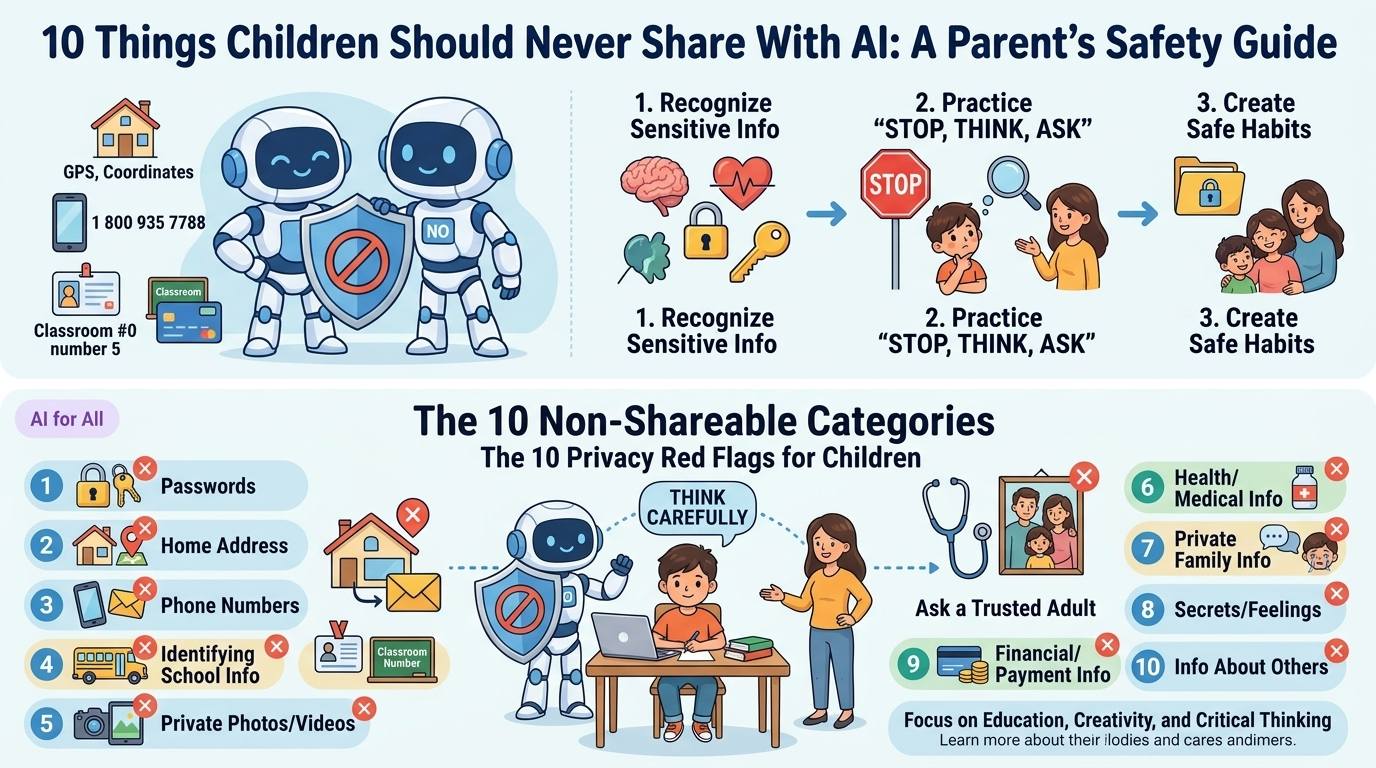
Here are 10 important categories of information that children should never share with AI unless a trusted adult has confirmed that it is appropriate and safe.
1. Passwords and Login Information
Passwords are one of the clearest examples of information children should never share with AI.
This includes:
- Email passwords
- School account passwords
- Social media passwords
- Gaming account passwords
- Banking or payment passwords
- Password reset codes
- One-time verification codes
- PINs and security answers
A child might think that an AI assistant needs a password to help solve a technical problem. It does not.
For example, instead of saying:
“My school account password is ABC123. Can you help me log in?”
A child can simply say:
“I cannot log into my school account. What general steps can I try?”
This allows AI to provide general guidance without receiving sensitive login information.
UNICEF also advises children to never share passwords, including with close friends.
2. Home Address and Exact Location
A home address is another type of information children should never share with AI unnecessarily.
Children should avoid entering:
- Home address
- Apartment or house number
- Exact GPS location
- Current location
- Regular travel routes
- Places they visit alone
- Details about when nobody is home
For example, saying “I live in Kathmandu” is very different from providing a complete home address.
Children should understand that location information can reveal where they live, study, or spend their time.
UNICEF recommends reviewing privacy settings and limiting access to location information when using digital services.
3. Phone Numbers and Personal Contact Details
Contact information is another category children should never share with AI carelessly.
Avoid sharing:
- Personal phone numbers
- Parents’ phone numbers
- Personal email addresses
- School email addresses
- Messaging app usernames
- Social media handles connected to personal identity
A child might ask AI to help write a message and accidentally include a phone number or email address.
A safer approach is to replace the information with a placeholder.
For example, instead of:
“Write a message to my teacher at [email protected].”
Use:
“Write a polite message to my teacher.”
This gives AI enough information to help without unnecessarily revealing personal contact information.
4. School Information That Identifies the Child
School details are a category of information children should never share with AI in full, even though each detail can seem harmless on its own.
Children should be careful about sharing:
- Full school name
- Classroom number
- Daily timetable
- Teacher’s personal information
- School ID number
- Student registration number
- School bus route
- Exact pickup and drop-off times
For example, asking AI to explain a Grade 6 science topic is generally very different from telling it the child’s full name, school, classroom, timetable, and daily route.
Parents and teachers can encourage children to use general descriptions instead.
Instead of providing identifying information, a child can say:
“I am a Grade 6 student and need help understanding force.”
That is enough for AI to provide educational assistance.
5. Private Photos and Videos
Photographs are an easy-to-overlook category of information children should never share with AI without checking first.
A photograph might show:
- A home address
- School uniform
- School ID card
- Family members
- Location
- Personal documents
- Vehicle registration information
- Other children
- Private surroundings
For this reason, children should think carefully before uploading photographs to AI tools.
This is especially important with AI image tools. A child may upload a personal photograph simply to change its background or create an artistic version. If your child wants to experiment safely with AI-generated images, our step-by-step guide on how kids can create a storybook with AI shows how to design illustrations without uploading personal photos at all.
Before uploading an image, ask:
“Does this picture contain information that should remain private?”
If the answer is yes, do not upload it without guidance from a trusted adult.
UNICEF has highlighted concerns about AI systems processing children’s photos, voices, locations, health information and other sensitive data.
6. Health and Medical Information
Health details belong on the list of information children should never share with AI casually.
Children should avoid unnecessarily sharing details such as:
- Medical records
- Medical identification numbers
- Prescription information
- Private diagnoses
- Detailed symptoms connected to their identity
- Mental health records
- Therapy information
- Sensitive health photographs
AI can provide general educational information about health topics, but it should not become a place where children freely upload their complete medical history.
For example, instead of entering a full medical record, a child can ask a general educational question such as:
“What are common reasons someone might get a headache?”
For personal medical concerns, children should talk to a parent, guardian, doctor, school counselor, or another trusted adult.
UNICEF specifically identifies health and other sensitive information as areas requiring strong protection for children.
7. Private Family Information
Family details are a sensitive category of information children should never share with AI, even when a conversation feels friendly.
This can include:
- Family problems
- Parents’ financial information
- Arguments at home
- Family passwords
- Private family conversations
- Parents’ personal information
- Details about family members’ relationships
AI may feel friendly because it responds conversationally, but children should remember that an AI system is not the same as a trusted family member, teacher, counselor, or friend.
UNICEF has warned that children may reveal personal information about their feelings, friendships, family life and other sensitive areas while interacting with AI.
8. Secrets, Private Conversations and Personal Feelings
Deeply personal experiences are among the hardest categories of information children should never share with AI to recognize in the moment, because the conversation feels supportive.
They may want to tell AI about:
- A private conversation with a friend
- A family secret
- Bullying experiences
- Personal fears
- Romantic or relationship issues
- Embarrassing experiences
- Deep personal feelings
It is important to distinguish between asking AI for general information and providing a detailed personal story that identifies the child or another person.
For example:
Safer: “How can someone deal with being nervous before an exam?”
Less safe: “My full name is [name], I attend [school], and here is everything that happened to me yesterday…”
When a child needs emotional support, a trusted adult should remain part of the conversation.
9. Financial and Payment Information
Payment details are perhaps the most obvious category of information children should never share with AI under any circumstance.
This includes:
- Credit card numbers
- Debit card numbers
- Bank account information
- Mobile banking details
- Payment PINs
- Digital wallet credentials
- Financial account passwords
Even if an AI tool claims that information is necessary, children should stop and ask a trusted adult before providing it.
A simple rule works well: never give financial credentials to a chatbot.
10. Information About Other People
Privacy is not only about protecting a child’s own information — it’s also on the list of information children should never share with AI when it belongs to someone else.
Children should also avoid sharing another person’s private information with AI, including:
- A friend’s phone number
- A classmate’s private photograph
- Another student’s personal problems
- A teacher’s private contact information
- Someone else’s password
- Private messages
- Personal medical information
Children should learn that having access to someone else’s information does not mean they have permission to share it.
UNICEF’s guidance on AI and children emphasizes protecting children’s data and privacy, including information and content about children.
What Children Can Safely Share With AI
Teaching what children should never share with AI does not mean children should avoid AI completely.
AI can still be useful for education and creativity when children use it responsibly.
For example, children can ask AI to:
- Explain a science concept
- Help practice mathematics
- Create quiz questions
- Suggest story ideas
- Explain difficult vocabulary
- Help brainstorm a school project
- Practice a new language
- Create a fictional story
- Explain a historical event
- Suggest ideas for an art project
The important difference is general information versus sensitive personal information.
A child can say:
“Explain photosynthesis in simple language.”
There is no need to add a full name, school name, address, phone number, or other identifying information.
Parents and teachers looking for more structured ways to guide this kind of AI use can also explore our guide on how parents can help their children learn AI, and teachers can find classroom-specific guidance in our ChatGPT in schools article.
A Simple Rule: Stop, Think and Ask
One of the easiest ways to teach children what they should never share with AI is a simple three-step habit:
1. Stop — Before typing or uploading something, pause.
2. Think — Ask:
- Is this information private?
- Does this identify me?
- Does this identify someone else?
- Would I be comfortable if another person saw it?
- Does AI really need this information?
3. Ask — If the answer is unclear, ask a parent, teacher, guardian, or another trusted adult.
This habit can help children make better decisions across AI tools, websites, games and social media.
UNICEF recommends encouraging children to pause before sharing information and helping them understand that information shared online may be difficult to remove later.
Why Children Need Special AI Privacy Guidance
Children are still developing their ability to understand online risks. They may not always recognize that seemingly harmless details can become sensitive when combined.
For example:
Name + school + daily schedule + location
can reveal much more than any single piece of information by itself.
UNICEF’s guidance emphasizes that children require specific protection because they may be less aware of the risks and consequences associated with personal-data processing.
AI systems can also make privacy issues harder to understand because conversations feel natural and personal. A child may feel like they are simply talking to a helpful assistant.
That is why learning what children should never share with AI should be part of basic digital literacy from an early age.
Parents Should Create an Open Conversation About AI
Rules work better when children understand the reason behind them.
Instead of simply saying:
“Never use AI.”
Parents can explain:
“AI can help you learn, but some information belongs to you and your family. Before sharing something personal, stop and ask.”
Parents can also explore AI tools together with their children, review privacy settings, and discuss what information different platforms collect.
UNICEF recommends open conversations about AI and encourages parents to review privacy settings and data practices together with children.
Final Checklist: What Children Should Never Share With AI
For an easy reminder, children should avoid sharing these types of information:
❌ Passwords and login codes
❌ Home address
❌ Exact location
❌ Personal phone numbers
❌ Private email addresses
❌ School ID or registration numbers
❌ Private photos and videos
❌ Detailed medical information
❌ Family financial information
❌ Bank or payment details
❌ Private family conversations
❌ Secrets and highly personal information
❌ Other people’s private information
The goal is not to make children afraid of artificial intelligence. The goal is to teach them how to use it responsibly.
Conclusion
Knowing what children should never share with AI is becoming an essential digital safety skill. AI can be an excellent learning and creative tool, but children should understand that not every question needs personal information.
The safest approach is simple: share less personal information, use general descriptions when possible, check privacy settings, and ask a trusted adult when unsure.
AI should help children learn and create without requiring them to give away information that could put their privacy, safety or future at risk.
As AI becomes more common in children’s lives, teaching what children should never share with AI should become a normal part of digital literacy — not something children learn only after a problem occurs.
For additional guidance, parents can review UNICEF’s Guidance on AI and Children.