What Age Should Children Start Using AI?
Artificial intelligence is becoming part of everyday life, and children are encountering AI earlier than many parents expected. From AI-powered search results and educational apps to chatbots and image generators, children may interact with artificial intelligence even before they understand what it is.
This raises an important question for parents and educators: what age should children start using AI?
There is no single age that applies to every child or every AI tool. A young child might safely explore an AI-powered educational activity with a parent, while an unsupervised chatbot conversation may be inappropriate. The right age depends on the child’s developmental stage, the type of AI involved, the purpose of using it, and the amount of adult supervision.
Current guidance increasingly emphasizes an age-appropriate, human-centered approach rather than treating AI access as a simple yes-or-no decision. UNESCO recommends age-appropriate approaches to generative AI in education, while UNICEF’s guidance emphasizes children’s safety, privacy, development, transparency, and preparation for an AI-driven future.
For parents, the goal should not be to keep children away from AI indefinitely. Instead, children should gradually learn how AI works, where it can help, where it can fail, and how to use it responsibly.
What Age Should Children Start Using AI?
For most children, AI exposure should begin with guided, age-appropriate experiences rather than independent chatbot use.
A practical framework is:
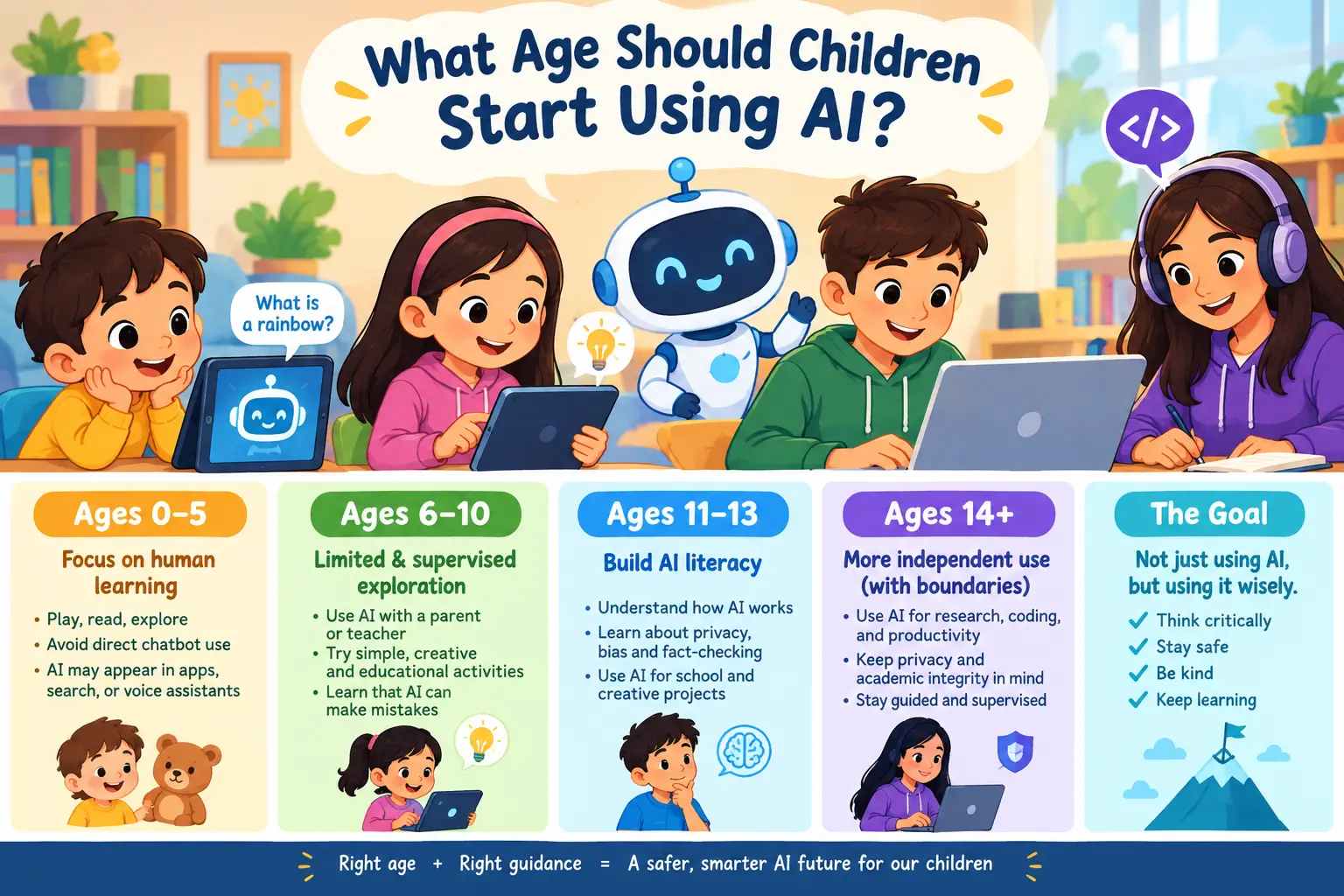
- Under 6: Avoid direct chatbot use; prioritize human interaction and traditional learning.
- Ages 6–10: Limited AI exposure with a parent, teacher, or another trusted adult.
- Ages 11–13: Introduce AI literacy, critical thinking, privacy, and responsible educational use.
- Ages 13–17: More independent use may be appropriate, but children still need boundaries, supervision, and guidance.
These are not universal legal or developmental rules. They are a practical framework for parents. Individual AI products can also have their own minimum-age requirements.
For example, OpenAI’s current terms require users to be at least 13, or the minimum age required in their country to consent to the service, and users under 18 need parental or guardian permission. OpenAI also states that ChatGPT is not intended for children under 13 and advises that interactions for children under 13 in educational contexts should be conducted by an adult.
Parents should therefore distinguish between using AI in general and creating an account or independently using a particular AI service.
Ages 5 and Under: Focus on Human Learning
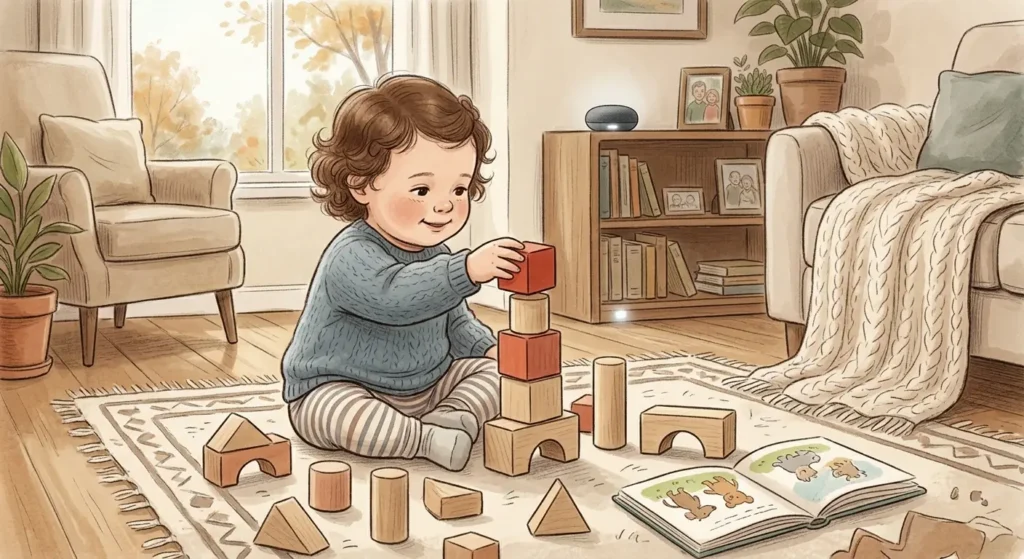
Children under six generally benefit more from direct interaction with parents, teachers, books, physical play, creative activities, and real-world exploration than from conversational AI.
Young children may also have difficulty understanding that an AI system is not a person. A chatbot can respond in natural language, express apparent confidence, and maintain a conversation, but it does not have human understanding or emotions.
Common Sense Media currently recommends no AI chatbot use for children five and under, noting that young children may struggle to distinguish AI from real people.
That does not mean children this age should never encounter AI. They already may encounter AI indirectly through recommendation systems, voice assistants, educational software, search engines, or digital toys.
The important distinction is that incidental exposure is different from independent interaction.
Ages 6–10: Limited and Supervised Exploration
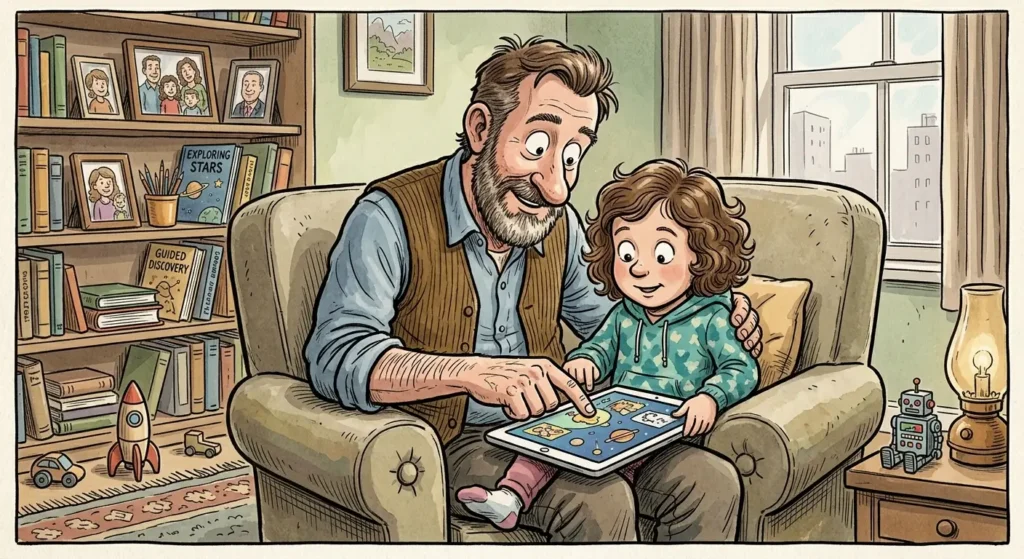
Children in the early elementary years can begin learning about AI through carefully selected activities.
At this stage, parents can use AI alongside children rather than giving them unrestricted access to a chatbot.
For example, a parent might ask an AI tool to:
- Create a simple story based on the child’s ideas
- Explain a science concept using age-appropriate language
- Generate questions for a family quiz
- Help brainstorm characters for a story
- Provide ideas for a simple creative project
The parent should remain involved and explain that AI can make mistakes.
Common Sense Media recommends limited AI chatbot use for children ages 6–12 alongside a parent or caregiver because AI can produce inaccurate information, inappropriate content, biased ideas, or language that is too difficult for younger users.
The goal at this age is exploration, not dependence.
Ages 11–13: Build AI Literacy
Around the preteen years, children can begin learning how generative AI works and why its answers should not automatically be trusted.
This is an important transition period because children may begin using AI independently for school assignments, research, creativity, or entertainment.
Parents and teachers can introduce concepts such as:
- What artificial intelligence is
- What generative AI does
- How AI models learn from data
- Why AI sometimes produces incorrect answers
- What an AI hallucination is
- How to fact-check AI-generated information
- Why personal information should not be shared
- How AI can reflect bias
- When AI use becomes cheating or plagiarism
This stage is less about teaching children to become AI engineers and more about teaching them to become critical AI users.
Ages 13 and Older: More Independent Use With Boundaries
Teenagers can generally begin using age-appropriate AI tools more independently, provided the specific service permits their age group and appropriate safeguards are in place.
At this age, AI can become a useful learning assistant.
Teenagers might use AI to:
- Brainstorm essay topics
- Practice a foreign language
- Explain difficult concepts
- Generate practice questions
- Debug code
- Explore career ideas
- Organize study plans
- Brainstorm creative projects
- Get feedback on writing
- Compare different approaches to a problem
However, independence should not mean abandoning supervision.
Current research from Common Sense Media shows that AI use is already widespread among children and teenagers. Its 2026 survey of 1,204 children ages 9–17 found that 86% had used AI, while more than four in ten said a parent or guardian had never talked with them about AI safety.
The question is therefore no longer simply whether children will encounter AI. For many families, the more useful question is whether children will learn to use it well.
Why Does Age Matter When Children Use AI?
Age matters because children’s cognitive, emotional, and social abilities develop over time.
UNICEF emphasizes that children are not simply smaller versions of adults. Its child-centered AI guidance stresses developmental appropriateness, safety, privacy, fairness, transparency, well-being, and children’s preparation for future AI developments.
Children’s Ability to Understand AI Limitations
A child needs enough critical reasoning ability to understand that a fluent answer can still be wrong.
AI systems can produce convincing explanations even when the underlying information is inaccurate. Younger children may be more likely to interpret confidence and fluency as evidence of truth.
Teaching children to ask “How do we know this is correct?” is therefore more important than simply teaching them how to write better prompts.
Critical Thinking and Fact-Checking
AI should not become a substitute for thinking.
If a child asks AI for the answer to every difficult question, the technology can remove the productive struggle involved in learning.
A better approach is to use AI as a tool for thinking:
“Give me a hint.”
“Explain where I went wrong.”
“Ask me questions that help me solve this.”
“Give me two possible approaches and let me choose.”
This keeps the child intellectually involved.
Recent Common Sense Media research makes a similar distinction. Among teens using AI for schoolwork, some use it to obtain direct answers, while others use it for brainstorming, checking work, or getting unstuck. The educational value depends heavily on how the technology is used.
Privacy and Personal Data
Children may not understand the consequences of sharing information with an AI service.
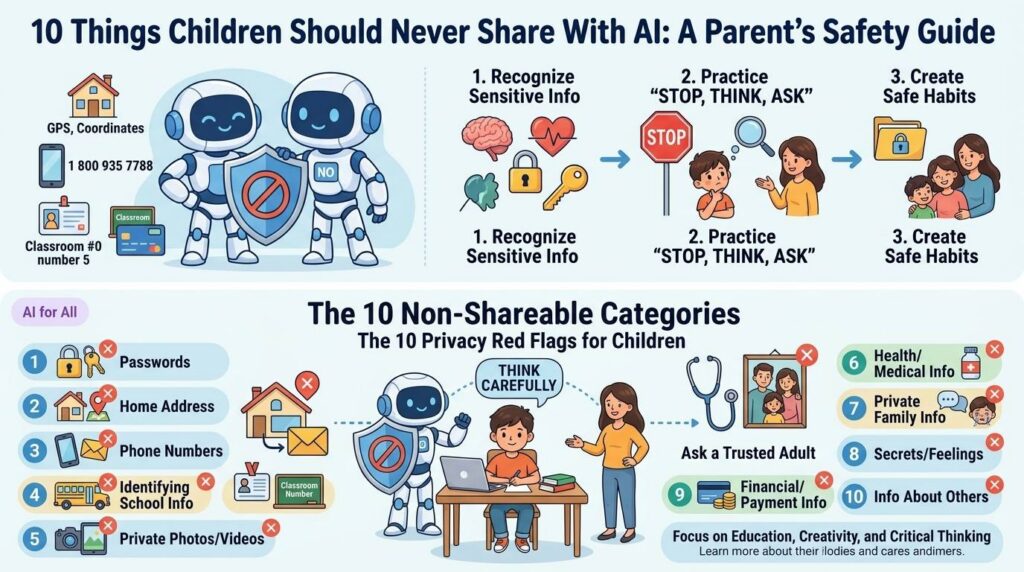
Parents should teach children never to casually enter:
- Full names
- Home addresses
- Phone numbers
- Passwords
- School login credentials
- Financial information
- Private family information
- Sensitive photographs
- Personal information about friends or classmates
UNICEF specifically identifies children’s data and privacy as a core requirement for child-centered AI.
The exact data practices vary between AI services, so parents should review the privacy policy and settings of the particular product their child is using.
What Are the Benefits of AI for Children?
AI can provide meaningful educational and creative benefits when used appropriately.
Personalized Learning
AI can explain the same concept in different ways.
For example, a child struggling with fractions could ask for:
- A simpler explanation
- A real-world example
- A visual analogy
- Practice questions
- Step-by-step hints
This can make difficult concepts more approachable.
Creativity and Idea Generation
AI can also support creative projects.
Children can use it to brainstorm:
- Story ideas
- Characters
- Art concepts
- Science projects
- Presentation topics
- Game ideas
- Coding projects
The important principle is that AI should support the child’s creativity rather than replace it.
Learning New Skills
Older children can use AI to explore coding, writing, research, languages, mathematics, design, and other subjects.
For example, a teenager learning programming could ask an AI assistant to explain why a particular function is producing an error. The student can then test the explanation and modify the code.
This is considerably more educational than simply asking AI to complete an entire assignment.
Accessibility and Learning Support
AI can also improve accessibility for some children.
UNICEF identifies learning support and increased accessibility for children with disabilities among the potential benefits of AI.
Tools that assist with language, reading, communication, organization, or other learning tasks can provide valuable support when used appropriately.
What Are the Risks of AI for Children?
AI is powerful, but children need to understand that it is not automatically safe or accurate.
Inaccurate Information
Generative AI can produce incorrect information while presenting it confidently.
Children therefore need to learn that AI output is not automatically a reliable source.
For school research, important claims should be checked against reputable sources such as books, academic materials, government websites, universities, and established organizations.
Overreliance on AI
The biggest educational risk may not be one incorrect answer. It may be gradually allowing AI to do too much of the thinking.
If a student always asks AI to write, solve, summarize, and explain everything, the student may complete more work while learning less.
A useful rule is: Use AI to improve your thinking, not to avoid thinking.
Privacy and Data Collection
Children may not understand what happens after information is submitted to an online service.
Parents should therefore teach a simple rule: If you would not share the information with a stranger, do not put it into an AI chatbot.
Parents should also review the service’s privacy controls and age requirements before allowing their children to use it.
Inappropriate Content
AI systems can sometimes produce material that is unsuitable for children despite safety controls.
This is another reason why unrestricted chatbot access is inappropriate for younger children.
Parents should consider not only the child’s age but also the AI product’s design, safeguards, moderation, privacy practices, and intended audience.
Academic Dishonesty
AI can write essays, answer questions, solve mathematical problems, and generate code.
That creates an obvious temptation for students to submit AI-generated work as their own.
Instead of treating AI as a shortcut, children should learn their school’s rules and understand the difference between acceptable assistance and academic dishonesty.
Common Sense Media recommends teaching children that submitting AI-generated work as their own can cross into plagiarism or cheating, depending on the school’s rules.
How Can Parents Introduce AI to Children Safely?
Parents do not need to become AI experts before talking with their children about artificial intelligence.
Start with a few simple rules.
1. Start With Age-Appropriate Activities
Do not give a young child unrestricted access to a general-purpose chatbot simply because the child is curious.
Instead, choose activities that match the child’s developmental level.
2. Use AI Together at First
For younger children, sit with them while they interact with AI.
Ask questions such as:
- “Do you think that answer is correct?”
- “How could we check it?”
- “Why do you think the AI said that?”
- “What would you answer without AI?”
This turns AI use into a learning activity.
3. Teach Children Not to Share Personal Information
Make privacy rules simple and memorable.
Children should know that an AI chatbot is not a private diary or a trusted adult.
4. Encourage Children to Question AI Answers
Teach children to look for evidence.
If AI makes a surprising claim, ask the child to verify it using another reliable source.
Common Sense Media recommends fact-checking AI output and teaching children to understand that generative AI can produce incorrect or biased information.
5. Establish Clear Family Rules
Parents can create rules around:
- Which AI tools children can use
- When AI can be used
- Whether an adult needs to be present
- What information must never be shared
- How AI can be used for homework
- What happens if inappropriate content appears
The rules can become less restrictive as the child demonstrates better judgment.
What Should Children Learn Before Using AI Independently?
Before allowing independent AI use, children should understand at least five fundamental ideas.
What AI Is and How It Works
Children do not need advanced mathematics or computer science knowledge.
They should simply understand that AI systems are created by people and trained using data to identify patterns and generate outputs.
Why AI Can Make Mistakes
Children should know that an AI response can sound confident and still be wrong.
This concept is fundamental to responsible AI use.
How to Verify Information
Children should know how to compare AI output with reliable sources.
For important topics, AI should be a starting point rather than the final authority.
How to Protect Privacy
Children need to understand that personal information should not be casually entered into AI systems.
How to Use AI Ethically
Children should understand that AI should not be used to:
- Bully someone
- Create harmful impersonations
- Cheat at school
- Spread false information
- Violate another person’s privacy
- Generate harmful or abusive material
AI literacy should include ethics, not just technical skills.
How Much AI Use Is Appropriate for Children?
There is no universal number of minutes that defines “safe AI use.”
The purpose and quality of use matter.
Thirty minutes spent working through a coding problem with AI is fundamentally different from thirty minutes spent talking to an AI companion for emotional reassurance.
Parents should therefore consider:
- What is the child using AI for?
- Is the child learning something?
- Is AI replacing another important activity?
- Is the child becoming dependent on AI?
- Is the child using AI instead of talking to people?
- Can the child complete similar tasks without AI?
The last question is particularly important.
A healthy AI user should still be able to think, write, research, communicate, solve problems, and interact socially without an AI assistant.
Should Children Use AI for Emotional Support?
This deserves a clear boundary: AI should not replace parents, teachers, counselors, doctors, or trusted human relationships.
AI companions and emotionally oriented chatbots present different risks from educational AI tools because they are designed to simulate social interaction.
Common Sense Media currently recommends against AI companions for anyone under 18, citing concerns about emotional attachment, inappropriate content, unhealthy reinforcement, and the difficulty of maintaining a clear distinction between simulated and real relationships.
For children and teenagers experiencing serious emotional difficulties, the appropriate response is to involve a trusted adult and qualified professional rather than relying on a chatbot.
How Should Schools Teach Children About AI?
Schools have an important role because children are already using AI for education.
UNESCO’s guidance on generative AI in education recommends a human-centered approach, including age-appropriate use, privacy protection, ethical considerations, and policies for educational institutions.
Schools should teach students:
AI Literacy
Students should understand what AI is, how generative AI works at a high level, and why its output can be unreliable.
Critical Evaluation
Students should learn to identify errors, bias, unsupported claims, and fabricated information.
Responsible AI Use
Students should understand when AI assistance is allowed and when it violates academic policies.
Prompting and Communication
Students can learn how to write clear instructions and refine prompts, but prompting should be treated as one part of broader information and problem-solving skills.
AI Ethics
Students should discuss privacy, bias, misinformation, copyright, academic integrity, and the social impact of AI. Schools should not focus solely on teaching students how to use AI tools. They should teach students how to think in a world where AI tools are readily available.
5 Essential Rules for Parents
If you want a simple starting point, use these five rules:
1. Younger children need more supervision.
Do not treat a chatbot like a digital babysitter.
2. Teach children to question AI.
A fluent answer is not necessarily a correct answer.
3. Protect personal information.
Children should know what information must never be entered into AI tools.
4. Use AI to learn, not simply to finish.
Hints, explanations, brainstorming, and feedback are usually more educational than having AI complete the task.
5. Keep humans in the loop.
AI can assist learning, but it should not replace parents, teachers, friends, counselors, doctors, or other trusted people.
Frequently Asked Questions About Children and AI
What is the best age for a child to start using AI?
There is no single best age. Young children should generally use AI only through age-appropriate, adult-supervised activities. More independent use becomes more reasonable as children develop stronger critical-thinking, privacy, and digital-literacy skills.
Can 8-year-olds use AI?
An eight-year-old may use selected AI tools with close adult supervision. Parents should avoid unrestricted access to general-purpose chatbots and should choose activities appropriate for the child’s age.
Should parents let children use ChatGPT?
Parents should first check the current age requirements and policies of the service. OpenAI currently states that ChatGPT is not intended for children under 13 and requires parental permission for users under 18.
Is AI safe for children?
AI is not automatically safe or unsafe. Safety depends on the child’s age, the AI system, the purpose of use, the safeguards available, and the level of adult supervision.
Should children use AI for homework?
AI can support homework when the school’s rules allow it and when the student remains responsible for the learning. Asking for explanations, hints, practice questions, or feedback is generally more educational than submitting AI-generated work as one’s own.
How can parents monitor AI use?
Parents can discuss AI use openly, review which tools their children use, establish family rules, check available parental controls, and periodically ask children what they use AI for.
What should children never share with AI?
Children should avoid sharing passwords, account credentials, financial information, home addresses, private family information, sensitive photographs, or other personal information unless there is a clear and trusted reason to do so.
Final Thoughts: When Should Children Start Using AI?
The answer to “what age should children start using AI?” is not simply 10, 13, or 16.
The better answer is: children should begin using AI when they are developmentally ready for the specific tool and have enough guidance to use it safely and critically.
For young children, that means supervised exploration. For preteens, it means developing AI literacy and critical-thinking skills. For teenagers, it can mean increasingly independent use with clear boundaries around privacy, academic integrity, emotional reliance, and appropriate content.
The goal should not be to raise children who simply know how to prompt an AI chatbot.
The goal is to raise children who understand when to use AI, when not to use it, how to question its output, how to protect their privacy, and when a human is more appropriate than a machine.
AI will continue to change. The most valuable skill parents and schools can give children is therefore not mastery of one particular AI tool. It is the ability to think critically and responsibly in an AI-powered world.
External References and Further Reading
For parents and educators who want to explore the topic further, these resources provide useful guidance:
- UNICEF — Guidance on AI and Children: UNICEF’s updated guidance outlines ten requirements for child-centered AI, including safety, privacy, fairness, transparency, well-being, inclusion, and preparing children for AI. UNICEF: Guidance on AI and Children
- UNESCO — Guidance for Generative AI in Education and Research: Provides an international framework for human-centered, age-appropriate use of generative AI in education. UNESCO: Guidance for Generative AI in Education and Research
- OpenAI — Is ChatGPT Safe for All Ages?: Explains ChatGPT’s age requirements and guidance for educational use with children. OpenAI: Is ChatGPT Safe for All Ages?
- Common Sense Media — AI Chatbots and Your Child: Provides age-and-stage guidance for children and teenagers using AI chatbots. Common Sense Media: AI Chatbots and Your Child
- Common Sense Media — Parents’ Ultimate Guide to Generative AI: Covers the benefits, risks, privacy concerns, misinformation, and responsible use of generative AI by young people. Common Sense Media: Parents’ Ultimate Guide to Generative AI