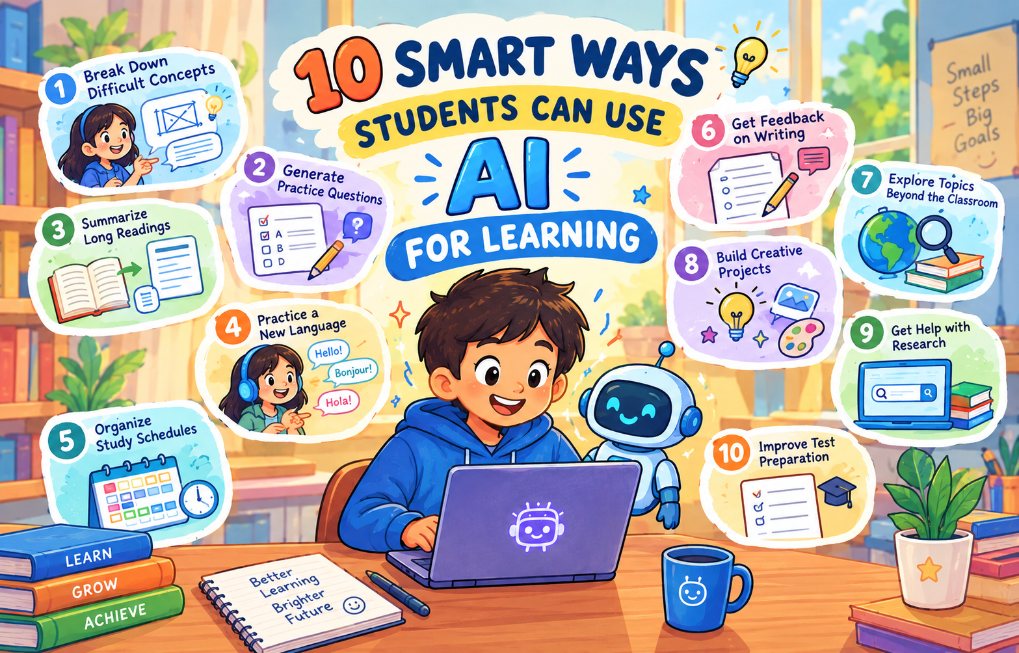
How to Use AI to Study Without Cheating: A Student Guide

AI can help students understand difficult lessons, practise for exams, improve their writing and organize their studies. But there is an important question students need to consider: How can you use AI to study without cheating?
The simple answer is to use AI to support your learning, not replace your thinking.
Students can use AI responsibly to explain concepts, create quizzes, provide feedback, generate practice questions and help with revision. However, asking AI to complete an assignment and submitting the answer as your own may violate your school’s academic rules.
Here are practical ways to study with AI while keeping the learning yours.
Is Using AI for Studying Cheating?
No, using AI for studying is not automatically cheating. It depends on how you use it and the rules set by your school or teacher.
Using AI as a tutor, study partner or feedback tool can support learning. Problems arise when students use AI to complete work they are expected to do independently and then present AI-generated work as their own. Organizations such as Khan Academy similarly recommend using AI to support learning rather than replace a student’s thinking.
For example:
| Responsible AI Use | Potentially Cheating |
|---|---|
| Asking AI to explain a difficult concept | Asking AI to complete your assignment |
| Creating practice questions | Copying AI answers into homework |
| Checking your grammar | Submitting an AI-written essay as your own |
| Getting feedback on your work | Using AI during a test when it isn’t allowed |
| Creating flashcards | Pretending AI-generated work is entirely yours |
| Making a study schedule | Using AI to avoid learning the topic |
Because rules differ between schools and assignments, always check your teacher’s AI policy before using AI for assessed work.
1. Ask AI to Explain a Topic Instead of Giving You the Answer
One of the best ways to use AI to study without cheating is to treat it like a tutor.
Imagine you don’t understand photosynthesis.
Instead of asking:
“Give me the answer to this photosynthesis question.”
Try:
“Explain photosynthesis to me like I’m 12 years old. Give me a simple real-life example and ask me three questions afterward to check my understanding.”
This changes the purpose of AI.
Instead of completing your work, AI is helping you understand how to complete it yourself.
You can use this approach for mathematics, science, history, computing, languages and many other subjects.
2. Turn AI Into a Quiz Partner
Reading notes repeatedly isn’t the only way to revise. Testing yourself can also help you identify what you understand and what you still need to learn.
Ask AI:
“Create 10 questions about the solar system. Start easy and gradually make them harder. Don’t show me the answers until I have attempted all the questions.”
Answer the questions yourself first.
Then ask AI to check your responses and explain your mistakes.
You can also ask it to create:
- multiple-choice questions
- true-or-false questions
- flashcards
- short-answer questions
- exam-style questions
- revision challenges
This is a practical way to use AI for students without allowing it to replace the learning process.
3. Get Feedback on Your Writing Instead of Asking AI to Write It
AI can be useful for improving essays, reports and other written work.
However, there is a major difference between feedback and replacement.
Instead of:
“Rewrite my entire essay and make it perfect.”
Try:
“Read my essay and identify three things I could improve. Don’t rewrite it. Explain what I should change and why.”
You remain the writer while AI acts as a reviewer.
You could ask AI to look for:
- unclear sentences
- grammar mistakes
- repetition
- weak arguments
- paragraph structure
- missing explanations
Read the feedback and decide which changes you want to make yourself.
4. Ask AI to Simplify Difficult Lessons
Sometimes a textbook explanation simply doesn’t make sense the first time you read it.
AI can explain the same concept in another way.
For example:
“Explain Newton’s First Law using a football example.”
Or:
“Explain this paragraph using language a Grade 7 student could understand.”
Still confused?
Ask:
“I don’t understand yet. Can you explain it using a completely different example?”
You can continue asking questions until the concept makes sense.
That is one of the most useful ways of using AI for studying: getting explanations that match the way you learn.
5. Create Practice Questions With AI
Suppose you have a mathematics test tomorrow.
Rather than asking AI to solve all your homework, give it a topic and ask:
“Create five fraction problems for me to solve. Don’t provide the solutions yet.”
Solve them yourself.
Then ask:
“Here are my answers. Check them and explain any mistakes without immediately giving me the correct answer.”
This encourages you to try again instead of simply copying a solution.
6. Make a Study Plan With AI
AI can also help students organize their time.
For example:
“I have exams in mathematics, science and English in 14 days. I can study for two hours every evening. Create a realistic revision schedule that includes practice questions, breaks and review days.”
AI can organize the plan, but you still have to complete the studying.
You can adjust the prompt by including:
- subjects
- exam dates
- difficult topics
- available study time
- breaks
- revision days
This makes AI a planning assistant rather than an answer generator.
7. Try the AI → Me → AI Study Method
A simple responsible AI study method is:
Step 1 — AI: Learn
Ask AI to explain the topic and provide examples.
Step 2 — Me: Practise
Stop using AI temporarily and complete questions or activities yourself.
Step 3 — AI: Check
Return to AI and ask for feedback on your answers.
For example:
AI: Explains fractions.
↓
You: Solve five fraction problems independently.
↓
AI: Checks your answers and explains your mistakes.
The important part is the middle step: you still do the thinking.
8. Don’t Automatically Believe AI
Using AI responsibly also means knowing that AI can make mistakes.
AI-generated answers can sometimes contain incorrect information, outdated information, misunderstood questions or unreliable references.
That means students should learn to verify important information rather than automatically trusting an AI response.
Check important claims using:
- textbooks
- class materials
- trusted educational websites
- books and reliable publications
- your teacher
If AI gives you a source, quotation or statistic, check whether the original source actually exists and says what AI claims it says.
Building AI literacy also means understanding AI’s risks, limitations and ethical use.
AI literacy isn’t just knowing how to ask AI questions. It also means knowing when to question its answers.
The Three-Question AI Check
Before submitting work where you have used AI, ask yourself:
1. Do I understand what I am submitting?
Could you explain the answer to your teacher without AI?
If not, you probably need to study it further.
2. Did I do the thinking?
AI can provide explanations and feedback, but you should still understand and contribute to the final work.
3. Would I be comfortable explaining how I used AI to my teacher?
If you wouldn’t want your teacher to know how AI was used, reconsider whether you’re using it appropriately.
And remember: your school’s rules always come first.
What Is the Best Way for Students to Use AI?
The best way for students to use AI is as a learning assistant rather than an answer machine. Students can use AI to understand difficult concepts, generate practice questions, receive feedback, organize revision and test their knowledge while completing the actual learning themselves.
AI works best when it helps you become more independent, not more dependent.
Frequently Asked Questions About Using AI for Studying
Is using ChatGPT for homework cheating?
Not necessarily. Using AI to understand a homework question, practise a similar problem or receive feedback may be acceptable. Having AI complete the homework and submitting its response as your own may violate academic rules. Always follow your teacher or school’s policy.
Can students use AI to write essays?
AI can help students brainstorm, understand a topic, organize ideas or receive feedback. Whether AI-generated writing is permitted in the final essay depends on the assignment and school rules.
Can I use AI to study for exams?
Yes. AI can create practice questions, quizzes, flashcards, explanations and revision plans. However, using AI during an actual exam may be prohibited unless specifically allowed.
How can students use AI responsibly?
Students should use AI to support their own thinking, verify important information, protect personal information, follow school rules and understand anything they submit.
What are good AI prompts for studying?
Try prompts such as:
“Explain this topic in simpler language.”
“Quiz me on this chapter without showing the answers first.”
“Give me feedback on my answer without rewriting it.”
“Create five practice questions that gradually become more difficult.”
“Ask me questions to find out which parts of this topic I don’t understand.”
Final Thoughts
Learning how to use AI to study without cheating is becoming an important skill for students.
You don’t need AI to do your homework for you to benefit from it.
Use AI to explain.
Use it to practise.
Use it to ask questions.
Use it to organize your revision.
Use it to identify mistakes.
But keep the thinking and learning yours.
The goal isn’t to get AI to produce the perfect answer. The goal is to use AI to help you become a better learner.
Explore more
How Can Schools Start Teaching AI to Students?
How to Explain Artificial Intelligence to a 10-Year-Old With Simple Analogies
Beyond Coding: Why Prompt Engineering Is the Next Big Skill for K–12 Students